
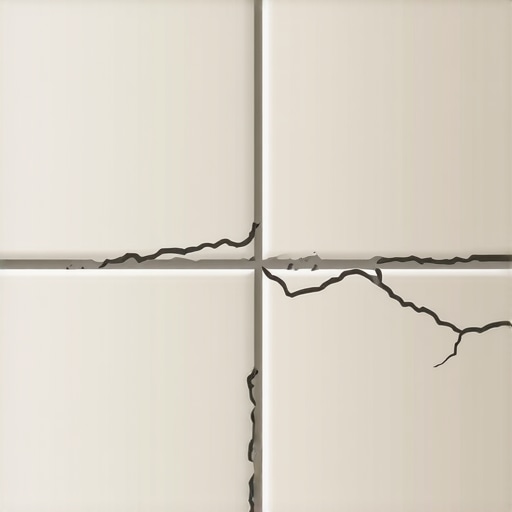
I spent three days grinding concrete on a job last month just so the floor wouldn’t click like a castanet. Most guys skip the leveling compound. They think the underlayment will hide the dip. It won’t. I have spent twenty-five years with my knees on a subfloor and sawdust under my nails, and I can tell you that a shower is not a work of art, it is a hydraulic machine. When your grout cracks in a brand new installation, it is not a cosmetic hiccup. It is a mechanical failure of the highest order. It smells like wet concrete and frustration in the field when we see this. People want their showers to look like a magazine cover, but they ignore the physics of the assembly. If you are seeing thin lines through your grout lines, your structure is moving or your chemistry is wrong. Period. There is no middle ground in tile work. You either build it to the standards of the Tile Council of North America or you build it to fail.
The structural lie of the modern bathroom
Grout cracks in new showers because the subfloor deflection exceeds the L/360 limit, the thin-set coverage is below the required 95 percent for wet areas, or the framing is moving. These structural deficiencies put shear stress on the rigid grout joints which cannot flex. When a house settles or a floor joist bends under the weight of a water-filled tub, the grout is the first thing to snap. It is the weakest link in a rigid system. If your contractor did not check the joist span and the thickness of the subfloor, they were guessing. Guessing leads to callbacks. I have seen guys try to cover a bouncy floor with more tile. It is like putting a band-aid on a broken leg. You need to understand that grout is essentially just colored cement and sand. It has almost zero tensile strength. If the tile moves even a fraction of a millimeter, the grout must fail because it is trapped between two immovable objects. [IMAGE_PLACEHOLDER]
The microscopic war between water and cement
Grout failure is often a chemical issue related to the hydration process of Portland cement during the initial curing phase. If a helper uses too much water in the bucket to make the grout easier to spread, they are effectively diluting the polymer chains. When that excess water evaporates, it leaves behind microscopic voids. These voids make the grout porous and brittle. It looks fine for a week, but as soon as the shower cycles through hot and cold water, those voids expand and contract. This is why you need grout restoration secrets for long-lasting results even on new builds. The water-to-powder ratio is not a suggestion. It is a chemical requirement. If the mix is too soupy, the pigment floats to the top and the structural integrity stays at the bottom of the bucket. I have walked onto jobs where the grout was so soft I could scrape it out with a fingernail. That is a hydration failure. The cement never reached its full potential because the installer was lazy with the measuring cup.
“A floor is only as good as the subfloor beneath it; deflection is the enemy of every joint.” – Master Flooring Axiom
When the subfloor gives up the ghost
Subfloor deflection refers to the vertical movement of the floor system under a live load, which must be less than L/360 for ceramic and L/720 for natural stone. If your joists are spaced too far apart or the plywood is too thin, the floor will bow like a diving board. You might not feel it when you walk, but the tile feels it. The tile is a rigid sheet. The grout is a rigid filler. The wood is a flexible organic material. When these three things fight, the wood always wins and the grout always loses. This is why baseboards can sometimes show a gap at the floor line. If you are looking for baseboards makeover ideas to elevate your space, remember that they should be nailed to the wall, not the floor, to allow for this inevitable movement. In many modern showers, installers fail to use a proper uncoupling membrane. These membranes act as a shear-release layer. They allow the subfloor to move horizontally without snapping the tile and grout above it. If your installer went straight over plywood with thin-set, they built a ticking time bomb.
Technical comparison of grout stability
| Grout Type | Flexibility Rating | Moisture Resistance | Best Use Case |
|---|---|---|---|
| Sanded Grout | Very Low | Moderate | Large joints over 1/8 inch |
| Unsanded Grout | Extremely Low | Low | Narrow joints, wall tile |
| High-Performance Cement | Moderate | High | Commercial and wet areas |
| Epoxy Grout | High | Impermeable | Maximum durability, chemical resistance |
The chemical failure of the bond
Thin-set mortar coverage is the fundamental bond that prevents tile movement and subsequent grout cracking in high-moisture environments. The TCNA mandates 95 percent coverage in wet areas like showers. If an installer uses a “spot-bonding” or “dot-troweling” method, there are air pockets behind the tile. When you step on that tile, it flexes into the air pocket. This movement translates directly to the grout line. This is also why you see how to refresh grout without replacing it becoming a popular search. People are trying to fix a structural bond issue with a surface-level patch. It will not work. You have to pull the tile and check the ridges. If the trowel ridges are not collapsed, the tile is not supported. I have seen entire shower floors fail because the installer let the thin-set skin over before they set the tile. The tile just sits on top like a leaf on a pond. There is no mechanical lock. No lock means movement. Movement means cracks.
The 1/8 inch that ruins everything
Expansion joints are mandatory movement gaps that must be filled with 100 percent silicone caulk rather than cementitious grout at all plane changes. This is the most common mistake in the industry. Where the wall meets the floor, or where two walls meet in a corner, you cannot use grout. Those are different framing members. They move at different rates. If you pack grout into those corners, it will crack within months. It is the law of physics. Many homeowners want a continuous look, but they do not realize that the house is a living, breathing thing. You need that 1/8 inch gap filled with color-matched silicone. This allows the shower to expand and contract without destroying itself. If you are looking at showers that wow modern designs for 2025, you will notice that the best designers use these expansion joints as part of the aesthetic. They do not hide them. They use them to protect the investment. A floor that cannot move is a floor that will break.
“Movement joints are not optional; they are the pressure relief valves of the tile system.” – TCNA Handbook Principle
- Verify subfloor thickness and joist spacing before the first tile is set.
- Ensure 95 percent thin-set coverage with no air pockets behind tiles.
- Use only 100 percent silicone at all vertical and horizontal plane changes.
- Mix grout with a low-speed drill to avoid whipping air into the mixture.
- Measure water precisely according to the manufacturer’s technical data sheet.
The regional climate expert perspective
Atmospheric humidity and local temperature swings dictate the curing rate of grout installations in different geographic regions. In a humid coastal area, the grout might stay wet too long, leading to soft joints. In a dry desert climate, the moisture can be sucked out of the grout too fast, stopping the chemical reaction. An experienced installer knows to mist the joints or cover them with plastic to control the rate of hydration. This is not about the weather outside. It is about the micro-climate inside your bathroom. If the HVAC system is blasting dry air, your grout will fail. If the house is not yet climate-controlled, do not even think about grouting. I have seen guys grout a house in January with no heat. The water in the mix froze and expanded. By March, the grout was turning to powder and falling out. You cannot fight nature. You have to work within its parameters.
Final checklist for a crack-free shower
Before you sign off on a job, you need to be the inspector. Check the corners. If there is grout in the corners instead of caulk, make them dig it out. Tap on the tiles with a screwdriver handle. If it sounds hollow, you have an air pocket and that tile will eventually cause the grout to crack. Ask to see the empty bags of thin-set and grout. If they used the cheapest stuff from a big-box store instead of a high-performance polymer-modified system, you are in for a short ride. Quality costs money, but failure costs more. Building a shower is a structural engineering challenge. Treat it like one. If you skip the leveling, the uncoupling, or the proper mixing, the house will remind you of your mistakes every time you step into the water.