
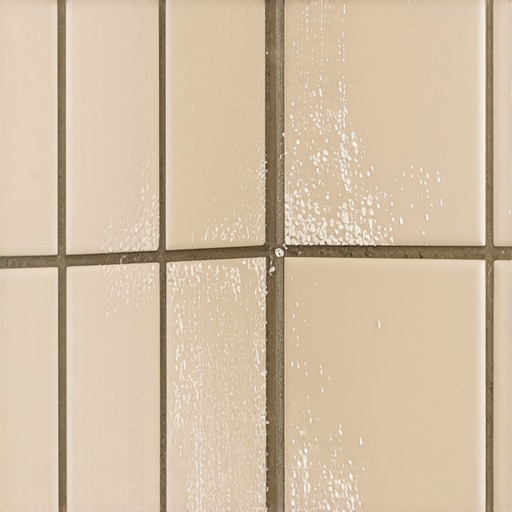
The ghost in the mortar bed
I spent three days grinding concrete on a job last month just so the floor wouldn’t click like a castanet. But showers are worse. I once walked into a house where a custom shower looked like it was growing salt crystals after only three weeks. The homeowner thought it was soap scum. It was not. It was a structural failure of chemistry. When you see a white crusty film on your new tile, you are witnessing a process called efflorescence. It is the result of water moving through the substrate and bringing minerals to the surface. It is the signature of a shower that is not drying properly. We are going to look at the physics of this failure and why your expensive stone is turning into a salt mine.
The science of mineral migration
Efflorescence is a crystalline deposit of salts and minerals that forms on tile and grout surfaces. This happens when water dissolves calcium hydroxide in the mortar or substrate. As the moisture migrates to the surface and evaporates, it leaves behind a white crusty film which is often hard to remove. This is not a cleaning issue. It is a moisture management issue. If you have this problem, your shower is likely holding water in the mud bed. The water turns into a saline solution. It travels through the capillary pores of the grout. When it hits the air, the water vanishes and the salt remains. This cycle repeats until the calcium in the cement is exhausted or the water source is cut off. You might find some help with grout restoration secrets for long lasting results if the damage is already done.
“A floor is only as good as the subfloor beneath it; deflection is the enemy of every joint.” – Master Flooring Axiom
The molecular reality of Portland cement is that it is never truly solid. It is a lattice of pores. When you mix thin-set or grout, you are initiating a hydration reaction. If the water-to-cement ratio is too high, the resulting structure is overly porous. These pores act like microscopic straws. They wick water from the saturated mud bed or the adhesive layer up to the face of the tile. In regions with high humidity like Florida or Houston, the drying process is slowed down significantly. This gives the water more time to dissolve minerals. The crust grows thicker. It hardens. It eventually reacts with carbon dioxide in the air to form calcium carbonate. At that point, you need acid to move it. This is why many showers that wow modern designs for 2025 focus heavily on topical waterproofing membranes that prevent the water from ever reaching the mortar bed in the first place.
The mystery of the blocked weep hole
Weep holes are small openings in the drain assembly designed to let moisture escape the mortar bed. If these holes are blocked by thin-set or debris, water becomes trapped. This leads to a saturated sub-base and constant efflorescence on the grout lines. Every traditional shower pan has a liner. Above that liner sits a thick bed of sand and cement. Water goes through the grout and the mortar. It hits the liner. It flows toward the drain. The drain has little holes specifically for this water. If the installer was sloppy and covered those holes with mortar, the water stays in the pan. It rots. It grows mold. It forces salt to the surface. This is a primary reason why showers fail prematurely.
| Material Type | Porosity Level | Efflorescence Risk | Recommended Sealant |
|---|---|---|---|
| Ceramic Tile | Low | Minimal | Grout Only |
| Natural Marble | High | Extreme | Penetrating Solvent |
| Porcelain | Near Zero | Low | Grout Only |
| Slate | Medium | High | Breathable Film |
Checking the moisture levels in the wall is the next step. Sometimes the leak is not from the shower floor. It could be a plumbing leak behind the wall. The water saturates the cement board and then works its way out through the grout. You will see the white film starting at the bottom of the wall and moving upward. It is a slow, relentless climb. It will ruin your baseboards makeover ideas to elevate your space if the water travels past the shower curb. Moisture doesn’t respect boundaries. It follows the path of least resistance. In the dry heat of Phoenix, this might happen faster because the evaporation rate is so high. The salt is pulled out of the wall with aggressive speed.
The structural error of heavy saturation
Many installers use too much water when mixing grout. This is a cardinal sin. They want it to flow easily. They want it to be easy to spread. But extra water creates extra air pockets. When that water evaporates, it leaves a honeycomb structure that is weak and absorbent. If you want a floor that lasts, you need a dense, low-water mix. This is especially true when working with eco friendly tile solutions for sustainable homes in 2025 where materials might have different absorption rates than traditional ceramics. A weak grout is a sponge. It will suck up every drop of soapy water and hold onto it until it can dump the minerals back onto the surface.
“Standard installation practices for tile must include a secondary drainage path to prevent hydrostatic pressure buildup.” – TCNA Technical Manual
If you are planning a renovation, look at showers with a style trendy ideas for small bathrooms and ensure your contractor is using a topical waterproofing system. This prevents the mud bed from ever getting wet. The water stays on top of the membrane and goes directly into the drain. No mud bed saturation means no efflorescence. It is a simple engineering fix for a centuries-old problem. It costs more in materials but saves thousands in repairs. I refuse to build a shower any other way now. The old way is a gamble with the homeowner’s money.
The strategy for removing the white shadow
You cannot just scrub this off with soap. You are dealing with minerals. You need a mild acid or a specialized efflorescence remover. But be careful. If you have natural stone like marble or limestone, acid will etch the surface. It will eat a hole in your investment. You have to identify the material before you treat the symptom. Once the surface is clean, you have to address the source. If the weep holes are blocked, no amount of cleaning will stop the crust from returning. It will come back every time you shower. For ongoing maintenance, refer to tile cleaning tips for a sparkling bathroom in 2025 to keep the surface clear after the structural issues are solved.
- Identify if the film is soap scum or mineral salt by applying a drop of vinegar.
- Check the shower drain for blockages at the weep hole level.
- Dry the shower completely with a fan for 72 hours to see if the salts return.
- Apply a high-quality penetrating sealer to the grout lines once dry.
- Consult a professional if the tile is loose or the grout is cracking.
Sometimes the film is actually caused by the water itself. Hard water is a common culprit in many suburban areas. The minerals in the tap water stay behind. This is easier to fix than efflorescence from the mortar bed. A water softener or a different cleaning routine can handle it. But if the crust is coming from the grout joints specifically, it is the mortar talking to you. It is telling you that there is water where it shouldn’t be. Do not ignore it. If you catch it early, you can sometimes save the installation. If you wait, the salt will eventually expand and pop the tile right off the wall. If you need to fix just the look, check out how to refresh grout without replacing it for some temporary relief. But remember, the ghost in the mortar bed will remain until the moisture is gone. Professional results require professional standards. There are no shortcuts in the physics of flooring.