
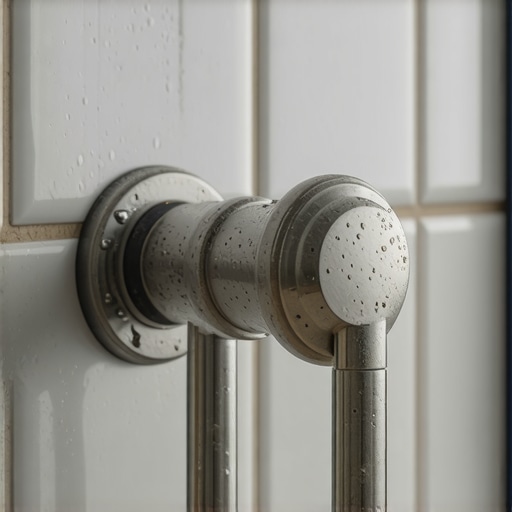
I spent three days grinding concrete on a job last month just so the floor would not click like a castanet. Most guys skip the leveling compound because they think the underlayment will hide the dip. It won’t. That same lazy approach to the fundamentals is exactly why you are feeling resistance in your bathroom fixtures. When a homeowner tells me their shower handle feels like it is grinding through sand, they usually expect me to pull out a wrench. Instead, I start looking at the tile, the grout, and the waterproofing membrane behind the wall. That grit is a symptom of a larger structural or chemical failure within the wet area ecosystem. It is the physical manifestation of mineral precipitation or internal debris migration that suggests your shower is not the closed system you think it is. A floor is a performance surface, and a shower is a pressurized environment where physics always wins. If you ignore the microscopic reality of your subfloor and plumbing, you end up with hardware that feels like it belongs in a concrete mixer.
The mechanical ghost in your plumbing
A gritty shower handle is usually caused by mineral accumulation, cartridge degradation, or sediment migration from a failing water heater. These calcium and magnesium deposits crystallize inside the mixing valve, creating physical friction against the rubber O-rings and ceramic discs. When you rotate the handle, you are literally grinding rock against precision-engineered parts. This is not just an annoyance. It is a sign that your home’s internal chemistry is attacking your hardware. If you have recently performed a tile cleaning routine with aggressive acids, you might have even accelerated this process by stripping the factory lubrication from the valve stem. Grit is never an isolated incident. It is a warning that the mechanical integrity of your shower is under threat from the very water it is meant to manage.
“A floor is only as good as the subfloor beneath it; deflection is the enemy of every joint.” – Master Flooring Axiom
The chemistry of your water supply interacts with the structural components of your bathroom in ways most people never consider. When we talk about showers, we are talking about a high-moisture zone where the hydrostatic pressure of the water column meets the capillary action of the grout lines. If your installer did not use a high-quality epoxy grout or a properly modified thin-set, the water can leach minerals out of the setting materials and deposit them directly into your plumbing fixtures via backflow or simple proximity in a humid wall cavity. This is especially true in regions with high humidity where the drying time of the substrate is nearly infinite. I have seen solid wood floors buckle three rooms away because a shower pan was not sloped correctly, leading to moisture migration that carried sediment into the main lines.
Why your grout is turning into sandpaper
Grout erosion occurs when the Portland cement binder in the mixture breaks down due to improper hydration or chemical attack. This releases sand aggregates and pigment particles that can find their way into the shower handle housing during cleaning or through vapor transmission. Low-quality grout is essentially just colored sand held together by hope. When it fails, it does not just disappear. It migrates. It gets behind the escutcheon plate of your shower handle and creates that tactile grinding sensation. If you are dealing with this, you might need to look into grout restoration to stabilize the surface before it completely disintegrates. The grit you feel is the literal pieces of your bathroom wall falling apart at a molecular level and finding a home in your moving parts.
| Material Type | Mineral Resistance | Janka Hardness Equivalent | Recommended Use |
|---|---|---|---|
| Epoxy Grout | Extreme | High | Steam Showers |
| Cementitious Grout | Low | Medium | Dry Areas |
| Pre-mixed Resin | Moderate | Low | Backsplashes |
| Modified Thin-set | High | N/A | Substrate Bonding |
In the world of Master Flooring, we understand that everything is connected. If you have a subfloor that flexes, your tile will move. If your tile moves, your grout cracks. Once the grout cracks, water infiltrates the wall cavity. That water carries debris. That debris ends up in your shower valve. It is a chain reaction of structural failure that starts with a single eighth of an inch of deflection. I always tell my clients that they should focus on what they cannot see. The baseboards might look pretty, but if the moisture barrier is missing, the wood will rot from the back side out. You can find chic baseboard designs that look like a million bucks, but they will not save you from a failing subfloor that is rattling your pipes every time the water turns on.
The structural failures behind the aesthetic
Subfloor deflection causes plumbing vibrations that can loosen sediment inside old galvanized pipes or copper tubing. When the floor joists are over-spanned, the entire bathroom floor acts like a drum head. Every footstep sends a shockwave through the drain lines and supply lines. This mechanical stress can flake off scale from the inside of the pipes, which then flows directly into the shower cartridge. This is why a floor that clicks or feels soft is often found in the same house as a shower handle that feels gritty. The house is moving in ways it was never designed to. We use the NWFA standards to ensure that every floor has the stiffness required to support not just the weight of the tile, but the integrity of the plumbing system connected to it.
- Check the water hardness levels in your area to determine the rate of mineral buildup.
- Verify that the shower valve was lubricated with plumber’s grease during installation.
- Inspect the grout lines for signs of crumbling or “soft spots” that indicate poor mixing.
- Ensure the subfloor meets L/360 deflection standards for ceramic tile.
- Clean the shower cartridge annually to remove accumulated grit.
- Use a water softener if your local municipality provides high-calcium water.
- Seal all grout lines with a high-quality penetrating sealer.
- Check the expansion gaps at the perimeter of the room to prevent pressure on plumbing.
- Avoid using bleach-based cleaners that can degrade internal rubber gaskets.
- Consult a professional if the grit is accompanied by a drop in water pressure.
The 1/8 inch that ruins everything is not just a catchphrase. It is a reality of the trade. If your tile is off by that much, your shower pan will hold water. If the pan holds water, the vapor pressure inside the wall increases. That pressure forces moisture into the mechanical components of your fixtures. I have seen showers that wow on the surface but are absolute disasters underneath. They use cheap underlayment and ignore the acclimation needs of the surrounding materials. In a place like the humid South, ignoring these steps is a death wish for your bathroom. The wood swells, the tile pops, and the plumbing grinds. It is all one big system. You cannot fix the handle without understanding the floor. If you want a space that lasts, you have to invest in the engineering, not just the finish. For more information on how to build it right from the ground up, you can always visit our contact page to speak with a specialist who understands the physics of the job.