
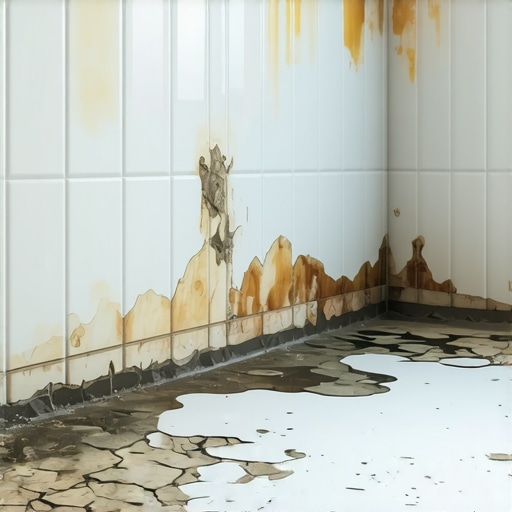
5 signs your shower waterproofing has completely failed
Most guys skip the leveling compound. They think the underlayment will hide the dip. It won’t. I spent three days grinding concrete on a job last month just so the floor wouldn’t click like a castanet. That job taught me that what happens beneath the surface is the only thing that matters. When it comes to showers, that subfloor secret is even more dangerous. If you ignore the signs of a failed membrane, you are not just looking at a tile repair, you are looking at a structural nightmare that can eat through your floor joists and grow a forest of black mold in your wall cavities. I have seen million dollar homes ruined by a single pinhole in a liquid membrane or a poorly taped corner. You cannot treat a shower like a regular room. It is a high temperature, high humidity wet cell that requires perfect engineering. If any part of that engineering fails, the clock starts ticking on your home structural integrity.
The ghost in the expansion gap
Shower waterproofing failure occurs when moisture breaches the primary barrier, leading to substrate saturation, efflorescence in grout, and structural rot. These signs are often subtle at first, appearing as small dark spots or a faint musty smell that persists even after cleaning. If you see these indicators, the liquid or sheet membrane behind your tile has likely lost its integrity. The chemistry of a shower is a battle between water molecules and the adhesive bonds of your thin set. When water gets behind the tile, it does not just sit there. It travels. It finds the path of least resistance, which is usually your subfloor. This is why I always tell people to look at their baseboards makeover ideas as a way to hide damage, but also as a warning system. If those baseboards are swelling, the ghost in the machine is water. You need to understand that tile and grout are not waterproof. They are water resistant. The real work is done by the membrane underneath. When that fails, the water has a direct line to your wood framing. This leads to a loss of structural rigidity that no amount of cosmetic cleaning can fix. You might even notice that the floor feels a bit soft under your feet. That is not your imagination, it is the wood fibers breaking down under constant moisture load. You have to be vigilant because water is a patient enemy. It will wait months to show you its full destructive power.
The chemistry of a failing grout joint
Grout failure is characterized by cracking, persistent dampness, and chalky residue known as efflorescence. These symptoms indicate that water is dwelling beneath the tiles and pulling minerals out of the setting materials as it evaporates. When grout fails to dry out between showers, it means the substrate is already waterlogged. I have spent years looking at grout restoration secrets for long lasting results, and the biggest secret is that grout cannot stay healthy on a rotten foundation. If your grout is falling out in chunks, it is because the subfloor is moving. Wood swells when it gets wet. When the plywood or OSB under your shower expands, it creates shear force. That force snaps the bond between the tile and the thin set, and the grout is the first thing to crack. It is a chain reaction. You might try to patch it, but if you do not fix the leak, the new grout will crack within weeks. This is why the TCNA has such strict rules about deflection. If your floor bends more than 1/360th of its span, your tile will fail. Water speeds up this process by softening the wood and increasing that deflection. You are essentially standing on a wet sponge that is trying to hold up a rigid ceramic surface. It is a physical impossibility.
“A floor is only as good as the subfloor beneath it, deflection is the enemy of every joint.” – Master Flooring Axiom
Why your baseboards are lying to you
Baseboard swelling and paint peeling near the shower entrance are definitive signs of lateral moisture migration. This occurs when the waterproof pan or vertical membrane has failed, allowing water to wick into the adjacent drywall and trim. It is a sign that the entire wet area is no longer contained. When I walk into a bathroom and see the bottom of the door casing or the baseboards looking like they are blowing bubbles, I know exactly what I am going to find behind the tile. It is usually a failed corner transition where the installer didn’t use enough liquid membrane or skipped the reinforcing fabric. You might be tempted to look for chic baseboard designs to replace the ugly ones, but you are just putting a band-aid on a gunshot wound. The water is moving through the wall like a straw. This is called capillary action. It can pull water up several inches above the actual floor line. If you see mold growing on the outside of the shower wall, the waterproofing failure is already advanced. At this point, the drywall is likely mush. You can poke a screwdriver through it with zero effort. This is the stage where the repair costs start to double every week you wait. You are not just fixing a shower anymore, you are rebuilding a bathroom wall. I have seen instances where the water traveled ten feet away from the shower before it finally surfaced in a hallway. That is the danger of hidden leaks. They follow the level of the subfloor until they find a low spot or an edge to climb up.
The 1/8 inch that ruins everything
The success of a shower depends on a minimum slope of 1/4 inch per foot toward the drain and a perfectly sealed drain flange. If the slope is incorrect, water pools, creating hydrostatic pressure that eventually forces moisture through the microscopic pores of the membrane. I have seen guys try to eyeball the pitch of a shower pan. It never works. You need a level and you need precision. If the water cannot get to the drain fast enough, it sits on the grout. Grout is porous. Eventually, that water works its way down to the membrane. If there is even one tiny gap in that membrane, the pressure of the standing water will find it. This is why showers that wow are not just about the big tiles and the rain heads, they are about the geometry of the floor. If you have a flat spot in your shower, you have a failure waiting to happen. You might notice that the shower stays wet for hours after you use it. That is a red flag. A properly sloped shower should have no standing water within minutes of the water being turned off. If you are constantly fighting pink mold or slime in one corner, it is because that corner is not draining. That constant moisture load will eventually eat through any sealant you apply. It is a battle of attrition, and water always has more time than you do. You need to verify the pitch of your floor with a straight edge. If it is flat, your waterproofing is under a constant state of attack.
“Proper drainage is the first line of defense in any wet area, without it, even the best membrane will eventually succumb to hydrostatic pressure.” – TCNA Handbook Summary
| System Component | Failure Symptom | Structural Impact |
|---|---|---|
| Liquid Membrane | Grout Efflorescence | High: Substrate saturation |
| Sheet Membrane | Hollow Tiles | Medium: Bond failure |
| Pre-pitched Pan | Standing Water | Critical: Hydrostatic pressure |
| Drain Flange | Ceiling Leaks | Extreme: Structural rot |
| Sealant/Caulk | Mildew in Corners | Low: Aesthetic damage |
The structural reality of a soggy subfloor
A failed shower leads to wood rot, termite attraction, and diminished load-bearing capacity of the floor joists. You will often see cracked tiles near the drain or along the perimeter as the underlying wood loses its ability to support the weight of the tile assembly. This is the end game of waterproofing failure. When the wood gets wet and stays wet, it attracts pests. It also becomes a breeding ground for fungi that literally eat the cellulose in the wood. I have seen joists that were originally two inches thick reduced to the consistency of wet cardboard. This is especially common in older homes where they used traditional mud beds without a modern topical membrane. They relied on a lead or PVC liner buried deep under two inches of concrete. If that liner fails, the concrete holds the water against the wood forever. If you are worried about your current setup, you can check out tile cleaning tips but if the tile is moving, cleaning won’t help. You need a full tear out. It is a hard truth to swallow, but once the structural integrity is gone, there is no way to fix it from the top down. You have to get to the bones of the house. I always recommend a flood test for any new installation. You plug the drain and fill the pan with water for 24 hours. If the level drops, you have a leak. It is better to find out before you lay a single tile than to find out a year later when your kitchen ceiling starts to sag. If you are planning a renovation, look into showers with a style but prioritize the waterproofing kit above the tile choice. Spend the extra money on a high quality foam board system or a premium liquid membrane. It is the cheapest insurance policy you will ever buy.
Checklist for Inspecting Your Shower Health
- Check for any grout lines that stay dark or damp long after the shower is used.
- Inspect the transition where the wall meets the floor for any cracking in the caulk or grout.
- Press on the tiles around the drain to see if there is any movement or a squishy sound.
- Look at the ceiling directly below the shower for any yellow staining or bubbling paint.
- Check the baseboards on the other side of the shower wall for swelling or mold.
- Use a moisture meter on the drywall adjacent to the shower to detect hidden leaks.
- Verify that the grout is not turning into a white, chalky powder which indicates efflorescence.
If you find that your shower is failing, do not wait. The damage from water is cumulative. It does not stop, and it does not dry out on its own once it is trapped behind tile. You might be able to find some temporary relief by looking at how to refresh grout without replacing it, but that is only if the membrane is still intact. If the signs I mentioned above are present, you are looking at a structural failure. While most people want the thickest underlayment or the most expensive tile, the reality is that the 1/8 inch of waterproofing membrane is the only thing standing between you and a $20,000 repair bill. Too much build up of thin set or using the wrong trowel size can also lead to air pockets that trap water. Everything in a shower must be solid. No voids. No gaps. No excuses. I have spent 25 years on my knees fixing these mistakes. Do not let your home be the next cautionary tale I tell on a job site.