
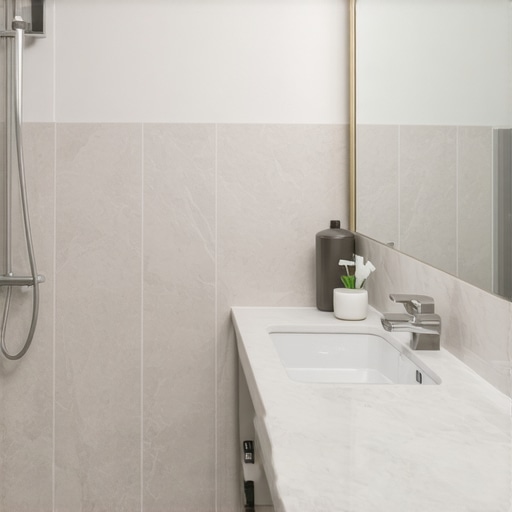
Porcelain tile remains the industrial standard for long term durability
Porcelain tile is the most durable and low maintenance material for bathroom renovations because of its water absorption rate of less than 0.5 percent and its resistance to chemical cleaners. It outlasts vinyl and natural stone by decades when installed over a properly prepared substrate. Most homeowners prioritize the look of a tile, but I focus on the vitrification process. When kaolin clay and feldspar are fired at temperatures exceeding 2200 degrees Fahrenheit, the particles fuse into a nearly impenetrable mass. This is not just a floor. It is a dense, glass-like surface that rejects water at a molecular level. Most guys skip the leveling compound. They think the underlayment will hide the dip. It won’t. I spent three days grinding concrete on a job last month just so the floor wouldn’t click like a castanet. That client wanted a low maintenance bathroom, but you cannot have ease of care if the floor is bouncing and cracking the grout lines. I smell like oak dust and WD-40 most days, and I have seen every shortcut in the book. If you want a floor that survives a decade of steam, you do not buy the cheap stuff at the big-box clearance aisle.
The physics of moisture vapor transmission in subfloors
Every bathroom renovation lives or dies by what is happening under the surface. Concrete slabs are porous. They breathe moisture. If you trap that moisture under a non-breathable barrier without proper testing, you create a petri dish for mold. I always pull out my calcium chloride test kits before a single piece of tile touches the ground. If the slab is pushing out more than three pounds of moisture per 1,000 square feet, you are asking for a failure. The bond between the thin-set and the substrate requires a clean, pH-neutral surface. When the moisture levels are too high, the alkalis in the concrete rise to the surface and eat away at the adhesive. This process, called efflorescence, is what causes those white, powdery stains in your grout. You can scrub until your hands bleed, but if the subfloor is not sealed with a moisture vapor barrier, the stains will return. I prefer using a liquid-applied waterproofing membrane that serves dual purposes as a crack isolation layer. This ensures that even if the house shifts, the tile stays put. A floor is a structural system. It is a performance engine that must handle hundreds of pounds of static load from bathtubs and dynamic loads from foot traffic.
“A floor is only as good as the subfloor beneath it; deflection is the enemy of every joint.” – Master Flooring Axiom
The chemistry of epoxy grout and liquid membranes
Grout is the weak link in every bathroom. Traditional cement-based grout is essentially a hard sponge. It has microscopic pores that soak up hair dye, soap scum, and dirty mop water. If you want a truly low maintenance bathroom, you have to move to epoxy or high-performance premixed grouts. Epoxy grout is a two-part chemical reaction. Once it cures, it is essentially plastic. It does not need to be sealed, and it is completely waterproof. I tell my clients that if they want to stop worrying about tile cleaning tips, they need to invest in the grout chemistry. It is much harder to install. It is sticky and has a short working time. But once it is in, it is permanent. You also need to consider the transition from the floor to the wall. This is where most installers fail. You never use hard grout in a change of plane. You use a 100 percent silicone caulk that matches the grout color. This allows for the expansion and contraction that happens when the shower heats up. If you use grout in the corners, it will crack within six months. That is a guarantee. For those dealing with existing issues, how to refresh grout without replacing it is a common concern, but starting with epoxy avoids that headache entirely.
| Material Type | Water Absorption Rate | Stain Resistance | Expected Lifespan |
|---|---|---|---|
| Porcelain Tile | Less than 0.5% | Excellent | 50+ Years |
| Ceramic Tile | 3% to 7% | Moderate | 20 Years |
| Natural Marble | High | Poor | Varies |
| Luxury Vinyl | 0% (Surface) | Good | 10-15 Years |
The lie of waterproof vinyl in wet environments
The marketing departments have done a great job convincing people that luxury vinyl plank is the perfect bathroom floor. It is a lie. While the planks themselves are waterproof, the system is not. Water will find its way through the click-lock joints or around the perimeter. Once water gets under a floating vinyl floor, it cannot escape. It sits there on the subfloor and rots the wood or grows mold on the concrete. Porcelain tile, when coupled with a proper waterproofing system like a bonded membrane, creates a sealed envelope. Vinyl cannot do that. Vinyl also expands and contracts with temperature changes. In a bathroom with a hot shower, the floor can grow and shrink enough to unzip the locking mechanisms. I have replaced dozens of vinyl floors that were only three years old because the joints snapped. While some people look for eco-friendly tile solutions, they often forget that longevity is the ultimate form of sustainability. Replacing a floor every five years is a waste of resources. A porcelain floor is a one-and-done solution. It requires a rigid substrate. If your plywood subfloor has too much flex, the tile will crack. We measure this as L/360. The floor should not deflect more than the span divided by 360 under a standard load. If it does, we add another layer of exterior-grade plywood or a cement backer board.
Designing showers that resist mold and grime
The shower is the most aggressive environment in the home. It is a constant cycle of saturation and drying. To keep it low maintenance, you need to minimize grout lines. Large format tiles are the answer here. Using 12×24 or 24×48 inch tiles means you have 80 percent less grout than a traditional subway tile layout. Less grout means less surface area for mold to take root. When building showers that wow, the internal structure is more important than the aesthetics. I use integrated foam shower pans that are pre-sloped. This eliminates the old-school mud bed which can hold gallons of stagnant water if the liner leaks. A topical waterproofing system ensures that every drop of water goes down the drain, not into your joists. For those with limited space, showers with a style must still follow these rigid engineering rules. I always check the thin-set coverage. For wet areas, you need 95 percent coverage. Most guys just ‘dot-set’ the tile, leaving huge air pockets behind the porcelain. Those pockets collect condensation and eventually cause the tile to pop off the wall. I back-butter every single piece. It is back-breaking work, but it is the only way to ensure the bond is structural.
“Cementitious backer units must be fastened every six inches on center to prevent movement at the transition seams.” – TCNA Installation Handbook
Baseboards that never rot or swell
Most contractors put wood baseboards in bathrooms. This is a mistake. Wood is hygroscopic. It sucks up moisture from the air and the floor. Over time, the paint peels and the wood swells at the bottom. For a low maintenance bathroom, you should use porcelain baseboards or cellular PVC. Porcelain baseboards are just strips of the floor tile with a finished top edge. They are impervious to water. If you prefer the look of traditional trim, cellular PVC is the way to go. It looks exactly like wood when painted but will never rot. You can find many chic baseboard designs that use these synthetic materials. When I install them, I leave a small gap at the bottom and fill it with color-matched silicone. This creates a watertight seal that protects the wall behind the trim. People spend thousands on baseboards makeover ideas but ignore the material science. In a wet zone, wood is a liability. You need materials that can be hosed down without consequences. I also recommend checking your grout restoration secrets before the floor gets too old, as preventative maintenance is easier than a full teardown.
- Verify subfloor flatness within 1/8 inch over 10 feet.
- Choose porcelain tile with a COF rating of 0.42 or higher for slip resistance.
- Use epoxy grout to eliminate the need for periodic sealing.
- Install a liquid-applied waterproofing membrane in the shower and 2 feet beyond the curb.
- Replace wood baseboards with PVC or porcelain to prevent rot.
- Ensure 95 percent thin-set coverage on all wet area tiles.
The reality of long term bathroom maintenance
A bathroom renovation is an investment in the envelope of your home. If you go for the cheapest materials, you are just renting a floor for a few years. Low maintenance does not mean zero maintenance, but it does mean you should not be on your knees with a bleach bottle every Saturday. Use a pH-neutral cleaner. Avoid acidic solutions that eat away at the sealer or the finish of the tile. If you have natural stone, you are committed to a lifetime of sealing and polishing. That is why I steer everyone toward high-end porcelain. It mimics the look of Carrara marble or Belgian bluestone without the porous headache. I have seen floors that were fifty years old and still looked new because they were installed with the right mortar and the right substrate. It takes time. It takes patience. It takes a willingness to grind concrete until the air is thick with dust. But when you stand on a floor that is perfectly level and bone dry, you know it was worth the effort. Do not let a fast-talking salesman tell you that a click-together floor is just as good as a mud-set tile installation. Physics does not care about your budget. Water will always find the path of least resistance. Your job is to make sure that path leads straight to the drain and nowhere else.