Most guys skip the leveling compound. They think the underlayment will hide the dip. It won’t. I spent three days grinding concrete on a job last month just so the floor wouldn’t click like a castanet because the homeowner wanted that high-end flush wall look. If your subfloor is off by even an eighth of an inch over ten feet, your recessed baseboard will look like a jagged mountain range instead of a clean architectural line. You cannot fake precision when the wall and the floor meet on the same plane. I have spent twenty five years fixing the mistakes of installers who thought a little bit of caulk could save a bad framing job. It can’t. When we talk about recessed baseboard installation, we are talking about a structural commitment that starts long before the finish material arrives on site.
The subfloor secret that ruins flush walls
Recessed baseboard installation requires a subfloor flatness of 1/8 inch over 10 feet to ensure the aluminum reglet or shadow bead remains perfectly parallel to the floor surface. Any deviation in the concrete slab or plywood substrate will cause the flush wall transition to appear uneven, destroying the minimalist aesthetic and creating gaps where the baseboard insert meets the flooring material. Listen, if you aren’t starting with a moisture meter and a long straightedge, you have already lost the battle. I have seen guys throw down expensive engineered wood over a hump in the hallway and then wonder why the shadow line looks like a snake. The physics of it are simple. A flush wall offers no hiding place for structural errors. When you use chic baseboard designs that transform rooms in 2025, you are removing the traditional trim that covers the expansion gap. This means your floor must be perfectly flat and your wall framing must be dead straight. I check every stud with a laser. If a stud is bowed, I plane it down or sister a new one. This is not about being a perfectionist. This is about the reality of how light hits a flat surface. Any dip in that subfloor will telegraph through the entire installation.
“A floor is only as good as the subfloor beneath it; deflection is the enemy of every joint.” – Master Flooring Axiom
The physics of the recessed baseboard profile
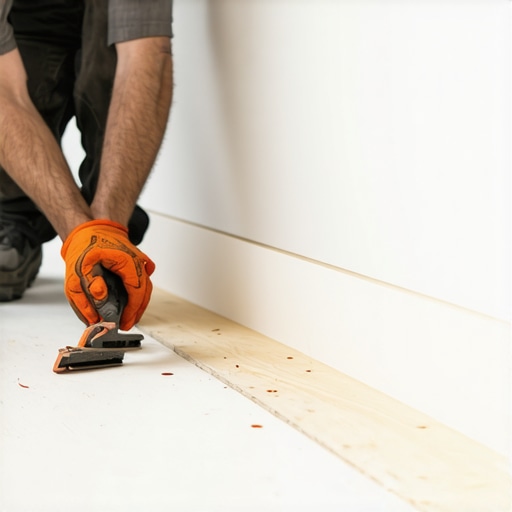
The recessed baseboard profile relies on a Z-shaped metal reveal or a shadow bead that creates a structural break between the drywall and the floor. This architectural reglet allows the wall to sit slightly behind the plane of the baseboard or creates a shadow gap that accommodates structural movement while maintaining a clean, zero-threshold appearance. To get this right, you have to understand the chemistry of the bond. You are often mixing materials like aluminum, gypsum, and wood. They all expand and contract at different rates. The aluminum reglet acts as a stabilizer. It gives the drywaller a hard edge to mud against and the floor installer a consistent reference point. If you are working in a bathroom, this transition is even more difficult. You might be looking at showers that wow modern designs for 2025 where the tile flows right into a flush wall. In those cases, the waterproofing must be integrated into the reglet itself. You cannot just slap some thin-set on the wall and hope it stays. You need to account for the capillary action of moisture. I always use a high-quality sealant at the bottom of the track to prevent any spills from migrating into the wall cavity.
Why moisture meters are your only friends
Measuring the relative humidity of the concrete slab is the only way to prevent baseboard warping or adhesive failure in flush wall installations. A calcium chloride test or in-situ probe must confirm that the moisture vapor emission rate is below the manufacturer’s threshold, typically 3 pounds per 1000 square feet, before the recessed trim or flush wood base is installed. I don’t care if the house is a year old or fifty years old. I’ve walked into jobs where the moisture was so high the baseboards were literally sweating. If you are doing a recessed installation, that moisture has nowhere to go. It gets trapped behind the flush panel. This causes the wood to swell, which then pushes against the drywall, cracking your perfect mud job. I always insist on an ASTM F2170 test. It measures the humidity inside the slab, not just on the surface. This is the only way to be sure. If the numbers are high, we install a moisture barrier. It is an extra step and extra money, but it is cheaper than ripping out a whole floor in six months.
The 1/8 inch that ruins everything
Precision milling of the baseboard insert to a tolerance of 1/16 inch is essential for a flush wall transition to function without visible gaps. The expansion gap must be hidden within the recessed cavity, allowing the floor to move horizontally under the wall while the vertical shadow line remains consistent across the entire perimeter of the room. People think they can just cut some wood on a table saw and call it a day. It doesn’t work that way. The wood has to be acclimated to the site for at least two weeks. I tell my clients that the wood needs to get to know the house. If you install it straight from the truck, it will shrink or grow. In a traditional house, the baseboard hides that. In a flush wall house, that movement will either blow out your drywall or leave a gap big enough to see the framing. We often use a kerf cut on the back of the baseboard to help it stay flat and prevent cupping. It is these small details that separate a master from a hack.
| Material Property | Aluminum Reglet | Solid Oak Insert | MDF Profile |
|---|---|---|---|
| Thermal Expansion | High | Moderate | Low |
| Moisture Resistance | Excellent | Poor | Moderate |
| Structural Rigidity | Very High | High | Medium |
| Installation Speed | Slow | Moderate | Fast |
Mastering the Z shadow bead installation
Installing a Z shadow bead requires the removal of the bottom section of drywall to allow the metal flange to be fastened directly to the wall studs. This creates a recessed pocket where the flooring or baseboard can sit flush with the finished gypsum board, providing a clean line that eliminates the need for projecting trim or shoe molding. The trick is in the mudding. If the drywaller isn’t on his game, the flange will hump out. I always coordinate with the taper. We use a high-strength setting compound for the first coat, not the premixed bucket stuff. This ensures the metal doesn’t flex. For areas near tile cleaning tips for a sparkling bathroom in 2025, we ensure the grout line is also flush. It is a symphony of different trades. If the framer is off, the drywaller is off. If the drywaller is off, the floor is ruined. I’ve had to tell general contractors to tear down walls because they weren’t plumb enough for a flush base. They hate me for it, but they thank me when the final photos look like an architectural magazine.
How floor expansion kills a flush wall
Floor expansion is a non-negotiable physical reality that must be managed by leaving a hidden expansion gap behind the recessed baseboard. Without this perimeter relief, the flooring material will exert lateral pressure against the wall structure during high-humidity seasons, leading to buckling, tenting, or the destruction of the drywall flange. Most people want the thickest underlayment, but too much cushion actually causes the locking mechanisms on LVP to snap under pressure. This is especially true with recessed bases. You need a firm, flat substrate. If the floor is bouncing, it is hitting the bottom of your recessed trim. Over time, that friction will wear down the finish and create a squeak that will drive you crazy. I use a high-density rubber underlayment or go with a direct glue-down application for the most stable results. Glue-down is better for flush walls because it limits the overall movement of the floor to a microscopic level.
“Expansion space is not a suggestion; it is a structural necessity for the survival of the finish.” – NWFA Protocol
- Verify subfloor flatness using a 10-foot straightedge.
- Acclimate all wood inserts to the room’s humidity for 14 days.
- Install the metal reglet with a laser level for perfect horizontal alignment.
- Use setting-type joint compound for the reglet flange to prevent cracking.
- Leave a 1/4 inch expansion gap hidden behind the recess for seasonal movement.
- Apply a high-quality sealant to the bottom of the track in wet areas.
The chemistry of polymer modified thin-set
Polymer modified thin-set mortars provide the shear strength necessary to hold large format tiles in place when they are used as part of a flush baseboard system. These ANSI A118.15 compliant adhesives offer enhanced flexibility, allowing the tile-to-wall joint to withstand the vibrational stresses and thermal cycling common in modern residential construction. When you are looking at baseboards makeover ideas to elevate your space, don’t overlook the technical side of the adhesive. If you use a cheap mastic, it will fail. Mastic is basically organic glue. It has no structural integrity in a wet environment. For a flush tile base, I want a mortar that has a high concentration of dried polymers. This creates a bridge between the substrate and the tile that can actually handle some movement. It’s about the molecular bond. The polymers interlock with the pores of the tile and the slab. This is why you see tiles popping up in cheap flips. They didn’t use the right chemistry.
Checklist for structural wall transitions
Achieving a perfect flush wall transition starts with a comprehensive site assessment and ends with a multi-stage installation protocol. This includes framing rectification, moisture mitigation, and precision carpentry to ensure that every architectural reveal is uniform and that the structural integrity of the wall is not compromised by the recessed channel. You have to think about the long term. A house is a living thing. It breathes. It moves. If you lock it down too tight with a flush baseboard, something is going to break. The goal is to create the illusion of a solid, seamless connection while actually building in the flexibility that the materials require. This is why I use grout restoration secrets for long-lasting results later on, because even the best installations need maintenance. But if the structure is sound, the maintenance is easy. If the structure is bad, you are just putting a bandage on a broken leg.