
The subfloor secret that contractors wont tell you
Most guys skip the leveling compound. They think the underlayment will hide the dip. It won’t. I spent three days grinding concrete on a job last month just so the floor wouldn’t click like a castanet. When it comes to showers, that same laziness leads to crumbling grout and eventual structural rot. If you see a crack in your shower floor, you are not looking at a cosmetic issue. You are looking at a flashing red light on the dashboard of your home’s integrity. Water is a patient predator. It finds the 1/16 inch gap and uses capillary action to move upward and outward, saturating your subfloor until the wood fibers lose their lignin and the floor begins to bounce. This bounce then creates more cracks, accelerating the cycle of destruction. I have seen entire floor systems in $2 million homes turn into mush because a homeowner ignored a few flakes of sandy grout in the drain trap. You cannot just smear more grout over the top. You have to understand the physics of why it failed in the first place.
The structural reality of porous grout lines
Shower grout serves as a sacrificial barrier that manages surface tension and hydrostatic pressure within the tile assembly. When cementitious grout loses its bond strength, it is usually due to deflection in the joist system or improper hydration during the initial install. If the subfloor flexes more than 1/360th of the span, the rigid grout will snap. It is simple engineering. You are trying to bridge a moving gap with a brittle material. Once that bridge breaks, the waterproof envelope is compromised. People think tile is waterproof. It is not. Tile is a shedder. The real work happens at the vapor barrier and the sloped pan beneath the surface. If your grout is crumbling, it means moisture is sitting stagnant in the setting bed, creating a vapor drive that pushes against the back of the tile, popping the grout right out of the joints. You need to address the moisture levels before you even think about a cosmetic fix. [IMAGE_PLACEHOLDER]
“A floor is only as good as the subfloor beneath it; deflection is the enemy of every joint.” – Master Flooring Axiom
The hidden war between water and your joists
Moisture migration in residential bathrooms occurs through capillary pathways formed when porous grout absorbs soapy residue and hard water minerals. This process, known as efflorescence, weakens the crystalline structure of the Portland cement. As the water travels, it hits the baseboards and the drywall, wicking upward through the paper backing. If you notice your baseboards makeover ideas are being ruined by peeling paint at the bottom, your shower is likely the culprit. The water travels along the silicone bead, finds a pinhole in the grout, and begins to rot the bottom plate of your wall studs. By the time you see the mold, the plywood is already at 30 percent moisture content. This is where the structural engineer has to step in. You aren’t just cleaning anymore. You are performing surgery on the house. You have to check the wicking capacity of every material in a 3 foot radius of that shower curb.
The chemistry of modern cementitious bonds
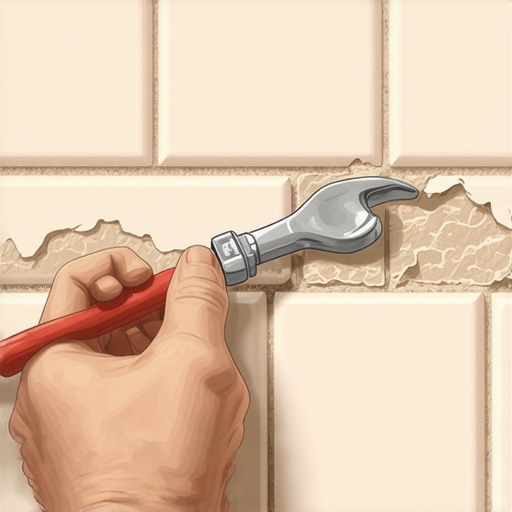
Polymer-modified grout relies on latex additives to provide tensile flexibility and reduced permeability compared to standard sand and cement mixes. These polymers create a cross-linked network that holds the aggregate in place even when the subfloor undergoes thermal expansion. If you used a cheap, non-modified grout, the calcium silicate hydrate crystals will eventually separate from the sand grains. This is why the grout turns to powder. When you look at grout restoration secrets, the first secret is always chemical compatibility. You cannot put epoxy grout over wet cement grout. The amine blush will prevent a proper bond, and the new layer will simply flake off in six months. You have to mechanically remove at least 2/3 of the depth of the joint. It is a grueling, dusty process that requires a carbide-tipped rake or an oscillating tool. If you don’t get the depth, the new grout has no mechanical key to hold onto.
The 1/8 inch that ruins everything
Expansion joints are the most neglected part of any shower installation, yet they are the primary reason for grout failure at the perimeter. Every change of plane, where the floor meets the wall, must be caulked with a 100 percent silicone sealant, never grouted. Grout is rigid. Houses move. When the house settles, that internal corner acts as a fulcrum. If there is grout in that joint, it will crack, and water will pour into the wall cavity. I have seen subfloors completely rotted out under the shower valve because a guy grouted the corner instead of using color-matched caulk. It is a rookie mistake that costs thousands in mold remediation. You need to leave a 1/8 inch gap at every junction. This allows the tile assembly to breathe and shift without snapping the bond coat. It is about structural harmony, not just filling gaps. For those looking for showers that wow, remember that the most beautiful design is worthless if it leaks into the kitchen below.
| Grout Type | Flexibility Rating | Moisture Resistance | Best Use Case |
|---|---|---|---|
| Sanded Cement | Low | Medium | Wide joints over 1/8 inch |
| Unsanded Cement | Very Low | Low | Polished stone, tight joints |
| High-Performance Cement | Medium | High | General residential showers |
| Epoxy Grout | High | Impermeable | Steam showers, commercial kitchens |
The anatomy of a failing bond
Adhesive failure between the thin-set mortar and the tile substrate often presents as hollow sounds or cracking grout before the tile actually moves. This is common in large format tile installs where back-buttering was skipped. If the tile isn’t fully supported, the grout becomes the load-bearing element. Grout is not meant to carry weight. It is a filler. When you walk on a shower floor with voids in the mortar, you are crushing the grout walls. To fix this, you have to find the hollow spots using a plastic mallet or a tile tapping tool. If more than 20 percent of the floor is hollow, the NWFA and TCNA standards say the floor is a failure. You can learn how to refresh grout without replacing it, but if the underlying bond is gone, you are just putting a bandage on a broken leg. You have to stabilize the substrate first.
“Tile is a finish, not a waterproofing membrane; the management of moisture occurs behind the aesthetic layer.” – TCNA Technical Bulletin
The precise steps to reclaim your shower floor
Grout removal must be done with surgical precision to avoid chipping the glaze of the ceramic or porcelain tile. Once the old material is out, you must use a HEPA vacuum to remove every microscopic particle from the joint channel. Any dust left behind will act as a bond-breaker for the new grout. After cleaning, you should perform a moisture test. If the subfloor is still wet, you must wait. Putting new grout over a saturated bed will trap the water, leading to anaerobic bacteria growth. This is the smell people describe as a stinky drain. It isn’t the drain. It is the rotting mud bed under the tile. You might need to run a dehumidifier in the bathroom for 72 hours before the moisture levels drop below the 12 percent threshold required for re-grouting. It is a test of patience, but skipping it ensures a re-failure within a year.
- Inspect all grout joints for hairline fractures or chalky texture.
- Remove damaged grout to a depth of at least twice the joint width.
- Check the moisture content of the subfloor through the open joints.
- Select a high-performance grout with antimicrobial properties.
- Apply a penetrating sealer after the hydration period is complete.
- Replace all plane-change joints with 100 percent silicone.
The final word on structural integrity
A shower is a high-stress environment where thermal cycling and mechanical loads constantly test the integrity of the subfloor. If you ignore crumbling grout, you are inviting structural decay that will eventually require a full tear-out to the joists. I have spent 25 years watching minor leaks turn into major catastrophes. Treat your grout as the early warning system it is. By maintaining the chemical bond and mechanical stability of your tile assembly, you protect the wood and steel that holds up your home. Do not settle for builder-grade fixes. Use the technical standards provided by the TCNA and ensure your bathroom remains a watertight sanctuary for decades. Real craftsmanship is found in the things you cannot see, like the levelness of the concrete and the purity of the adhesive bond beneath the surface.