
Most guys skip the leveling compound. They think the underlayment will hide the dip. It won’t. I spent three days grinding concrete on a job last month just so the floor wouldn’t click like a castanet. That hollow thud you hear when you walk across your bathroom isn’t just an annoyance. It is the sound of a structural failure between the ceramic and the substrate. I have spent twenty-five years on my knees with a moisture meter and a level, and I can tell you that a floor is a performance surface, not a decoration. When a tile sounds like a drum, it means the bond has failed or was never there to begin with. You are walking on a bridge with no supports. Eventually, that bridge is going to crack.
The phantom sound under your feet
Hollow sounding tiles are caused by debonding from the mortar bed, insufficient thin-set coverage, or subfloor deflection. To fix this without a full tear-out, you must identify the extent of the void using a floor-tapping tool or a simple golf ball. If the area is localized, an epoxy injection system can fill the void. If the failure is widespread, the tile must be removed and the substrate leveled to meet TCNA standards. This requires precision and a deep understanding of adhesive chemistry.
When you hear that high-pitched click or the deep, hollow thud, you are listening to air. In a perfect installation, the tile, thin-set, and subfloor act as a single monolithic unit. When an installer is lazy and uses the dot-set method, which involves just putting a few blobs of mortar on the corners, they create air pockets. These pockets are where moisture collects and where the tile eventually snaps. The physics of the situation are simple. Every time you step on that tile, you are bending it. Ceramic has high compressive strength but almost zero flexural strength. You cannot treat it like vinyl. It will crack if it is not supported across one hundred percent of its surface area.
“A floor is only as good as the subfloor beneath it; deflection is the enemy of every joint.” – Master Flooring Axiom
The truth about thinset coverage
Thin-set mortar coverage must reach a minimum of 80 percent in dry areas and 95 percent in wet areas like showers. For a bathroom floor, I always aim for 95 percent because of the humidity. Anything less creates voids where water can migrate, leading to mold or further debonding. You achieve this by using the correct notched trowel and back-buttering every single tile to ensure the mortar ridges are collapsed into a solid bed of adhesive. This is the difference between a floor that lasts five years and one that lasts fifty.
The chemistry of the bond is where most DIY enthusiasts fail. Modern thin-sets are not just mud and sand. They are highly engineered polymers. When you mix a modified thin-set, you are initiating a chemical reaction that creates microscopic crystalline structures. These structures need a clean, stable surface to latch onto. If your subfloor was dusty or if you didn’t prime the concrete, those crystals have nothing to grab. The result is a floor that looks beautiful on day one but sounds like a hollow shell by month six. If you find yourself in this position, you need to assess if the grout is also cracking. If the grout is failing, it is a sign that the tile is moving too much for a simple fix.
| Substrate Type | Required Prep | Max Deflection | Thin-set Type |
|---|---|---|---|
| Concrete Slab | Grinding / Leveling | L/360 | Modified Poly-set |
| Plywood | Sanding / Screw-down | L/720 | EGP Modified |
| Cement Board | Tape and Mud Joints | L/360 | Unmodified or Modified |
The secret life of grout and expansion joints
Grout acts as the shock absorber for your tile system but it cannot compensate for a moving tile. If you notice that your grout lines are turning to powder or falling out, it is because the tile underneath is rocking. Before you try to fix the hollow sound, you should consider if you need to refresh grout without replacing it once the tile is stabilized. In bathrooms, the intersection between the floor and the wall is a critical failure point. You should never use hard grout in that corner. You need a 100 percent silicone caulk that matches the grout color to allow for the natural expansion and contraction of the house framing.
The expansion gap is often the 1/8 inch that ruins everything. If the tile is pushed tight against the wall, it has nowhere to go when the house shifts. This pressure can cause the tile to tent or pop off the floor, creating that hollow sound. When I do an inspection, the first thing I check is the perimeter. If the installer didn’t leave a gap under the chic baseboard designs, the floor is doomed. I have seen entire bathroom floors lift three inches off the ground because there was no room for the tile to breathe. It is a slow-motion car crash that starts with a tiny hollow sound.
Injecting a solution into the void
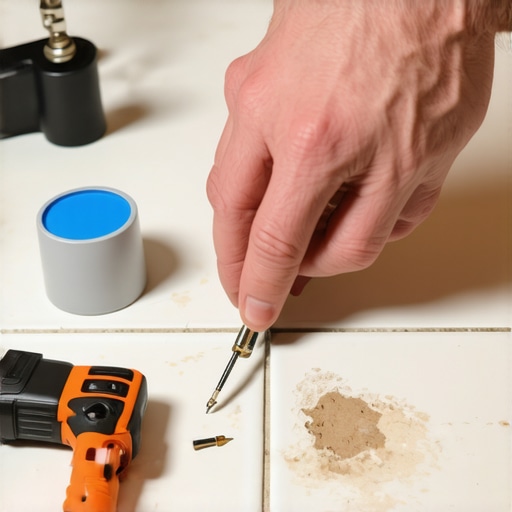
Tile injection repair involves drilling small holes through the grout lines and pumping a high-strength adhesive into the hollow space. This method is effective when you have one or two problematic tiles and you do not want to risk breaking them during removal. You must use a masonry bit and be careful not to hit the tile itself. Once the adhesive is injected, you weight the tile down with several buckets of water or sandbags for twenty-four hours to ensure a flat, solid bond. It is a surgical procedure for your floor.
- Tap the floor to locate the exact boundaries of the hollow void.
- Drill 1/8 inch holes in the grout lines at the corners of the hollow area.
- Vacuum out all dust and debris from the holes to ensure adhesive penetration.
- Insert the injection nozzle and slowly fill until the adhesive resists back-pressure.
- Clean up excess adhesive immediately with a damp sponge before it cures.
- Weight the tile and wait 24 hours before walking on the surface.
The adhesive used in these kits is usually a low-viscosity epoxy or a specialized acrylic. It is designed to creep into the smallest gaps using capillary action. This is not a fix for a floor that was installed over a rotting subfloor. If the wood underneath is soft, no amount of glue will save you. You need to be honest with yourself about the structural integrity. If you are dealing with modern showers, the waterproofing membrane adds another layer of complexity. If you drill too deep, you might puncture the pan, and then you have a leak that will cost thousands to repair.
The structural reality of moisture in showers
Moisture is the primary catalyst for bond failure in bathroom environments. Even if the tile was installed correctly, a failure in the tile cleaning tips or maintenance can allow water to seep behind the grout. Once water gets under the tile, it begins to break down the chemistry of the thin-set. In older homes, we see this often with organic mastics which turn back into mush when they get wet. If your hollow tile is inside the shower stall, you aren’t just looking at a sound issue. You are looking at a potential rot issue for your joists.
“Cementitious grout is porous; without a properly sloped sub-base and waterproofing, the bond is perpetually at risk.” – TCNA Handbook Summary
When I am architecting a floor system for a high-moisture area, I insist on liquid-applied membranes. These create a rubberized barrier that moves with the house. If you are trying to fix a hollow tile in a wet area, you have to be incredibly careful. If the tile is loose, it is likely that the waterproofing has already been compromised. Sometimes the best advice is the hardest to hear. You might need to pull that tile up and inspect the substrate. If you see black staining on the wood or damp concrete, the injection method is just putting a bandage on a gunshot wound.
Why the baseboard makeover matters
Baseboards and transitions are the final defense against moisture intrusion and structural shifting. When you are finishing a repair, look at your trim. Using baseboards makeover ideas can help hide the necessary expansion gaps you must leave at the edge of the tile. I see so many people caulk the baseboard to the tile with hard caulk. That is a mistake. Use a flexible sealant. The house is a living thing. It breathes. It moves with the seasons. If you lock your tile in place with rigid grout and tight baseboards, the floor will eventually protest with that hollow sound.
Protecting the floor also means choosing the right materials from the start. People ask me about eco-friendly tile solutions and how they affect the bond. Whether you are using recycled glass or ceramic, the physics remain the same. The bond is everything. If you are in doubt, call a professional. You can find our info on the contact us page if you need a consult on a failing subfloor. Do not let a small hollow sound turn into a full bathroom renovation because you ignored the warnings. Check your moisture levels. Check your deflection. And for heaven’s sake, stop using the dot-set method.