
Proven Methods to Remove Stubborn Grout Stains Without Using Bleach
I have spent twenty five years on my knees with a moisture meter and a level, smelling like sawdust and thin set. I am a master floor installer who has seen it all. Most homeowners think bleach is a miracle cure for dirty floors, but they are wrong. I spent three days grinding concrete on a job last month just so the floor would not click like a castanet, and while I was there, I saw the damage bleach does to a bathroom. The homeowners had poured gallons of it into their shower grout. The result was not a clean floor. The result was a crumbling mess of brittle cement that was falling out in chunks. Bleach is an oxidizer that can kill mold on the surface, but it actually destroys the binders in your grout over time. If you want a floor that lasts for decades, you have to stop reaching for the white bottle and start understanding the chemistry of the material under your feet.
The hidden failure of bleach on porous surfaces
Bleach fails to clean grout because it is a surface level oxidizer that cannot penetrate the capillary structure of cementitious materials. While it may whiten the top layer, the organic stains and bacteria remain trapped deep within the porous matrix of the tile joints in your shower.
When we talk about grout, we are talking about a microscopic sponge. Grout is typically a mixture of Portland cement, sand, and pigments. Under a microscope, it looks like a mountain range full of caves and tunnels. When you spill coffee or when body oils wash off in the shower, those liquids travel deep into these tunnels. Bleach has a high surface tension. It sits on top. It changes the color of the stain so you cannot see it, but the physical material of the stain is still there. Over time, the salt in the bleach crystallizes inside the grout pores. This causes internal pressure that leads to cracking and spalling. I have seen beautiful tile jobs ruined by homeowners who thought they were being clean. They were actually accelerating the death of their floors. To truly fix a stain, you need a cleaner that can lower the surface tension and lift the dirt out of those tunnels rather than just turning it white.
Why your grout acts like a petrified sponge
Cementitious grout is a sand based material that relies on polymer chains to hold its shape between ceramic or porcelain tiles. Because it lacks the density of the tile itself, it absorbs moisture, soap scum, and mineral deposits through capillary action, making it a magnet for deep set stains.
Understanding the physics of your floor is the first step toward maintaining it. Most people do not realize that the subfloor determines how your grout behaves. If there is even a tiny bit of deflection in the subfloor, the grout will develop micro cracks. These cracks are invisible to the naked eye, but they act as superhighways for moisture. If you live in a humid region like Florida or the Gulf Coast, those micro cracks will suck moisture out of the air and hold it against the thin set. This creates a breeding ground for mold that bleach can never reach. This is why professional installers focus so much on floor leveling. If the floor is flat and the subfloor is rigid, the grout stays intact and remains easier to clean. If you are dealing with a stain that won’t budge, it might be because the moisture is coming from underneath the tile rather than from the top.
“A floor is only as good as the subfloor beneath it; deflection is the enemy of every joint.” – Master Flooring Axiom
The chemistry of alkaline cleaners and oxygen bleach
Oxygen bleach, also known as sodium percarbonate, is a non toxic alternative that releases oxygen bubbles when mixed with water to physically lift dirt from grout lines. Unlike chlorine bleach, it does not degrade the structural integrity of cement or affect the pigment of the joint filler.
When you mix sodium percarbonate with warm water, it creates a chemical reaction that generates millions of tiny bubbles. These bubbles penetrate the pores of the grout and push the dirt to the surface. It is a mechanical process as much as a chemical one. You have to let it sit. I tell my clients to give it at least twenty minutes. If you scrub immediately, you are wasting your time. Let the chemistry do the heavy lifting. This is especially important in showers that wow modern designs for 2025 where large format tiles are used. Large tiles mean fewer grout lines, but those lines are often under more stress. Using a gentle but effective alkaline cleaner ensures that the minimal grout you do have stays pristine without eroding.
When mechanical removal is the only path forward
Mechanical removal involves using a grout saw or a carbide tipped scraper to remove the top millimeter of stained grout before applying a fresh layer of matching material. This is a last resort for stains that have chemically bonded with the cement or have penetrated through the entire depth of the joint.
Sometimes the stain is not just on the grout. Sometimes the stain is the grout. If a homeowner has used the wrong cleaning chemicals for years, the surface might be permanently etched. At this point, no amount of scrubbing will help. I have had to go into bathrooms and manually scrape out the top layer of grout. It is a tedious job that requires a steady hand. You do not want to chip the edge of the tile. Once the top layer is gone, you can apply a grout colorant or a thin layer of new grout. This is a common part of how to refresh grout without replacing it effectively. It is much cheaper than a full tear out, but it requires patience and the right tools. If you are going this route, make sure you vacuum every bit of dust out of the joints before you try to apply anything new. Even a tiny bit of dust will prevent the new grout from bonding to the old.
| Cleaner Type | pH Level | Best Use Case | Risk Level || :— | :— | :— | :— || Chlorine Bleach | 11 to 13 | Surface Disinfecting | High Structural Damage || Vinegar | 2 to 3 | Mineral Deposit Removal | High Etching Risk || Oxygen Bleach | 10 | Deep Organic Stains | Very Low || Alkaline Cleaners | 8 to 9 | Daily Maintenance | None |
The relationship between baseboards and floor moisture
Baseboards serve as the perimeter seal for a tile floor, hiding the expansion gap required for structural movement. If moisture seeps behind the baseboard, it can travel under the tile and cause grout discoloration from the bottom up, a phenomenon known as efflorescence.
I always look at the baseboards when a client complains about grout stains near the walls. Often, the stain is not dirt. It is minerals being carried up from the subfloor by moisture. If the transition between the floor and the wall is not sealed correctly, water from mopping or humidity can get trapped. This is why I am a stickler for using 100 percent silicone caulk at the base of the baseboards rather than hard grout. Grout will crack at the wall line because the walls and floors move at different rates. For those looking for baseboards makeover ideas to elevate your space, remember that function must come before fashion. A beautiful baseboard that lets water seep behind it is a failure of engineering. If you see white, crusty stains on your grout, check your perimeter seals first. You might be fighting a losing battle against the ground itself.
The essential grout restoration checklist
To successfully restore your tile joints without using harsh chemicals, you must follow a systematic approach that respects the physics of the material. Here is the professional toolkit and workflow I use on every job site.
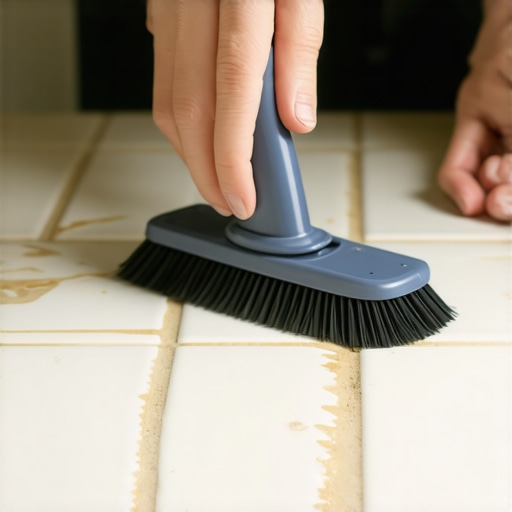
- Stiff nylon scrub brush with a narrow profile for joint penetration.
- Sodium percarbonate powder mixed with distilled warm water.
- Wet dry vacuum to remove dirty slurry before it can reabsorb.
- Microfiber cloths for final residue removal.
- High quality penetrating sealer for long term protection.
- pH neutral cleaner for future maintenance to avoid stripping the sealer.
The ghost in the expansion gap
Expansion gaps are the quarter inch spaces left around the perimeter of a tile installation to allow for thermal expansion and structural settling. Without these gaps, the grout will crack and stain as the tiles press against each other, creating fissures that trap debris and moisture.
Every floor breathes. It may look solid, but it is moving. In a place like Phoenix, the dry heat makes everything shrink. In a place like Houston, the humidity makes everything swell. If your installer shoved tile right against the wall, that floor has nowhere to go. The pressure will find the weakest point, which is always the grout. Cracked grout is impossible to keep clean. It becomes a gutter for every bit of dust and mop water in the house. This is why chic baseboard designs that transform rooms in 2025 are so important. They allow you to leave that necessary gap while keeping the room looking finished. If you are struggling with grout that seems to get dirty immediately after cleaning, check for cracks. If the grout is cracked, you are not just cleaning a floor, you are cleaning a crack in the foundation of your home.
“Cementitious grout is naturally porous and must be treated with a high-quality sealer to maintain structural integrity and aesthetic clarity.” – TCNA Handbook Excerpt
Sealing the deal against future shadows
Grout sealer is a hydrophobic coating that fills the pores of the cement to prevent liquids from penetrating the surface. Applying a sealer every twelve to eighteen months is the only way to ensure that stubborn stains do not return to your tile floors.
After you have done the hard work of cleaning the grout with oxygen bleach or mechanical scraping, you cannot just leave it bare. Bare grout is a tragedy waiting to happen. You need a penetrating sealer. There are two types of sealers: topical and penetrating. Topical sealers sit on top like a layer of plastic. They peel and look terrible over time. I hate them. Penetrating sealers dive into the pores and live there. They do not change the look of the floor, but they make water bead up like it is on a freshly waxed car. This is the secret to grout restoration secrets for long-lasting results. If you skip this step, you will be back on your knees in six months doing the same thing all over again. I tell my clients to test their sealer by dropping a few beads of water on the grout line. If the water soaks in and turns the grout dark, the sealer has failed. If the water sits there, you are safe.
The reality of long term tile maintenance
Regular maintenance with pH neutral cleaners prevents the accumulation of alkaline residues that attract dirt and grime to tile surfaces. By avoiding acidic cleaners like vinegar, you protect the calcium carbonate structure of the grout and the protective sealer applied to it.
I have seen people use vinegar on their tile for years because they heard it was a natural cleaner. Vinegar is acetic acid. It eats calcium. Grout is full of calcium. Every time you use vinegar, you are essentially dissolving a tiny layer of your floor. This makes the grout more porous and harder to clean in the future. It is a vicious cycle. Use a dedicated stone and tile cleaner that is pH balanced. This will keep your tile cleaning tips for a sparkling bathroom in 2025 effective and simple. Flooring is not just about aesthetics. It is a structural engineering challenge. If you treat it with respect and understand the materials, it will last longer than the house itself. Stop using bleach, stop using vinegar, and start using your head. A clean floor starts with a solid subfloor and ends with the right chemistry. Anything else is just a temporary fix for a permanent problem.