
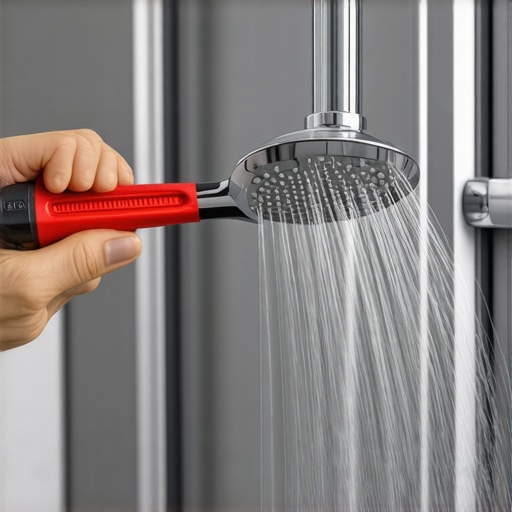
How to Remove a Stuck Shower Head Without Breaking Pipes
I spent three days grinding concrete on a job last month just so the floor wouldn’t click like a castanet, and that same level of obsessive prep is what you need for a seized shower head. I once walked onto a job where a homeowner tried to manhandle a 1990s chrome fixture off a copper pipe. He didn’t use a backer wrench. He just pulled. He ended up ripping the drop-ear elbow right off the 2-by-4 backing inside the wall. Water sprayed like a geyser behind his expensive tile. Most guys skip the prep. They think they can just crank on it. They are wrong. Removing a stuck shower head requires an understanding of galvanic corrosion and mineral lithification. When calcium carbonate and magnesium from hard water sit in a threaded joint for a decade, they basically turn into stone. You are not fighting a bolt, you are fighting a geological formation. If you do not respect the torque limits of a half-inch NPT pipe, you will be opening up your wall and calling a plumber for a three-thousand-dollar repiping job.
The hidden chemistry of the seized joint
To remove a stuck shower head, you must first neutralize the mineral bonds and oxidation holding the threads together using penetrating oils or white vinegar. This process involves the chemical breakdown of calcium deposits and the lubrication of the metal-to-metal interface. When different metals touch, like a brass shower arm and a zinc-alloy head, they create a small electrical charge that leads to corrosion. This is the molecular reality that most DIY enthusiasts ignore. You need to saturate the joint. I always recommend a high-quality penetrating oil or a concentrated acetic acid solution. If you rush this, you break the pipe. It is that simple. While you are working on the fixture, you might notice the surrounding surfaces need attention. You can find excellent advice on tile cleaning tips for a sparkling bathroom in 2025 to ensure the rest of the space matches your new hardware. The goal is to soften the debris so the friction coefficient drops enough for the threads to slide.
“A floor is only as good as the subfloor beneath it; deflection is the enemy of every joint.” – Master Flooring Axiom
The 1/8 inch that ruins everything
A single eighth of an inch of movement in the wrong direction can snap a brittle shower arm or crack the surrounding grout line. This mechanical failure usually happens because the installer did not use a second wrench to provide counter-torque. You need to stabilize the shower arm. If that arm moves, you are putting stress on the fitting behind the wall. That fitting is often just held by two small screws. If they are rusted, they will fail. I have seen it happen a hundred times. I smell the WD-40 and the old metal every time I walk into a bathroom with a stuck fixture. It reminds me of the precision needed in flooring transitions. Just like you need a perfectly level subfloor for tile, you need a perfectly stable pipe for torque. If you find the tile around the arm is already loose, you should check out grout restoration secrets for long lasting results to fix the structural integrity of the wall assembly before you proceed.
Tools that save your plumbing and your sanity
The specific tools required for a seized shower head include a strap wrench, a pair of tongue-and-groove pliers, and a dedicated pipe wrench for counter-torque. Using a standard adjustable wrench often rounds off the flats of the fixture. You want a tool that bites or a tool that grips via friction without marring the finish. A strap wrench is the minimalist curator’s choice because it leaves zero marks. However, if the corrosion is heavy, you need the teeth of a pipe wrench. You must wrap the shower arm in a thick rubber sheet or several layers of electrical tape to prevent scratching. This is the same care I take when laying a delicate oak floor. You don’t just hammer things into place. You protect the finish. If you are planning a full bathroom refresh after this repair, look into showers that wow modern designs for 2025 for inspiration on what to install next.
| Tool Type | Best Use Case | Risk Level |
|---|---|---|
| Strap Wrench | Chrome or polished finishes | Very Low |
| Adjustable Wrench | Fixtures with flat sides | Moderate |
| Pipe Wrench | Heavily corroded, stuck joints | High (Surface Marring) |
| Locking Pliers | Stripped or rounded heads | High |
The physics of heat and vibration
Applying heat to a stuck shower head causes the outer metal to expand faster than the inner threads, breaking the bond of the corrosion. You can use a heat gun or a hair dryer on its highest setting for several minutes. Do not use a propane torch near plastic inserts or fiberglass tubs. The heat vibrates the molecules and forces the mineral deposits to crack. It is a game of expansion and contraction. I use this same logic when dealing with stubborn adhesive on a subfloor. If you can change the temperature, you can change the state of the bond. After heating, a quick tap with a rubber mallet can provide the necessary vibration to loosen the threads. This staccato force is often more effective than raw pulling power. It is about finesse, not muscle.
“Moisture mitigation is not a luxury; it is the fundamental requirement of every tile assembly.” – Master Flooring Axiom
- Saturate the joint with penetrating catalyst for at least 24 hours.
- Apply a second wrench to the shower arm to prevent wall-side breakage.
- Use a rubber mallet to provide light impact vibration.
- Clean the threads with a wire brush before installing the new head.
- Apply high-quality PTFE tape in a clockwise direction.
The ghost in the pipe thread
The ghost in the pipe thread refers to the microscopic imperfections and leftover debris that cause a new shower head to leak or seize prematurely. Once you get the old head off, the job is only half done. You have to inspect the male threads on the shower arm. They will be covered in white gunk and old tape. If you leave that there, the new fixture won’t seat properly. I treat this like cleaning a subfloor before the thin-set goes down. If there is dust, the bond fails. Use a stiff wire brush and some white vinegar to scrub those threads until they shine. This prevents the need for future force. If your shower arm looks like it has seen better days, it might be time to update the hardware entirely to match a modern aesthetic. Small changes to fixtures often lead to bigger projects, like looking into baseboards makeover ideas to elevate your space to complete the room’s transformation. Every detail matters in a high-performance environment.
Preventing the next calcium lockdown
Preventing a stuck shower head requires the use of nickel-based anti-seize or premium PTFE tape during the installation of the replacement fixture. Most people over-tighten their shower heads. You only need it hand-tight plus a quarter turn. The rubber washer does the sealing, not the threads. If you crank it down, you are just setting yourself up for another disaster in five years. I always tell my clients that a floor needs room to breathe at the expansion gap, and a pipe needs room to exist without being crushed. Use a high-quality thread sealant. This acts as a barrier against the minerals in your water. It keeps the moisture from getting into the thread interface. This is basic preventative maintenance that saves your pipes and your bank account. A little bit of foresight goes a long way in home engineering.