
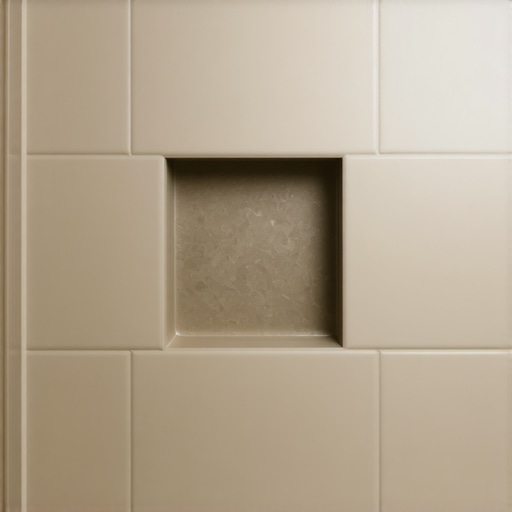
I spent three days grinding concrete on a job last month just so the floor would not click like a castanet. That level of obsession is the only thing that saves a home from the slow, silent rot of a leaking shower niche. Most guys think they can slap some thinset on a piece of foam and call it a day. They are wrong. I once walked into a luxury master bath where the marble was pristine, but the subfloor in the adjacent hallway was soft as a sponge. The water had been migrating through a pinhole in the niche grout, traveling down the back of the cement board, and pooling under the hardwood. It was a thirty thousand dollar mistake that could have been avoided with a moisture meter and a bit of integrity. When we talk about fixing a niche without demolition, we are talking about surgical precision. We are talking about the chemistry of resins and the physics of surface tension. It is not a job for the faint of heart or the homeowner who wants a quick fix from a big box store. This is structural engineering disguised as home repair.
The silent rot behind your expensive tile
Leaking shower niches usually fail because of capillary action and poor flashing at the horizontal sill interface. A successful non-destructive repair involves identifying the breach point using thermal imaging and moisture mapping. We then utilize epoxy resins and hydrophobic sealants to reconstruct the waterproof barrier from the surface level inward. Most people do not realize that tile and grout are not waterproof. They are the decorative skin. The real work happens in the membrane layers that nobody ever sees until they fail. If that membrane is breached, gravity becomes your worst enemy. Water will find the path of least resistance, which is usually the gap between the wall studs and the niche box. Once it is back there, it stays dark and damp, creating the perfect environment for mold to thrive. We use high-frequency moisture meters to track exactly where the water is traveling before we even think about opening our toolkits. If you want to see what a properly finished space looks like, check out showers that wow modern designs for 2025 for inspiration on how these elements should look when done right.
“A niche represents the most vulnerable intersection of vertical and horizontal planes in a wet environment.” – Master Flooring Axiom
The geometry of a failed niche
Water migration in a shower niche is often the result of a negative slope on the bottom shelf or sill tile. If the tile is not pitched toward the drain at a minimum of one quarter inch per foot, water will sit in the grout lines. This ponding water eventually breaks down the polymer chains in the sealant and finds its way into the substrate. I have seen niches that looked perfect to the naked eye, but when I put a digital level on them, they were tilted back toward the wall. That tiny fraction of a degree is enough to ruin a house. When the water sits there, it creates hydrostatic pressure. This pressure pushes water molecules into the microscopic pores of the cementitious grout. Over time, these molecules widen the pores. It is a slow, relentless attack. You might not see a leak for two years, but by the time you see a brown spot on the ceiling below, the damage is done. The fix requires us to re-establish a positive slope without removing the tile, which involves a specific technique of layering translucent epoxy and grinding it to a perfect, invisible pitch.
The chemical reality of topical waterproofing
Topical waterproofing relies on surface tension and molecular bonding to create a hydrophobic shield over porous grout. We use penetrating silane sealers that bond with the silica in the grout matrix to prevent moisture intrusion. This is not the cheap spray-on stuff you find at the hardware store. We are using industrial grade chemicals that actually change the surface energy of the tile. By lowering the surface energy, we make the water bead up and roll off rather than soaking in. This is the same technology used on high-performance windshields, but formulated for the high-alkalinity environment of a shower. We also look at the transition points. The corners of a niche are where the movement happens. If the house settles even a millimeter, a standard grout joint will crack. That is why we replace those critical joints with 100 percent silicone or high-movement epoxies. For more on maintaining these surfaces, read about grout restoration secrets for long lasting results to keep your shower watertight for the long haul.
| Material Property | Cementitious Grout | Epoxy Grout | Single Component Resin |
|---|---|---|---|
| Water Absorption | High (5 to 10 percent) | Negligible (less than 0.5 percent) | Low (1 to 2 percent) |
| Flexural Strength | Low | Extremely High | Moderate |
| Chemical Resistance | Poor | Excellent | Good |
| Shrinkage Rate | Moderate | Zero | Minimal |
Why your grout is a sponge in disguise
Standard grout is a cement-based product that is inherently porous at the microscopic level. It acts as a capillary network that can pull liquid water into the wall cavity if not properly sealed or maintained. I tell my clients that grout is like a hard sponge. It looks solid, but it is full of tiny holes. When you take a twenty minute hot shower, you are creating a high-humidity environment that forces water vapor into those holes. Once the vapor is inside, it condenses back into liquid. If there is no exit path, it just sits there. This is why we often see grout that is darker in the corners. It is saturated. Our fix involves a process called deep-cell extraction. We use heat and vacuum pressure to pull every bit of moisture out of the grout before we inject our resins. If you seal moisture inside, you are just making a mold sandwich. You have to get the substrate dry first. This often takes forty eight hours of continuous airflow and dehumidification. To understand how to handle these materials without a full replacement, see how to refresh grout without replacing it for professional techniques.
The surgical approach to epoxy injection
Epoxy injection involves using low-viscosity resins to fill voids behind loose tiles or cracked grout. This process restores structural integrity and creates an internal water barrier without the need for demolition or tile removal. We use a tiny diamond-tipped bit to drill inconspicuous holes in the grout lines. Then, we use a pressurized syringe to pump the resin in. You can actually hear the resin filling the hollow spots. It is a satisfying sound. It means the air is being pushed out and the bond is being restored. Once the resin cures, it is stronger than the tile itself. It is also completely waterproof. This is the only way to fix a niche that has started to delaminate. If the tile feels bouncy or sounds hollow when you tap it with your knuckle, this is the fix you need. It is a delicate balance. Too much pressure and you pop the tile off the wall. Too little and you do not get full coverage. It takes a steady hand and decades of feeling how the material moves. [IMAGE_PLACEHOLDER_1]
The 1/8 inch slope that saves a wall
Positive drainage is the fundamental principle of wet area construction and must be maintained at every horizontal surface. A shower niche sill must have a downward pitch of at least one eighth of an inch to ensure gravity-led drainage. If we find a niche that is flat, we do not have to tear it out. We can build up a new slope using clear, UV-stable casting resins. We create a small dam at the front of the niche, pour the resin, and let it self-level to the desired pitch. Once it is hard, we sand and polish it until it looks like a piece of glass. It is a clever way to redirect water without touching a single tile. This is the kind of information gain that saves homeowners thousands. Most contractors will tell you it is impossible. They just want the big paycheck that comes with a full remodel. I would rather fix it right and move on to the next one. A floor or a shower is a machine. If one part of the machine is not working, you fix the part. You do not throw the whole machine away.
“Waterproofing must be continuous and integrated with the drainage system to prevent structural rot.” – TCNA Handbook Summary
Protecting the perimeter and the baseboards
Moisture damage from a leaking shower often migrates to the bathroom perimeter and affects the baseboards and subflooring. Protecting these wood components requires silicone transition joints and high-quality moisture barriers at the floor-to-wall junction. I have seen beautiful baseboard installations ruined because a shower niche two feet away was leaking. The water travels along the bottom plate of the wall and wicks up into the MDF or wood. If you are doing a repair, you have to check the surrounding area. We often have to pull the baseboards in the hallway just to make sure the drywall behind them is dry. If you are looking to update your trim after a repair is completed, you should look at chic baseboard designs that transform rooms in 2025 to see what is trending. A good baseboard is not just for looks. It provides a final line of defense against minor spills and cleaning moisture. We always seal the bottom edge of our baseboards with a bead of clear silicone in bathrooms. It is a small step that most builders skip, but it makes a world of difference when the kids start splashing in the tub.
- Check the niche slope with a digital level to ensure at least 2 percent pitch.
- Use a moisture meter to map the extent of the leak behind the tile.
- Clean grout lines with an alkaline cleaner to remove body oils and soap scum.
- Vacuum dry the substrate for at least 24 hours before applying sealants.
- Inject low-viscosity epoxy into any hollow-sounding areas.
- Apply a high-grade penetrating sealer to all grout surfaces.
- Replace corner joints with 100 percent silicone caulk.
The bottom line on niche survival
The hard truth is that most shower niches are ticking time bombs. They are hard to build and easy to mess up. But if you catch the leak early, you do not have to go through the mess of a full tear out. It takes a technical understanding of how water moves and how chemicals bond. It takes the right tools and a lot of patience. If you see a cracked grout line or a bit of mold that will not go away, do not ignore it. It is not just an aesthetic problem. It is a structural threat. Fix it now, or you will be calling me in six months to replace your entire subfloor. That is a job nobody wants to pay for, and I do not want to do it twice because the first guy was lazy. Treat your shower like the engineering challenge it is, and it will serve you for decades. Keep the water on the tile and away from the wood. It is that simple, and that difficult.