
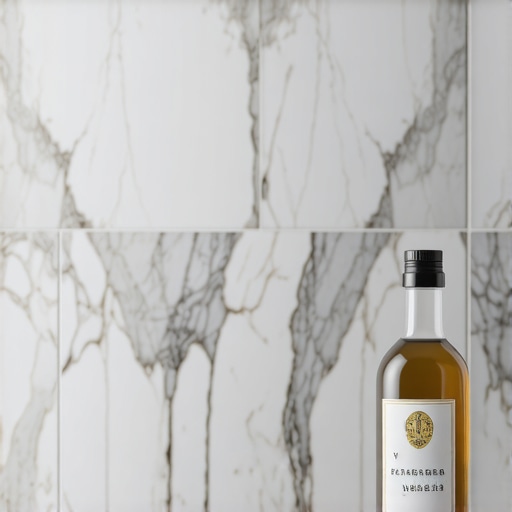
I spent three days grinding concrete on a job last month just so the floor wouldn’t click like a castanet. While I was there, I watched a homeowner spray a 50/50 mix of white vinegar and water onto their brand new Carrara marble shower floor. I nearly dropped my grinder. Most people think vinegar is a safe, natural cleaner. In the world of stone and tile, vinegar is an acid that performs a slow-motion demolition of your bathroom. Marble is not just a pretty surface. It is a metamorphic rock composed of recrystallized carbonate minerals. When you apply an acid like vinegar to a carbonate, you are triggering a chemical reaction that dissolves the stone. This is the structural reality of flooring that big-box retailers never mention in their marketing brochures.
The microscopic war on your stone
Marble consists primarily of calcium carbonate which reacts instantly to the acetic acid found in common white vinegar. This reaction creates calcium acetate, a salt that washes away, leaving behind a dull, pitted surface known as etching. This is not a stain. It is physical damage to the stone structure. Unlike a stain which sits on top or penetrates the pores, etching is the actual removal of the stone material. Once the polished surface is gone, the stone becomes even more porous. This opens the door for mold, mildew, and deep-seated grime to take hold. If you want to keep your bathroom looking professional, check out showers that wow modern designs for 2025 to see how high-end materials should be maintained.
“A floor is only as good as the subfloor beneath it; deflection is the enemy of every joint.” – Master Flooring Axiom
The chemistry of marble destruction
The physics of a shower floor are more complex than most homeowners realize. You have a subfloor, a waterproof membrane, a mortar bed, and then the stone. Vinegar does not just stop at the surface of the marble. It seeps into the grout lines. Grout is typically cementitious, meaning it also contains calcium. The acid eats the binder in the grout, making it brittle and sandy. Over time, this leads to cracks. Cracks lead to water infiltration. Water infiltration leads to subfloor rot. I have seen joists turned to mush because a homeowner wanted a green cleaning solution. Use tile cleaning tips for a sparkling bathroom in 2025 to understand the balance of pH in your cleaning routine. The acidity of vinegar is usually around 2.5 on the pH scale. For perspective, battery acid is around 1.0. You are essentially giving your shower a mild acid bath every week.
Why your grout is crying for help
Grout acts as the expansion joint and the secondary moisture barrier for your entire tile assembly. When the cementitious bond is weakened by acidic cleaners, the grout loses its integrity and begins to flake out in small chunks. This is often the first sign of a failing shower system. Most guys skip the leveling compound and try to hide it with thick grout. It never works. If your grout is already failing, you should look into how to refresh grout without replacing it before the structural damage becomes irreversible. Constant exposure to vinegar turns grout into a sponge. It will soak up dirty shower water and hold it against the thin-set. This eventually causes the tiles to delaminate from the floor. I have pulled up marble tiles with my bare hands because the vinegar destroyed the bond underneath.
The myth of the natural cleaner
Natural does not mean safe for every surface. Lemon juice, vinegar, and even some essential oils are far too aggressive for natural stone. The stone industry has established strict protocols for maintenance. If you ignore them, you void your warranty and ruin your home. The chemistry of the bond is what matters. When we install these floors, we use modified thin-set with polymers to ensure a permanent grip. Vinegar breaks down those polymers. It is a slow, invisible process. One day your floor looks fine. The next day, you notice a hollow sound when you walk on it. That is the sound of your money disappearing. For a better approach to bathroom aesthetics, consider showers with a style trendy ideas for small bathrooms that prioritize durable materials.
| Cleaner Type | pH Level | Effect on Marble |
|---|---|---|
| White Vinegar | 2.5 | Severe Etching |
| Lemon Juice | 2.2 | Surface Dissolution |
| Neutral Stone Soap | 7.0 | Safe and Effective |
| Dish Soap | 8.0 | Dulling Residue |
| Ammonia | 11.0 | Grout Stripping |
How to actually save a shower floor
Maintaining a marble shower requires a pH-neutral cleaner specifically formulated for natural stone. These cleaners do not react with the calcium carbonate. They lift the oils and skin cells off the surface without eating the stone. You also need to consider the protection of your grout. If the grout is already showing wear, follow grout restoration secrets for long lasting results to seal it properly. Sealing is not a one-time event. It is a recurring requirement. In a high-moisture environment like a shower, you should be sealing your stone and grout every six months. This creates a hydrophobic barrier that prevents the stone from absorbing water and chemicals. Without a sealer, your marble is just a very expensive sponge.
- Use only pH-neutral stone cleaners.
- Squeegee the walls after every shower to prevent mineral buildup.
- Dry the floor with a microfiber towel to stop water spotting.
- Seal the stone every six months with a high-quality impregnator.
- Avoid any cleaner containing citrus or acetic acid.
The role of pH neutral solutions
Modern chemistry has given us better tools than vinegar. Surfactants in neutral cleaners are designed to break the tension between the dirt and the stone surface. They allow you to wipe away the grime without a scrub brush. Scrubbing marble with an abrasive pad and vinegar is a recipe for a $10,000 restoration bill. I have seen people use scouring pads on marble. It makes me want to retire. The stone is soft. It sits at a 3 on the Mohs scale. For comparison, a diamond is a 10 and your fingernail is about a 2.5. You are cleaning something barely harder than your own nails with acid. It makes no sense. If you are looking to update your bathroom borders as well, look at baseboards makeover ideas to elevate your space for a complete professional finish.
“Marble is a metamorphic rock composed of recrystallized carbonate minerals, most commonly calcite or dolomite.” – Stone Industry Standard
The 1/8 inch that ruins everything
In flooring, precision is the difference between a job that lasts and a job that fails. This applies to cleaning too. Even a small amount of leftover vinegar in the corners of a shower will continue to eat the stone long after you have finished cleaning. This leads to “pitting” where small holes appear in the marble. These holes then fill with soap scum and bacteria. You cannot clean those holes. You have to have the stone professionally honed and polished to remove them. This is why I tell people to keep the vinegar in the kitchen. It belongs on a salad, not on a Carrara slab. If you are worried about the environment, there are plenty of eco friendly tile solutions for sustainable homes in 2025 that do not involve destroying your property with acid. We often see better results with steam cleaners than with any chemical solution. Steam kills the bacteria and lifts the dirt without changing the chemistry of the stone.
The ghost in the expansion gap
Every shower has movement. Houses breathe. Walls shift. This is why we leave expansion gaps at the corners and where the floor meets the wall. We fill these gaps with 100 percent silicone caulk, never grout. Vinegar also attacks the bond of silicone. When that bond fails, water gets behind the tile. You won’t see it for months. By the time the mold starts growing through the drywall on the other side of the wall, it is too late. The structural engineering of the shower has been compromised. Professional installers understand that every chemical introduced to the environment affects the longevity of the build. Use chic baseboard designs that transform rooms in 2025 to ensure your transitions are handled by professionals who know how to protect these gaps.