
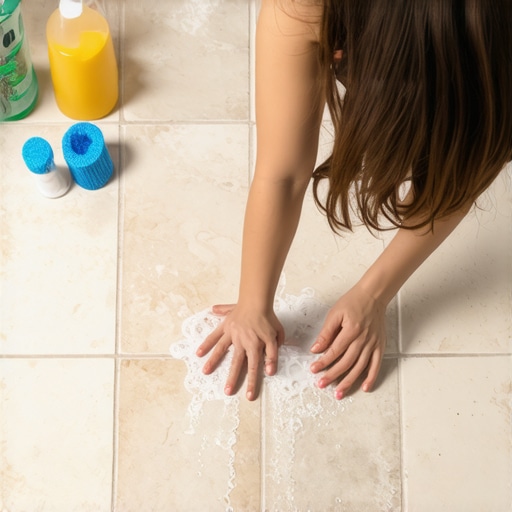
The chemical war on your natural stone floor
Natural stone cleaning requires pH-neutral cleaners, micro-fiber applicators, and specialized stone soap to protect the integrity of the calcium carbonate bond. You must avoid acidic solutions like vinegar or lemon juice, as these substances initiate a chemical reaction known as etching, which permanently dissolves the surface layers of marble, travertine, and limestone tiles. Most guys skip the leveling compound. They think the underlayment will hide the dip. It won’t. I spent three days grinding concrete on a job last month just so the floor wouldn’t click like a castanet, and stone showers are even worse. I once walked into a project where a high-end slate shower had been ruined by a ‘natural’ cleaning trend. The homeowner used white vinegar for six months. By the time I arrived, the slate was flaking in layers, a process called spalling, because the acid had compromised the metallic bonds holding the sedimentary layers together. That was a twelve thousand dollar tear-out that could have been avoided with a ten dollar bottle of pH-neutral stone soap. When you deal with stone, you are dealing with geology, not plastic. You are cleaning a slice of the earth crust. This requires an understanding of the molecular porosity that defines how water and minerals interact within your shower stall.
“A floor is only as good as the subfloor beneath it; deflection is the enemy of every joint.” – Master Flooring Axiom
The physics of stone porosity and moisture
Stone porosity refers to the volume of open space within a tile, which determines its rate of absorption and its vulnerability to organic growth. When we talk about showers, we are talking about a saturated environment. A porous stone like travertine is essentially a collection of tiny interconnected tunnels. If you use the wrong cleaner, those chemicals travel deep into the tile. Once there, they can crystallize and expand, causing internal pressure that shatters the stone from the inside out. This is why the industry relies on the TCNA Handbook for specific stone installations. We look at the water absorption rates. Granite typically has an absorption rate of less than one percent, while certain types of limestone can exceed five percent. If your subfloor is not perfectly pitched toward the drain, water will sit in those pores. Stagnant water in stone pores is a breeding ground for mold that cannot be scrubbed away because it is living inside the stone itself. You need to ensure your grout is also maintained to prevent water from bypassing the stone and rotting the mud bed underneath. For those looking at the bigger picture, grout restoration secrets for long lasting results offer a path to keeping that assembly watertight. The relationship between the stone surface and the capillary action of the grout determines whether your shower lasts thirty years or five.
Why pH balance dictates the life of marble
PH neutral cleaners maintain a value of seven on the scale to prevent the ionization of calcium minerals found in natural stone showers. Most people think ‘clean’ means ‘acidic’ or ‘bleach-heavy,’ but stone is different. When an acid hits a marble floor, it seeks out the calcium carbonate. The acid ions effectively eat the stone to neutralize themselves. This leaves a dull, white mark that no amount of scrubbing can fix. That is not a stain; it is a physical change in the surface texture. You have created a topographical valley in your tile. To clean safely, you need a surfactant that lowers the surface tension of water, allowing it to lift dirt and skin oils without attacking the mineral structure. We use non-ionic surfactants in the trade because they don’t leave a film. If you see streaks after cleaning, your soap is too thick or your water is too hard. In regions like the Southwest, hard water minerals like magnesium and calcium will build up on the stone. This creates a secondary layer of stone on top of your stone. Removing this requires a delicate balance of mechanical agitation and specific chelating agents that grab the minerals without harming the tile. It is a game of chemistry played on your knees with a soft brush.
The technical performance of common stone types
Stone performance metrics allow installers to predict how a shower floor will age under constant hydro-static pressure and chemical exposure. Not all stones are created equal for wet environments. A dense granite will behave differently than a soft, pillowed travertine. Understanding the Janka hardness is less relevant here than the MOHS scale of mineral hardness and the density of the material. Below is a breakdown of how these materials handle the shower environment.
| Stone Type | Porosity Level | Acid Sensitivity | MOHS Hardness | Cleaning Frequency |
|---|---|---|---|---|
| Marble | High | Extreme | 3 to 4 | Daily Rinse |
| Granite | Low | Low | 6 to 7 | Weekly Deep Clean |
| Slate | Medium | Moderate | 3 to 5 | Bi-Weekly |
| Travertine | Very High | Extreme | 3 to 4 | Daily Rinse |
As you can see, marble and travertine are the divas of the flooring world. They require the most care. If you are interested in more durable, modern alternatives, you might check out showers that wow modern designs for 2025 for materials that mimic stone without the chemical baggage. The density of the stone also dictates how much sealer it can hold. A dense stone needs a solvent-based sealer with smaller molecules to penetrate the surface, while a porous stone can take a water-based sealer with larger particles.
The hidden danger of expansion gaps and baseboards
Perimeter expansion gaps allow the entire floor assembly to move without cracking the stone or the grout lines during thermal fluctuations. Many installers make the mistake of grouting the stone directly to the wall. This is a failure. You need a 100 percent silicone caulk at every change of plane. When the hot water hits the stone, it expands. If it has nowhere to go, it will tent or crack. This transition is often hidden by the baseboards. If your baseboards are not properly integrated into the waterproof system, moisture will wick up the drywall behind them. This is why choosing the right trim is not just about looks. High-moisture areas require specific materials. You can find inspiration in chic baseboard designs that transform rooms in 2025 to ensure your aesthetics don’t compromise your waterproofing. I have seen countless showers where the stone was pristine, but the baseboards were rotting from the back because the installer didn’t use a back-bead of caulk. The stone floor is part of a larger structural system. If one part fails, the whole thing goes. You have to think about the movement of the house. Every building settles. Every floor shifts. The stone must be allowed to breathe and move within its envelope.
“Natural stone is a living material; it requires a balance of breathability and protection to survive the harsh environment of a modern shower.” – Master Flooring Axiom
The daily protocol for stone preservation
A squeegee is the most important tool for stone maintenance because it removes the mineral-rich water before it can evaporate and leave deposits. If you let the water sit, the minerals in your tap water will bond to the stone. This is the start of soap scum. Soap scum is not just soap; it is a metallic soap made from the reaction of fatty acids in your body wash with the calcium in your water. Once it hardens, it is a nightmare to remove from stone. You cannot use a scrub pad. You cannot use a razor blade. You must use a specialized alkaline cleaner that breaks the bond of the soap scum without etching the stone. Here is a mandatory checklist for anyone who owns a stone shower floor.
- Use a squeegee after every single shower to remove standing water.
- Clean the floor weekly with a dedicated pH-neutral stone soap.
- Inspect the grout and silicone joints monthly for any signs of separation.
- Apply a high-quality impregnating sealer every twelve to eighteen months.
- Never use a vacuum with a beater bar near the stone as it can cause micro-pitting.
By following this regimen, you avoid the heavy-duty restoration costs that come with neglect. For more general bathroom hygiene that protects your investment, tile cleaning tips for a sparkling bathroom in 2025 provides additional layers of maintenance logic. The goal is to prevent the need for aggressive cleaning. If you are scrubbing hard, you have already lost the battle. The chemistry should do the work for you.
Why your subfloor is lying to you
Subfloor deflection causes the grout in stone showers to crack which then allows water to seep into the structural framing of the home. Stone has zero flexibility. It is brittle. If your plywood subfloor has even a quarter-inch of bounce, the stone will crack. Most homeowners focus on the stone, but I focus on the joists. We often have to double-up the subfloor or add sister joists to meet the L/720 deflection standard required for natural stone. If you install stone over a standard subfloor designed for carpet, that stone will be in pieces in two years. This is the contrarian truth of the industry. While most people want the thickest, most beautiful stone, the reality is that the strength of the floor comes from the two inches of mortar and wire mesh hidden underneath it. If that mud bed isn’t packed right, the stone is just a mask for a failing structure. You must ensure that the installer used a proper pre-pan and a secondary waterproofing membrane like Schluter-Kerdi or a liquid-applied system. These membranes protect the subfloor from the moisture that the stone naturally absorbs. Without them, your subfloor is a ticking time bomb of rot and mold. Always ask for a flood test before the stone is laid. If the pan doesn’t hold water for twenty-four hours, the stone doesn’t matter. You are just decorating a leak.
The final word on stone restoration
Professional stone honing and polishing can restore a ruined floor by mechanically removing the top micro-layer of damaged minerals to reveal fresh stone. If you have already made the mistake of using harsh chemicals, all is not lost. We use diamond-impregnated pads starting at a 50-grit and working up to a 3000-grit to bring back the factory shine. This is a dusty, wet process that requires a pro. But it is cheaper than a tear-out. To avoid this, stay away from the hardware store ‘all-purpose’ cleaners. Those bottles are the enemy of marble. They contain chelating agents and acids that will strip the sealer and the polish in one go. Treat your stone shower floor like a fine piece of jewelry. You wouldn’t clean a diamond ring with a wire brush and bleach. The same logic applies here. The stone is an investment in your home value. It is a piece of history in your bathroom. Respect the chemistry, respect the structure, and the stone will outlast the house itself. If you ever find yourself in doubt, it is better to use plain distilled water than a chemical you aren’t sure about. The safest path is always the most patient one. Take care of the stone, and it will take care of your feet for decades to come. Ensure you check the privacy policy for any service agreements when hiring professionals for this delicate work. Understanding your rights and the guarantees on stone maintenance is part of being a responsible homeowner.