
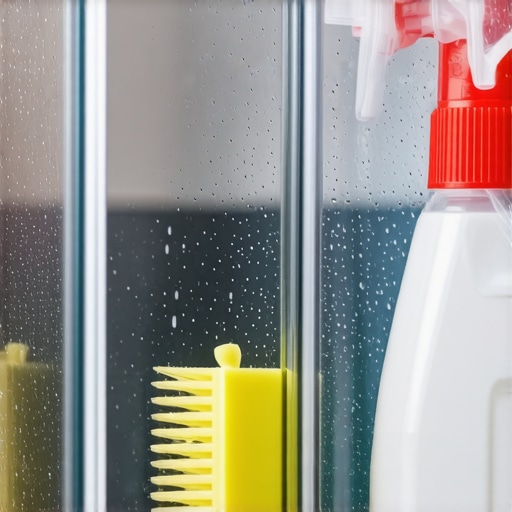
Most guys skip the leveling compound. They think the underlayment will hide the dip. It won’t. I spent three days grinding concrete on a job last month just so the floor wouldn’t click like a castanet. That same level of attention to the sub-surface is exactly what people miss when they try to clean a shower. You are not just cleaning a surface. You are fighting a chemical battle against liquid rock. I have spent 25 years on my knees looking at floors. I have seen fifteen-thousand dollar marble installations ruined because someone thought a little hard water was just a cosmetic issue. It is not. Hard water is a slow-motion geological event happening in your bathroom. It is the accumulation of calcium carbonate and magnesium sulfate that bonds to your surfaces at a molecular level. When you see those white, chalky spots on your tile or glass, you are looking at mineral skeletons that have anchored themselves into the microscopic pores of the material. If you don’t understand the chemistry of the bond, you will never win. You will just scratch your expensive glaze and wonder why the stains come back in a week. I smell like sawdust and floor wax most days, and I can tell you that the secret to a clean floor is the same as a flat floor. It is all about the preparation and the chemistry of the bond.
Mineral deposits are more than just white spots
Hard water stains consist of alkaline mineral deposits like calcium and magnesium that crystallize on surfaces as water evaporates. These minerals create a jagged microscopic structure that traps soap scum and body oils, turning a simple cleaning task into a complex chemical removal process requiring acidic intervention. The physics of this is simple but brutal. Water is a universal solvent. As it travels through limestone and chalk in the ground, it picks up ions. When that water hits your shower and evaporates, it leaves those ions behind. They don’t just sit there. They form a crystalline lattice. This is why you cannot just wipe them away with a wet rag. You are trying to wipe away a rock. In regions like the Southwest or Florida, the mineral count is so high that a single shower can leave enough residue to start the scaling process. If you have installed showers that wow modern designs for 2025, you need to protect that investment from day one. The mineral content creates a physical bridge between the water and the tile glaze. Over time, this bridge becomes a permanent part of the surface through a process called calcification.
“A floor is only as good as the subfloor beneath it; deflection is the enemy of every joint.” – Master Flooring Axiom
Why porous grout is a magnet for disaster
Grout is a cementitious material that acts like a hard sponge, pulling mineral-heavy water deep into its internal structure through capillary action. Once the water evaporates, the minerals remain trapped inside the grout pores, causing discoloration, structural weakening, and the eventually brittle failure of the grout joint. When I see people complaining about their grout, I usually see a failure of sealing. Grout is essentially concrete. It has millions of tiny holes. If you do not fill those holes with a high-quality sealer, the hard water moves in and sets up shop. This is why grout restoration secrets for long-lasting results always begin with deep cleaning and end with professional-grade sealing. If you let the minerals sit in the grout, they start to expand. This expansion can cause micro-fissures. You might think your grout is just dirty, but it might actually be eroding. The minerals act as an abrasive. Every time you walk on a tiled floor or scrub a shower wall, those mineral crystals act like sandpaper against the cement bond. It is a slow, grinding destruction of your installation.
The chemical bond between minerals and glass
Removing hard water from glass requires breaking the ionic bond between the mineral crystals and the silicon dioxide in the glass surface. Using a mild acid like acetic acid or citric acid dissolves the calcium carbonate while the mechanical action of a non-abrasive pad lifts the remaining residue. Glass looks smooth to the naked eye, but under a microscope, it looks like a mountain range. The minerals find the valleys in those mountains and wedge themselves in. If you live in an area with high humidity, like the Gulf Coast, the problem is even worse. The moisture in the air keeps the minerals slightly hydrated, allowing them to creep further into the glass surface. This is why many homeowners find that their shower doors look etched even after cleaning. The minerals have actually pushed into the surface. If you are looking at showers with a style trendy ideas for small bathrooms, remember that clear glass is a high-maintenance choice. You need a squeegee after every use. No exceptions. If you let the water sit, the minerals win. It is a battle of persistence.
| Mineral Type | Hardness (Mohs) | Best Removal Agent | Wait Time |
|---|---|---|---|
| Calcium Carbonate | 3.0 | Acetic Acid (Vinegar) | 15 Minutes |
| Magnesium Sulfate | 2.5 | Citric Acid | 10 Minutes |
| Silica Scale | 6.0 | Hydrofluoric Acid (Pro Only) | Immediate |
| Soap Scum Mix | 1.0 | Alkaline Degreaser | 5 Minutes |
Avoid the hardware store gimmicks
Professional grade removal of hard water stains relies on chemical dwell time and pH balance rather than aggressive mechanical scrubbing. Most retail products are either too weak to dissolve the scale or too abrasive, which leads to permanent scratching of the ceramic or stone surface. I see it all the time. Someone buys a “miracle” cleaner from a big box store, spends four hours scrubbing with a stiff brush, and ends up with a dull finish. The problem is the pH. Most hard water stains are alkaline. You need an acid to neutralize them. But if you use an acid that is too strong, you will eat the finish right off your fixtures. You need a balanced approach. I always recommend a 1:1 mixture of white vinegar and water for daily maintenance, but for the tough stuff, you might need a phosphoric acid-based cleaner. Just be careful. If you have natural stone, acid is the enemy. It will etch marble, travertine, and limestone instantly. For those surfaces, you need a specialized pH-neutral cleaner and a lot of patience. If you’ve looked into eco-friendly tile solutions for sustainable homes in 2025, you know that many of these new materials require specific care to maintain their green certifications and structural integrity.
The invisible decay at the floor line
Baseboards and the transition points where the floor meets the wall are primary collection zones for mineral-heavy runoff that can cause wood rot and paint failure. Water wicks behind the baseboard, leaving mineral salts that trap moisture against the wall, leading to mold growth and the degradation of the adhesive bond. I have pulled up enough baseboards to know that the worst damage is always hidden. When you mop a floor with hard water, the water pools at the edges. The minerals settle there. Over time, those salts build up and pull moisture out of the air. This keeps the bottom of your drywall and the back of your baseboards constantly damp. If you are considering chic baseboard designs that transform rooms in 2025, make sure you seal the bottom edge where it meets the tile. A small bead of 100 percent silicone can save you thousands in water damage. I have seen beautiful oak baseboards turned to mush because of a slow mineral buildup that nobody noticed. It starts as a white crust and ends with a structural failure. You can find more about this in my guide on baseboards makeover ideas to elevate your space where I talk about the importance of material selection in wet areas.
“Proper maintenance of tile and grout involves the use of pH-neutral cleaners to prevent the erosion of the cementitious bond.” – Tile Council of North America Maintenance Standard
Stopping the crust before it forms
Preventative maintenance for hard water involves a combination of water softening, surface sealing, and consistent mechanical removal of standing water before evaporation can occur. Implementing a daily squeegee routine and using a high-quality impregnating sealer every six months will eliminate 90 percent of mineral buildup issues. It sounds like a lot of work, but it is easier than grinding out old grout. I tell all my clients that the best tool in their bathroom is a five-dollar squeegee. If the water isn’t there, the minerals can’t stay. You should also check your sealer. Drop a bit of water on your grout. If it sinks in, your sealer has failed. If it beads up, you’re in good shape. For those who have already seen some damage, learning how to refresh grout without replacing it can be a lifesaver. It is about working smarter, not harder. Use the chemistry to your advantage. If you keep up with tile cleaning tips for a sparkling bathroom in 2025, you will spend less time on your knees and more time enjoying your home.
Hard Water Removal Checklist
- Test the water hardness level with a home kit to identify the mineral concentration.
- Apply an acidic cleaner to a small inconspicuous area first to check for surface etching.
- Allow the cleaning solution to dwell on the surface for at least 10 minutes without drying.
- Use a soft-bristled brush or a non-scratch nylon pad for mechanical agitation.
- Rinse the surface thoroughly with distilled water to remove all chemical residue.
- Dry the area completely with a microfiber cloth to prevent new spots from forming.
- Re-apply an impregnating sealer to grout lines and porous tiles after deep cleaning.
The final word on maintenance
Hard water is a persistent enemy. It doesn’t sleep, and it doesn’t stop. In dry climates like Phoenix, the evaporation happens so fast that the minerals don’t even have time to run off. They just freeze in place on your tile. You have to be more aggressive there than you would be in a place with softer water. It is a regional battle. But regardless of where you live, the principles remain the same. Respect the material. Understand the chemistry. Never use a tool that is harder than the surface you are cleaning. If you follow those rules, your floors and showers will look like the day I installed them. If you have questions about your specific installation or need professional advice on a project, you can always contact us for more information. Taking care of your home is a long game. Don’t let a few minerals win. For more details on our data handling and site use, please visit our privacy policy page.