
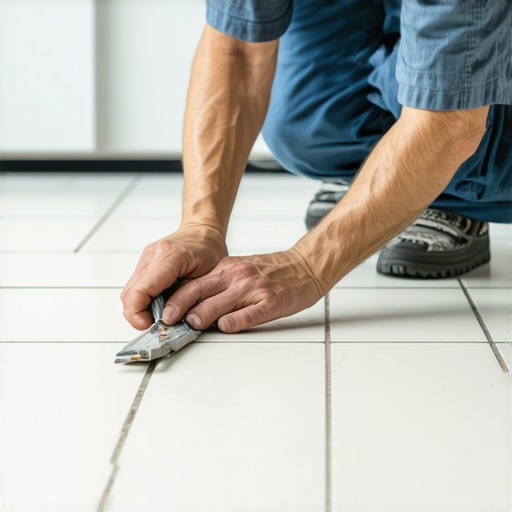
Most guys skip the leveling compound. They think the underlayment will hide the dip. It won’t. I spent three days grinding concrete on a job last month just so the floor wouldn’t click like a castanet. That job was supposed to be a simple installation, but the slab looked like the rolling hills of Kentucky. If you think you can just hide a bad subfloor with a thick pad, you are asking for a failure that costs five figures. Lippage is the same monster. It is a physical manifestation of laziness or a bad slab. I smell like WD-40 and oak dust most days, and I have seen enough stubbed toes to know that a 1/32 inch height difference is the difference between a professional finish and a lawsuit waiting to happen.
The physics of a stubbed toe
Tile lippage is the vertical displacement between the edges of adjacent tiles. It occurs when one edge sits higher than the next, usually caused by subfloor irregularities, improper trowel technique, or the natural warpage of large format tiles. Removing it without demolition requires mechanical grinding and a deep understanding of ceramic density. You are essentially re-engineering the surface level of the kiln-fired material to meet a uniform plane. This is not a task for the faint of heart or those who fear a little dust. It requires a precise approach to the molecular structure of the glaze and the clay body beneath it. If you do not respect the hardness of the material, you will ruin the floor entirely.
The mechanical grind of stone and ceramic
Mechanical grinding uses diamond-impregnated pads to shave down the high edges of tile until they sit flush with the surrounding surface. This process is most successful with natural stone like marble or travertine, but it can be applied to certain through-body porcelain tiles if the installer understands the risks of exposing the underlying biscuit. You start with a coarse grit, perhaps a 50-grit metal bond diamond, and work your way up to a 3000-grit resin bond for a mirror finish. The heat generated during this process can cause thermal shock, so a wet grinding system is often preferred to keep the tile stable. You are fighting against the Mohs hardness scale. Granite sits near a seven, while your diamond pads are a ten. It is a battle of attrition where the machine must win without cracking the tile or melting the grout.
“A floor is only as good as the subfloor beneath it; deflection is the enemy of every joint.” – Master Flooring Axiom
The 1/8 inch that ruins everything
The 1/8 inch expansion gap and the 1/32 inch lippage tolerance are the gold standards of a flat floor. When you exceed these, the structural integrity of the installation is compromised because the edges are exposed to lateral impact. In high-traffic areas like showers with a style or busy kitchens, these edges catch the soles of shoes and the wheels of carts. This chipping is irreversible once the glaze is compromised. By grinding the lippage, you are removing the point of impact. You must follow the TCNA Handbook guidelines which state that for grout joints less than 1/4 inch, the allowable lippage is only 1/32 inch. Anything more is a defect, not a character trait of the tile.
| Tile Material | Janka or Mohs Scale | Grinding Difficulty | Finish Potential |
|---|---|---|---|
| Travertine | 3-4 Mohs | Low | High Gloss |
| Marble | 3-5 Mohs | Medium | High Gloss |
| Porcelain | 7-9 Mohs | Extreme | Factory Satin |
| Granite | 6-7 Mohs | High | Mirror Finish |
The chemistry in the grout lines
Grout acts as a cushion and a buffer between tiles, but it is often the first casualty of lippage removal. Before you start grinding, you often have to remove the existing grout to prevent the diamond pads from gumming up with cementitious material. Once the floor is leveled, you will need to look into grout restoration secrets for long-lasting results to ensure the new joints are structurally sound. The interaction between the new grout and the freshly ground tile edge is critical. If the edge is too sharp, the grout will pop out. You need a slight micro-bevel to hold the material in place. This is where most DIY attempts fail. They leave a razor-edge on the tile that chips the moment someone walks on it in heavy boots.
The ghost in the expansion gap
Expansion gaps are often ignored by installers who want to jam tile tight against the wall. When the house settles or the humidity shifts, those tiles have nowhere to go but up. This creates