
I spent three days grinding concrete on a job last month just so the floor wouldn’t click like a castanet. That is the level of obsession required for a professional finish. Most installers think the finishing touch is just a quick squeeze of a caulk gun. They are wrong. When you are dealing with high-end showers and custom tile, the transition is the failure point. I have seen thousand-dollar vanities ruined because someone used cheap latex caulk where they needed 100 percent RTV silicone. I have seen baseboards rot because the seal at the floor was more of a suggestion than a barrier. This is the reality of the trade. If you do not respect the chemistry of the sealant, the physics of the expansion joint will humble you. This guide is about the surgical precision of the painters tape method, a technique that separates the weekend warriors from the masters of the craft.
The hidden chemistry of flexible joints
Silicone sealants function as high-performance gaskets that accommodate structural movement through elastic elongation and recovery properties. Unlike rigid grout, silicone maintains a waterproof bond during the thermal expansion of substrate materials. Selecting the right chemical composition, such as acetoxy or neutral cure, determines the long-term adhesion to tile and porcelain surfaces in wet environments like showers. I have walked into jobs where the grout was cracking at the corners. That is a rookie mistake. You never put grout in a change of plane. You need a movement joint. A movement joint is a gap filled with a flexible material that can stretch. If you use a rigid filler, the house will move, the filler will crack, and water will find its way into your subfloor. This is how mold starts. This is how subfloors die. You can learn more about keeping things clean in our guide on tile cleaning tips for a sparkling bathroom in 2025.
“A floor is only as good as the subfloor beneath it; deflection is the enemy of every joint.” – Master Flooring Axiom
Why your finger is the worst tool for the job
Using a bare finger to tool silicone introduces skin oils and bacteria into the sealant which degrades the chemical bond and promotes premature mold growth. Professional installers use specialized plastic profiles or the tape method to ensure a consistent contact angle and a uniform depth of the bead. Saliva, often used by amateurs, contains enzymes that can break down the fungicides in the silicone over time. When you use your finger, you are also forcing the silicone too thin at the edges. This creates a feathered edge. A feathered edge is a weak point. It will eventually peel up like a sunburn. You want a clean, defined shoulder on your silicone bead. This requires mechanical tooling or the precise application of tape to define the boundary of the sealant.
The preparation of the substrate for maximum surface energy
Proper surface preparation requires the removal of all mechanical contaminants and the use of high-purity isopropyl alcohol to increase the surface energy of the tile. Silicone requires a clean, dry, and dust-free environment to achieve a primary chemical bond with the substrate. Any residual soap scum or grout dust will act as a bond-breaker, leading to adhesive failure within months. I smell the sharp tang of denatured alcohol every time I prep a shower. It is the smell of a job done right. If you are working on showers that wow, you cannot skip this. You wipe it down until the rag comes back white. If there is even a hint of gray on that cloth, you are not done. The surface must be chemically clean so the silane coupling agents in the silicone can do their work at a molecular level.
The blue tape protocol for surgical precision
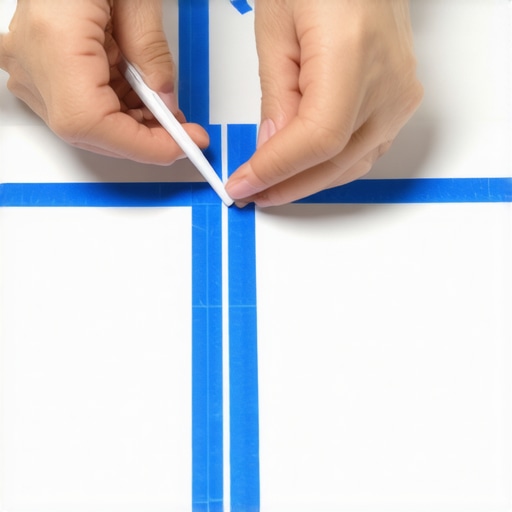
The painters tape method involves applying two parallel strips of low-tack masking tape exactly 1/8 inch from the corner to define the bead width. This technique allows for a heavy application of silicone that is then tooled flat, with the excess being removed entirely when the tape is pulled. The result is a crisp, professional line that looks like it was factory-installed. You need to use a high-quality tape like 3M Blue or FrogTape. Cheap beige masking tape has a gummy adhesive that can leave a residue. You lay the first strip on the baseboards and the second strip on the floor tile. Leave exactly the gap you want the bead to be. Usually, 1/4 inch total is the sweet spot for a standard transition.
Managing transitions between tile and baseboards
Applying silicone at the junction of baseboards and tile floors prevents moisture from wicking into the wood trim and causing swelling or finish failure. This joint is subject to significant movement as the house settles and the seasons change, making a high-quality flexible sealant the only viable option for long-term durability. If you are looking for baseboards makeover ideas, remember that the bottom seal is the most important part. I have seen beautiful oak baseboards turned to mush because a mop bucket was spilled and the water sat in a gap that should have been sealed. The tape trick works wonders here. It keeps the silicone off your expensive paint job and off your textured tile.
| Material Type | Recommended Sealant | Cure Time | Movement Capacity |
|---|---|---|---|
| Ceramic Tile | 100% Silicone RTV | 24 Hours | +/- 25% |
| Natural Stone | Non-Staining Silicone | 48 Hours | +/- 20% |
| Wood Baseboards | Siliconized Acrylic | 12 Hours | +/- 12% |
| Glass Tile | Translucent Silicone | 24 Hours | +/- 25% |
The chemistry of the perfect bead
Acetoxy cure silicones release acetic acid during the vulcanization process and provide superior adhesion to non-porous surfaces like glass and glazed tile. Neutral cure silicones are better suited for stone and masonry as they do not react with the minerals in the substrate or cause staining on sensitive materials. You have to know what you are holding in your hand. If it smells like vinegar, it is acetoxy. Do not use that on marble. It will etch the stone and leave a mark you cannot get out. For a high-end bathroom with trendy ideas for small bathrooms, you likely have a mix of materials. Use a neutral cure silicone if you are in doubt. It is safer for the variety of finishes we see in modern construction.
“Silicone must achieve a two-point bond to allow for elongation; three-point adhesion is the recipe for a torn joint.” – Master Flooring Axiom
The contrarian truth about sealant thickness
Most people think a thicker bead of silicone is stronger. That is a myth. A bead that is too thick cannot stretch effectively. If the silicone is bonded to three sides of a joint, it will tear down the middle when the house moves. You want a thin, flexible bridge. This is why we use backer rod in deep gaps. The backer rod prevents the silicone from sticking to the bottom of the joint, forcing it to only stick to the two sides. This allows the material to act like a rubber band. If it is stuck on three sides, it is locked. It will snap. Precision is not just about looks. It is about the physics of the material.
- Vacuum the joint to remove every grain of sand or dust.
- Wipe the area with 99 percent isopropyl alcohol and let it flash off.
- Apply your tape lines with firm pressure to prevent bleeding.
- Cut the caulk tube nozzle at a 45 degree angle to the width of the gap.
- Apply a continuous bead with steady pressure.
- Tool the bead immediately with a plastic spreader or a gloved finger.
- Pull the tape while the silicone is still wet, pulling away from the joint.
The final word on durable joints
The painters tape trick is not just a shortcut for people who cannot draw a straight line. It is a technical protocol that ensures the correct volume of material is placed in the joint without contaminating the surrounding surfaces. It creates a mechanical edge that is far superior to a hand-tooled feathered edge. When you pull that tape and see that perfect, crisp line, you know the job is done right. Your showers will stay waterproof. Your tile will look integrated. Your baseboards will stay dry. Do not settle for builder-grade shortcuts. Take the time to tape it off. Your floors depend on it.