
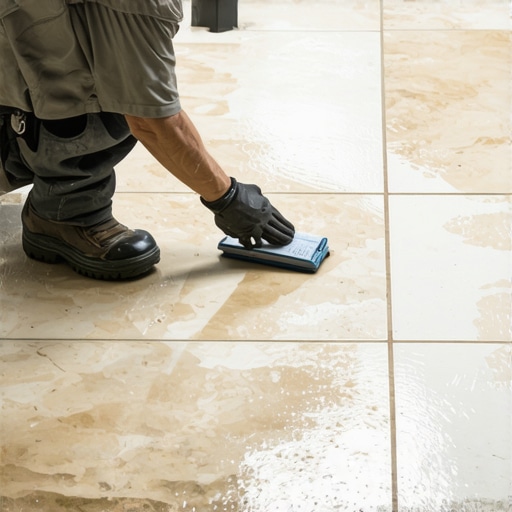
I smell like stone dust and knee pad sweat. After twenty five years of crawling across slabs, I can tell you that travertine is a liar. It looks solid, but it is actually a network of tiny tunnels and prehistoric air pockets. Most guys skip the leveling compound. They think the underlayment will hide the dip. It won’t. I spent three days grinding concrete on a job last month just so the travertine wouldn’t crack like a castanet under the weight of a stone vanity. When you put travertine in a shower, you are basically inviting water to live inside your walls. If you do not seal it with a chemical barrier that understands the physics of capillary action, that water will rot your framing and turn your grout into mush. This is not about aesthetics. This is about preventing a structural failure that will cost fifteen thousand dollars to fix in three years.
The structural reality of porous stone
Travertine tiles are sedimentary rocks formed in hot springs and they contain natural voids known as vugs. To seal them correctly in wet environments like showers or steam rooms, you must use a high grade penetrating sealer that fills these microscopic pores. Surface sealers will fail because they cannot bond to the calcium carbonate structure when moisture is pushing from behind the stone. You need a solvent based or high solids water based impregnator that moves into the stone through molecular attraction. If you leave these voids open, the water will sit. Standing water leads to efflorescence, which is that white crusty salt that ruins a good installation. You can learn more about keeping your bathroom looking right at tile cleaning tips for a sparkling bathroom in 2025 where we discuss the daily maintenance required for these surfaces.
“A floor is only as good as the subfloor beneath it; deflection is the enemy of every joint.” – Master Flooring Axiom
The ghost in the expansion gap
Expansion gaps are the most overlooked part of a stone installation in a wet environment. Travertine expands and contracts with thermal changes in the shower water. If you butt the stone tight against the wall without a gap, the stone will heave or the grout will crumble. I always leave a quarter inch at the perimeter and fill it with a 100 percent silicone caulk that matches the grout color. Never use hard grout in the change of plane. It will crack. The physics of movement demand flexibility. This is especially true when you are working with showers that wow modern designs for 2025 because those designs often feature large format tiles that put more stress on the bond coat. If the subfloor has even a sixteenth of an inch of deflection, your travertine is going to snap. It has zero tensile strength.
The microscopic world of penetrating sealers
Sealers work through the principle of surface tension by altering the energy of the stone surface so it repels water. A high quality penetrating sealer contains silanes or siloxanes that react with the minerals in the travertine. This creates a hydrophobic barrier deep within the stone. You are not painting a layer on top. You are changing the chemistry of the stone itself. In a wet environment, you must apply the sealer in multiple thin coats until the stone refuses to soak up any more. If the sealer is pooling on the surface, you have reached saturation. Wipe it off immediately. If you let it dry on the surface, it will leave a hazy residue that is a nightmare to remove. This process is similar to how we protect other surfaces, as seen in grout restoration secrets for long lasting results. The goal is always the same. Keep the water out of the substrate.
| Stone Property | Honed Travertine | Tumbled Travertine | Polished Travertine |
|---|---|---|---|
| Porosity Level | High | Very High | Moderate |
| Sealer Required | Penetrating | Deep Penetrating | Sub-Surface |
| Slip Resistance | High | Maximum | Low |
| Maintenance | Moderate | High | Moderate |
Why your subfloor is lying to you
Concrete slabs and plywood subfloors hold moisture that you cannot see with the naked eye. If you seal the top of the travertine before the moisture in the thin set and the slab has evaporated, you are trapping a vapor cloud under the stone. This causes the stone to darken and can lead to the bond failing. I use a moisture meter on every job. If the slab is over four percent, I wait. Most homeowners are in a rush. I tell them that I can do it fast or I can do it once. You have to understand that travertine is a sponge. If the bottom of the sponge is wet and you plastic wrap the top, that water has nowhere to go. It will eventually push the sealer off the stone from the inside out. This is why we pay so much attention to the details in showers with a style trendy ideas for small bathrooms where every inch of moisture management matters.
The step by step stone preservation checklist
Sealing travertine requires a clinical approach to ensure the chemical bond is permanent and effective against high humidity. Follow these steps for a professional finish.
- Clean the stone with a pH neutral cleaner to remove any grout film or dust.
- Allow the stone and grout to dry for at least forty eight hours.
- Apply the first coat of penetrating sealer using a lint free applicator.
- Wait fifteen minutes for the stone to absorb the liquid.
- Wipe away any excess sealer that has not been absorbed.
- Apply a second coat after two hours for maximum protection.
- Test the seal with a few drops of water after twenty four hours.
The 1/8 inch that ruins everything
Thin set coverage must be 95 percent or higher in a wet environment. If you have voids in the mortar behind the travertine, water will collect in those pockets. This is called a water dam. Over time, that water will grow mold and the minerals in the water will stain the stone from the back. I always back butter every single piece of travertine. It is a pain in the back. It takes twice as long. But it ensures that there is no air behind the stone. If you are also installing baseboards makeover ideas to elevate your space near a tiled area, make sure the transition is sealed perfectly. Water travels. It will find a way to the wood if you let it. I have seen water travel six feet behind a baseboard because the shower threshold wasn’t waterproofed correctly.
“In wet area installations, the transition between materials is where 90 percent of failures occur; waterproofing is not an option, it is the law.” – TCNA Handbook 2024
Maintaining the calcium carbonate bond
Never use acidic cleaners on travertine because they will eat the stone. Anything with lemon or vinegar is an acid. Travertine is a base. When the two meet, they react and the stone etches. This creates a dull spot that no sealer can fix. Use only products designed for natural stone. If you treat the stone right, it will last for a century. If you treat it like ceramic tile, it will look like junk in six months. This applies to everything in the room, including the chic baseboard designs that transform rooms in 2025 that often sit adjacent to these stone floors. Proper care keeps the whole system integrated. If you want a floor that performs, you have to respect the chemistry of the materials. It will buckle if you ignore the rules of expansion and sealing. Stick to the standards. Don’t cut corners. Your floor depends on it.