
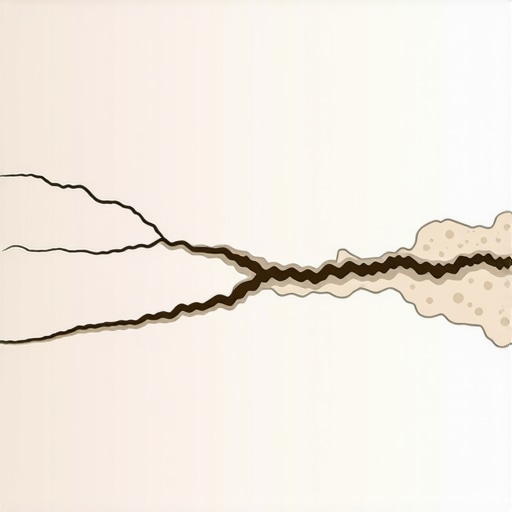
The microscopic breach that kills bathrooms
I smell like WD-40 and oak dust because I spent ten hours today grinding a concrete slab that was supposed to be flat. It was not. Most guys skip the leveling compound. They think the underlayment will hide the dip. It won’t. I spent three days grinding concrete on a job last month just so the floor wouldn’t click like a castanet. That same level of neglect is what leads people to ignore a tiny, hair-thin line in their shower tile. You look at it and see an aesthetic nuisance. I look at it and see a structural engineering failure waiting to bankrupt your bank account. A shower is a pressurized environment. When you turn on that water, you are creating a localized weather system. That hairline crack is an invitation for hydrostatic pressure to push moisture where it does not belong. It is the beginning of the end for your subfloor. We are not talking about a cosmetic issue here. We are talking about the physics of water and the chemistry of rot.
Why a hairline crack is a structural alarm
A hairline crack in a shower pan indicates that the waterproofing membrane or the mortar bed has experienced structural deflection or thermal expansion beyond its limit. This microscopic opening allows capillary action to pull water into the subfloor assembly, leading to mold growth and dry rot. If you ignore it, you are effectively letting a slow-motion flood destroy your home from the inside out. Water is a patient destroyer. It does not need a gaping hole. It needs a path. A crack the width of a human hair is more than enough for a water molecule to begin its journey through the grout and into the plywood or cement board below.
“A floor is only as good as the subfloor beneath it; deflection is the enemy of every joint.” – Master Flooring Axiom
The physics of capillary suction
Water has high surface tension. In a confined space like a crack in a shower floor, it exhibits capillary action. This is the same force that pulls water up the roots of a tree. It defies gravity. When you step on a cracked tile, you are creating a pump. Your body weight flexes the floor, opening the crack slightly and sucking water in. When you step off, the crack closes, trapping that moisture. It cannot evaporate. It stays there, saturating the thin-set and eventually reaching the wood framing. Over months, this moisture level stays at a constant high, creating the perfect nursery for fungal spores. These spores do not just eat the wood; they release mycotoxins into your air supply. You are not just looking at a floor repair. You are looking at a health hazard.
The ghost in the expansion gap
The expansion gap around the perimeter of a shower floor is often the first place where waterproofing fails because of differential movement. When installers tight-set tile against a wall without a soft joint of 100% silicone sealant, the stress of seasonal temperature changes forces the weakest point to snap. This is often the shower pan. Most homeowners do not realize that their house is breathing. It expands in the humid summer and shrinks in the dry winter. If your tile is locked in place with rigid grout at the corners, it has nowhere to go. It will buckle. It will crack. And then the water will find the gap. If you want to see how to avoid these mistakes in your design, check out showers that wow modern designs for 2025 for inspiration on proper assembly.
The chemistry of modified thin-set
We need to talk about what is holding your tiles down. Modern thin-set is not just mud. It is a polymer-modified adhesive engineered to provide a mechanical and chemical bond. However, these adhesives are often water-resistant, not waterproof. There is a massive difference. Water-resistant means it can handle getting wet. Waterproof means it acts as a barrier. When water sits in a crack, it begins to break down the polymer chains in the thin-set. This process is called hydrolysis. The bond weakens. The tile becomes loose. Now, every time you shower, the tile shifts slightly, grinding against the neighboring tiles and widening that hairline crack. You have moved from a moisture problem to a mechanical failure. You need to understand grout restoration secrets for long-lasting results to keep these systems intact before they fail.
The 1/8 inch that ruins everything
A deviation of 1/8 inch over a ten-foot span might seem insignificant to a layman, but in shower pan construction, it determines proper drainage and structural integrity. If the pre-slope is not perfectly executed, standing water will aggregate in low spots, putting constant hydrostatic pressure on the tile grout and waterproofing layers. This pressure is what forces water through hairline cracks that would otherwise remain dry. I have seen guys try to level a floor with extra thin-set. That is a crime. Thin-set is meant for bonding, not for build-up. When you use it to fill a dip, it shrinks as it cures. This shrinkage creates internal tension that snaps the tile above it. That is where your hairline crack comes from. It did not just happen. It was built into the floor the day it was installed.
| Waterproofing Component | Typical Failure Point | Time to Failure | Repair Difficulty |
|---|---|---|---|
| Liquid Membrane | Inadequate thickness/Pinholes | 2 to 5 years | High |
| Sheet Membrane | Poorly sealed seams | 5 to 10 years | Moderate |
| Traditional Mud Bed | Lack of pre-slope/Clogged weep holes | 10 to 15 years | Extreme |
| Cement Board | Fastener penetration without sealant | 1 to 3 years | High |
The regional moisture protocol
If you are living in a high-humidity region like the Gulf Coast or Florida, your shower has to work twice as hard. The ambient humidity prevents the shower from ever truly drying out between uses. In these climates, a hairline crack is a death sentence. The vapor drive moves from the warm, humid bathroom toward the cooler, air-conditioned wall cavities. This carries moisture through the crack and deposits it directly onto the studs. I have torn out showers in Houston where the 2x4s were so soft you could stick a screwdriver through them like butter. The homeowner thought they just had a dirty grout line. They actually had a house that was structurally compromised. If you find yourself in this situation, you might need to contact us for a professional evaluation before the floor collapses.
Why your subfloor is lying to you
The subfloor may look solid from the crawlspace, but wicking moisture often rots the plywood core while leaving the exterior veneer intact. By the time you see water stains on your basement ceiling or soft spots in the bathroom floor, the structural damage is already advanced. This is the great deception of modern building materials. Plywood is made of layers. The glue holding those layers together can fail before the wood itself looks rotten. This is called delamination. Once a subfloor delaminates, it loses all its shear strength. It starts to bounce. That bounce is what creates more cracks in your tile. It is a feedback loop of destruction. You fix a crack, the floor bounces, the crack returns. You cannot fix the surface until you fix the foundation.
- Inspect grout lines monthly for any darkening that indicates water retention.
- Check the junction between the floor and the wall for any separation of the sealant.
- Look for white, chalky powder on grout lines, which is efflorescence caused by migrating minerals.
- Ensure that your baseboards are not showing signs of swelling at the bottom edges.
- Test the floor for any movement or clicking sounds when stepped on.
“Waterproofing is not a single product; it is a system of overlapping defenses where the smallest gap constitutes a total failure.” – TCNA Handbook Principle
The hidden cost of aesthetics over engineering
People spend thousands on Italian marble but complain about the cost of a high-quality drain assembly or a bonded waterproof membrane. This is backwards. The tile is just the skin. The subfloor and waterproofing are the skeleton and the circulatory system. If you ignore a crack because you do not want to ruin the look of your expensive stone, you are making a massive financial mistake. A repair caught early might cost a few hundred dollars. A full subfloor replacement and mold remediation can easily hit five figures. You need to know how to refresh grout without replacing it if the damage is only on the surface, but you must be certain the moisture has not penetrated the pan.
The final verdict on shower integrity
The reality is simple. A hairline crack is never just a crack. It is a symptom of movement or a precursor to rot. In my twenty-five years of experience, I have never seen a shower crack get better on its own. It only gets wider, deeper, and more expensive. If you see a line, no matter how thin, it is time to act. You need to verify the integrity of the pan. You need to check the moisture levels with a professional meter. Do not let a 1/8 inch mistake turn into a total loss. Your floor is a performance surface. Treat it with the respect its engineering requires. Pay attention to the details, from the chic baseboard designs that transform rooms to the microscopic chemistry of your grout. The health of your home depends on it.