
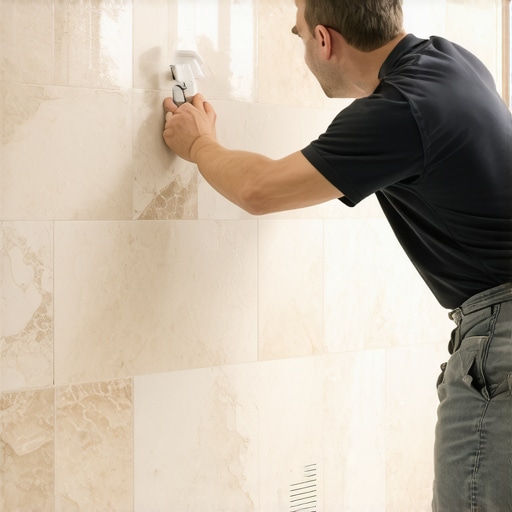
I have spent twenty-five years on my knees with a moisture meter and a grinder, scraping out the failures of people who thought stone was indestructible. My hands feel like eighty-grit sandpaper and the smell of WD-40 is basically my cologne at this point. I once walked into a luxury master bath in a high-rise where the homeowner had spent twenty thousand dollars on premium silver travertine. Six months later, the bottom three rows of tile were turning a sickly, swampy grey. The installer had skipped the sealing process, thinking the factory finish was enough. It was not. I spent three days grinding back the surface and drying out the substrate with industrial fans just to save the stone. Travertine is not a porcelain tile. It is a sedimentary rock formed by the rapid precipitation of calcium carbonate in hot springs. It is full of voids, pits, and microscopic capillaries that want nothing more than to drink your soapy shower water and rot from the inside out.
The silent betrayal of sedimentary rock
Travertine showers fail because installers treat them like ceramic instead of the porous geological specimens they actually are. To prevent water intrusion, you must understand that travertine is a collection of microscopic straws. These pores draw in moisture through capillary action, which then carries body oils and soap scum deep into the matrix of the stone. Once these contaminants are lodged inside, they become a breeding ground for bacteria that no surface cleaner can reach. A proper seal is not just a coating. It is a chemical modification of the stone surface that changes its surface tension, making it hydrophobic. This prevents the liquid from ever entering the pore structure in the first place. When you look at your shower walls, you should see water beading like a freshly waxed car. If the water flatly saturates the stone, your protection has already failed.
“A floor is only as good as the subfloor beneath it; deflection is the enemy of every joint.” – Master Flooring Axiom
Why your grout is a sponge in disguise
Grout is the weakest link in any shower assembly and acts as a primary highway for moisture to travel behind your stone panels. Most people think the tile is the waterproof layer. It is not. The grout between your travertine tiles is cementitious, meaning it is naturally permeable. When you are designing showers that wow, you have to account for the fact that every grout line is an open door. Sealing the travertine without sealing the grout is like locking your front door but leaving all the windows open. The sealant must be flooded into the grout joints until they cannot absorb any more liquid. This creates a monolithic shield across the entire wall surface. I have seen countless showers where the stone was fine, but the grout was so saturated that it started to crumble, allowing water to reach the backer board and eventually the wall studs.
The molecular dance of silane resins
Modern stone sealers utilize silane or siloxane resins to create an impregnating barrier that allows the stone to breathe while repelling liquid water. These molecules are engineered to be smaller than the pores of the travertine. When applied, they travel deep into the stone and bond with the calcium carbonate. This is an essential distinction. Topical sealers, which sit on top of the stone like a plastic film, are a death sentence for showers. They trap moisture behind the surface, leading to spalling and white, crusty efflorescence. An impregnator, however, leaves the pores open for vapor transmission. This means that if any moisture does get behind the stone, it can still evaporate out. You want a sealer with a high fluorochemical content because it provides the best resistance to both water-based and oil-based stains, which is vital in an environment where shampoo and conditioners are constantly present.
| Sealer Category | Molecular Anchor | Oil Resistance | Vapor Drive |
|---|---|---|---|
| Topical Acrylic | Surface Film | Moderate | Zero |
| Siloxane | Internal Pore | Low | High |
| Fluorochemical | Deep Matrix | Excellent | High |
Practical steps for a bulletproof seal
Success in sealing travertine depends entirely on the preparation of the stone surface and the elimination of all residual moisture. If you seal a damp stone, you are locking the water inside, which will eventually cause the stone to darken permanently or even crack. I never touch a sealer until my moisture meter reads below twelve percent across the entire wall. You also need to ensure that no soap film or hard water deposits are present. If you are working on an existing shower, you might need to look into grout restoration secrets before you even think about the sealer. Once the stone is clean and bone dry, you apply the sealer in a cross-hatch pattern, using a microfiber applicator. You must keep the surface wet with the product for at least five to ten minutes to allow for maximum absorption. After that, you must wipe away every single drop of excess. If the sealer dries on the surface, it will leave a sticky, white residue that is a nightmare to remove.
[IMAGE_PLACEHOLDER]
- Verify stone is clean and completely dry with a moisture meter.
- Remove all old caulking from corners and baseboard transitions.
- Apply the first coat of impregnator using a lint-free applicator.
- Keep the surface wet with the product for ten minutes.
- Wipe the tile completely dry with clean microfiber towels.
- Wait four hours and apply a second coat for maximum density.
- Test the seal with a few drops of water after twenty-four hours.
- Check the grout lines for any darkening that indicates a leak.
- Neutralize the pH of the stone after the final buffing.
- Avoid using the shower for at least forty-eight hours after sealing.
The maintenance lie that kills stone
The fastest way to destroy a professional seal is to use a generic bathroom cleaner or anything containing acid or bleach. Most homeowners reach for the blue spray under the sink, but that stuff is formulated to eat through soap scum, which means it will also eat through your sealer and etch the travertine. Travertine is chemically sensitive to anything acidic. Even a lemon-scented cleaner can leave a dull spot on the finish. You should only use pH-neutral cleaners specifically designed for natural stone. If you notice the water isn’t beading as well as it used to, don’t wait for the stone to turn grey. Clean it, dry it, and apply a maintenance coat. If the grout starts looking dingy, check out tile cleaning tips that focus on stone safety. You should also pay close attention to the chic baseboard designs or the bottom row of tiles where they meet the pan. This is where most water sits and where the seal fails first. If you keep the chemicals balanced and the moisture out, a travertine shower can last a lifetime, but it takes a mechanic’s eye to keep it that way.
“Cementitious grout is inherently permeable; without a hydrophobic barrier, it acts as a primary conduit for moisture migration into the substrate.” – Tile Protection Standards