
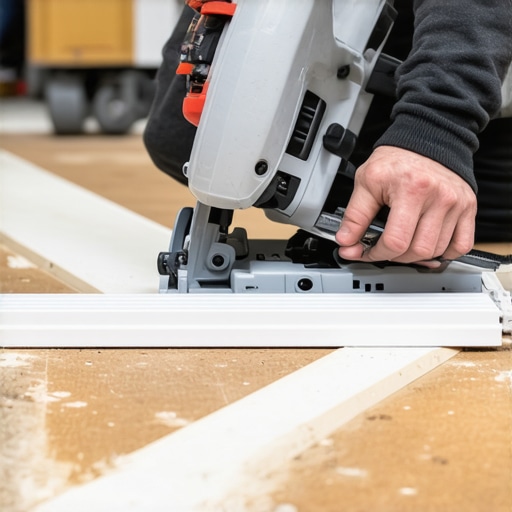
The nightmare of the uneven bathroom slab
Perfect miter cuts on PVC bathroom baseboards depend entirely on the levelness of the subfloor and the squareness of the wall. Most installers skip the leveling compound and think the underlayment or the baseboard will hide the dip. It will not, as the rigid nature of PVC highlights every shadow and gap. I once spent three days grinding concrete on a job last month just so the floor wouldn’t click like a castanet. The homeowner thought I was crazy, but that slab had a three-quarter inch dip across six feet. If I had installed the tile and the baseboards over that, the miters would have opened up within a week. Most guys are hacks. They use caulk to hide a quarter-inch gap because they were too lazy to use a straightedge. In a bathroom, where moisture is constant, that caulk eventually fails, turns black with mold, and the whole job looks like garbage. You have to start with the physics of the floor. If the floor isn’t flat, your 45-degree angle becomes a 46-degree nightmare. You cannot fight geometry with a hammer. You have to prepare the surface until it is dead flat, or you are just wasting high-quality materials on a low-quality foundation.
Why PVC wins the war against bathroom moisture
Cellular PVC baseboards are superior to wood or MDF in bathrooms because they are chemically inert and completely waterproof. Unlike wood, which absorbs airborne moisture from showers and expands, PVC maintains its structural integrity. This prevents the swelling that typically causes mitered corners to separate or rot over time. When you look at showers that wow, you often forget that the trim around them handles just as much humidity as the tile itself. Wood is a sponge. Even if it is painted, the end grain at the miter cut will suck up moisture. That leads to the paint peeling and the joint