
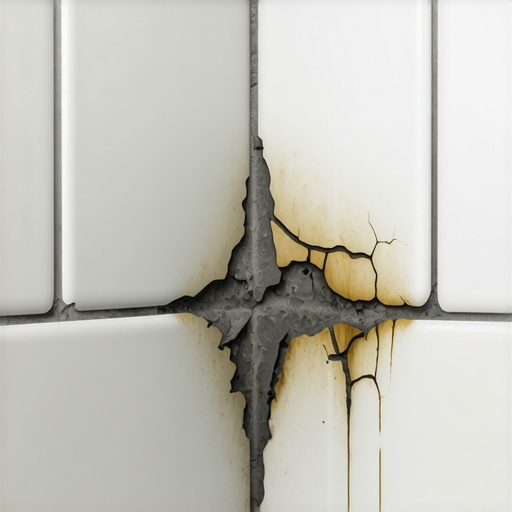
Most guys skip the leveling compound. They think the underlayment will hide the dip. It won’t. I spent three days grinding concrete on a job last month just so the floor wouldn’t click like a castanet. That same shortcut mentality is what kills steam showers. I have seen thousand dollar glass mosaics fall off the wall because some contractor used standard grout in a room that hits 115 degrees and 100 percent humidity. I have spent 25 years on my knees with a moisture meter and a level. I know when a floor is about to fail before the homeowner even moves in. Standard cementitious grout is a death sentence for a steam shower. It is not a matter of if it will fail, but how soon the mold will start growing behind your beautiful tile. We are talking about the physics of vapor drive and the chemistry of Portland cement. If you do not respect the science, the steam will win every single time.
The molecular betrayal of standard grout
Cementitious grout fails in steam showers because it is inherently porous and hydrophilic, meaning it absorbs water vapor. High temperatures and constant moisture cycles cause efflorescence, structural cracking, and binder degradation, leading to a total failure of the waterproofing assembly behind the tile. Standard grout is basically a hard sponge. When you turn on a steam generator, you are not just dealing with water. You are dealing with water in a gaseous state. These gas molecules are tiny. They move faster and penetrate deeper than liquid drops. They find every microscopic void in the grout matrix. Once inside, they expand and contract with the temperature. This movement creates micro fractures that you cannot see with the naked eye until it is too late. You might think you are safe because you used a sealer. Sealers are a temporary fix. They break down under the intense heat of a steam unit. Most sealers are designed for standard bathrooms, not the punishing environment of a residential spa.
Why steam is the enemy of Portland cement
Steam behaves differently than liquid water by entering the capillary pores of grout as a gas. Once inside, it condenses and creates internal hydrostatic pressure, which pushes against the tile bond. This process eventually leaches out the calcium hydroxide, leaving the grout brittle and crumbly. Portland cement is the binder in most grouts. It relies on a chemical reaction called hydration to stay strong. However, in a steam shower, that hydration process is essentially reversed or corrupted. The constant heat speeds up the leaching of the minerals that hold the sand together. This is why you see white crusty stuff on your grout lines. That is efflorescence. It is the literal guts of your grout being pulled to the surface by moisture. When those minerals leave, the grout becomes soft. You can scrape it out with a fingernail. If you are dealing with an old installation, you might need how to refresh grout without replacing it to see if it is salvageable, but usually, in a steam room, replacement is the only real answer.
“A floor is only as good as the subfloor beneath it; deflection is the enemy of every joint.” – Master Flooring Axiom
The vapor drive that ruins backer boards
Vapor drive is the force that moves moisture through porous materials from areas of high concentration to low concentration. In a steam shower, the pressure is so high that it pushes vapor through the grout, through the thin set, and into the wall cavity if you did not use a topical vapor barrier. I have seen guys use standard cement board with no liquid membrane. That board acts like a wick. It sucks up the moisture and holds it against the wooden studs. Within two years, those studs are rotting. You could have the most expensive tile in the world, but if the skeleton is rotting, the room is a loss. This is why the TCNA has such strict rules for steam rooms. You need a vapor perm rating of 0.5 or less. Standard grout has a perm rating that is off the charts. It allows everything through. You must think about the entire assembly. For modern inspiration on how these should look when done right, check out showers that wow modern designs for 2025.
The expansion gap that saves the shower
Thermal expansion is the physical growth of materials when they get hot, and in a steam shower, this growth is significant. Tile, thin set, and grout all expand at different rates. If you do not leave a soft joint at the corners and where the floor meets the wall, the floor will tent. I have walked into showers where the floor tile had literally popped up three inches because there was no room for it to move. You must use 100 percent silicone in the corners. Never use grout in a change of plane. Silicone is flexible. It can handle the expansion and contraction. Grout is rigid. When the tile expands and hits the grout, something has to give. Usually, it is the bond between the tile and the floor. This is a basic rule that many builders skip to save time. It is a mistake that costs thousands of dollars to fix. If your baseboards are also being affected by the moisture, you might want to look into chic baseboard designs that transform rooms in 2025 to find materials that handle humidity better.
| Grout Type | Vapor Permeability | Thermal Resistance | Typical Lifespan in Steam |
|---|---|---|---|
| Standard Cementitious | High | Poor | 1 to 3 Years |
| Polymer Modified | Medium | Moderate | 3 to 7 Years |
| Epoxy | Very Low | Excellent | 15+ Years |
Proper installation versus the easy way
The right way to build a steam shower involves a total water management system that includes a dedicated vapor barrier and high performance grout. You cannot just treat it like a regular shower. You need to use epoxy grout or a high quality pre mixed grout that is specifically rated for steam. These materials do not have the same capillary pores as cement. They are essentially plastic or resin based. They do not absorb the steam. This keeps the moisture on the surface of the tile where it can run down the drain. It also prevents mold from finding a home inside the grout. If you are struggling with keeping an existing shower clean, read up on tile cleaning tips for a sparkling bathroom in 2025. But remember, cleaning cannot fix a structural failure. If the grout is falling out, the shower is compromised.
- Use a topical waterproofing membrane with a perm rating below 0.5.
- Select a high performance epoxy grout to resist vapor penetration.
- Ensure 100 percent thin set coverage to eliminate air pockets.
- Install silicone soft joints at all changes of plane and corners.
- Allow the shower to cure for at least 14 to 28 days before the first use.
“In steam environments, the vapor drive can exceed the capacity of traditional porous materials.” – TCNA Handbook Technical Committee
The bottom line on steam room durability
Building a steam shower is a structural engineering challenge. You are creating a high pressure weather system inside a small room. If you use cheap materials like standard cement grout, you are inviting disaster. The heat will break down the chemical bonds. The moisture will rot the frame. The mold will make the air toxic. I have spent my life fixing these mistakes. Do it right the first time. Use epoxy. Use a vapor barrier. Respect the physics. If you need help with the finishing touches or choosing materials that last, you can always contact us for expert advice. For more maintenance help, see grout restoration secrets for long lasting results. Your floor is a performance surface. Treat it like one.