
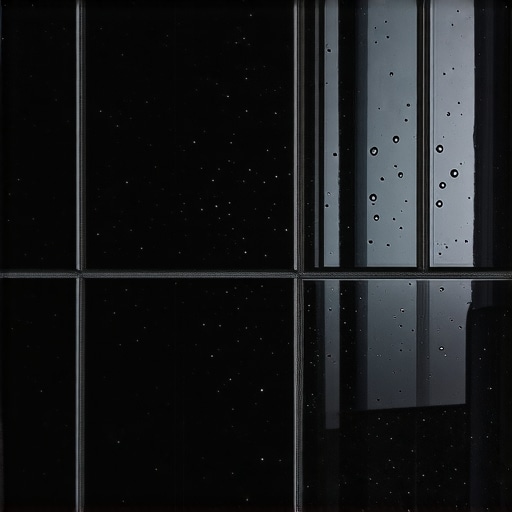
Why Matte Black Tiles Are a Nightmare for Hard Water Areas
I have spent twenty-five years standing behind this counter, smelling the sharp scent of floor wax and the metallic tang of fresh porcelain. I have seen every trend come and go, but the current obsession with matte black tiles makes my knees ache. Homeowners come into my shop with a magazine photo and a dream, ignoring the chemical reality of their own plumbing. They see a moody, sophisticated bathroom. I see a future of white crust, chemical etching, and a homeowner who will eventually hate the very floor they paid ten thousand dollars to install. Most guys at the big-box stores will sell you whatever looks pretty. I won’t. I spent three days grinding concrete on a job last month just so the floor wouldn’t click like a castanet, and I refuse to let you install a surface that is fundamentally incompatible with your environment. If your water comes from a limestone-rich aquifer, matte black is not a design choice, it is a life sentence of scrubbing.
The chemical trap of the dark surface
Matte black tiles fail in hard water areas because of the high concentration of calcium and magnesium ions that precipitate as white calcite when water evaporates from the surface. This is not a matter of cleanliness, but of chemistry. In regions like Phoenix or the limestone corridors of the Midwest, the grains per gallon (GPG) of water can exceed 15 or 20. When a droplet of this water sits on a matte surface, the H2O molecules transition into the gas phase, leaving behind a crystalline structure of calcium carbonate. On a white or beige tile, this residue is invisible. On a matte black surface, the refractive index of the white minerals creates a stark, chalky contrast that is impossible to hide. The minerals do not just sit on top. They bond. The microscopic peaks and valleys of a matte finish provide a massive surface area for these ions to latch onto, creating a mechanical bond that resists basic wiping. You are not just looking at a dirty floor. You are looking at a geological formation growing in your shower.
“The bonding of mineral salts to a ceramic surface is accelerated by the absence of a glass-phase glaze, which typically provides a smoother interface for water shedding.” – Master Flooring Axiom
Why evaporation is the enemy of matte finish
Evaporation rates in modern bathrooms are accelerated by radiant heat and ventilation, which leaves mineral deposits behind before they can be wiped away. When you have a dark, heat-absorbent surface like matte black porcelain, the surface temperature often remains higher than the surrounding air. This heat fuels the evaporation of water. In a standard shower, the water does not just roll off the wall. It clings to the texture of the tile. As the water vanishes, the mineral concentration reaches a tipping point where it can no longer stay in solution. It solidifies. This is why you see those white rings or ‘ghosting’ effects. If you are planning showers that wow, you must account for the fact that black absorbs nearly all visible light. Any disruption in that absorption, like a white mineral flake, is magnified a thousand times. It is the same reason a black car looks filthy five minutes after a car wash. The physics are identical, but with tile, the ‘dirt’ is a rock-hard mineral deposit. You will find yourself searching for tile cleaning tips for a sparkling bathroom in 2025 before the grout is even fully cured.
The microscopic reality of mineral bonding
The surface of a matte tile is characterized by a high coefficient of friction and a lack of liquid-glass sealant, making it a porous magnet for hard water ions. Unlike polished porcelain, which undergoes a vitrification process that closes off most pores, matte finishes are left open to achieve that flat, non-reflective look. At a molecular level, the surface is a mountain range of jagged edges. When hard water hits these mountains, the surface tension of the water is broken, and the minerals are driven into the crevasses. This is why you cannot just ‘wipe’ a matte black floor. You are trying to pull minerals out of microscopic holes. Over time, these minerals build up, layer by layer, until the black tile begins to look like a dusty charcoal gray. If you try to use acidic cleaners to melt the calcium, you risk etching the tile itself or damaging the grout. The grout will inevitably show the same wear, leading to a need for grout restoration secrets for long lasting results. I have seen people try to hide the mess with oils or waxes, but that just creates a sticky trap for hair and skin cells. It is a losing battle.
How to save a failing installation
Saving a matte black installation in a hard water zone requires a whole-home water softening system and the immediate application of a high-grade penetrating sealer. You cannot treat this like a normal floor. You have to be proactive. First, you must test your water. If you are above 7 Grains Per Gallon, you are in the danger zone. A water softener replaces the calcium and magnesium with sodium ions, which are much more soluble and less likely to form hard white crusts. Second, you must seal the tile. Even though it is porcelain, a penetrating sealer will fill those microscopic voids I mentioned earlier. This prevents the minerals from getting a mechanical grip on the tile. Third, you must change your behavior. Every time that shower is used, it must be squeegeed. No exceptions. If water is allowed to air-dry on matte black, the mineral ghost will return. This is the price of the aesthetic. Even your baseboards makeover ideas to elevate your space will be overshadowed by a floor that looks like it is covered in flour. Maintenance is not a suggestion. It is a requirement for survival.
“Water quality must be evaluated alongside tile porosity to ensure long-term aesthetic performance in residential environments.” – TCNA Handbook Adaptation
The truth about black tile maintenance
Maintenance of dark matte surfaces is a perpetual cycle of pH-balanced cleaning and mechanical agitation that most homeowners are unprepared to perform. Most people reach for the vinegar. Do not do that. While vinegar melts calcium, its acidity can be detrimental to certain grout pigments and tile finishes over time. You need a dedicated sequestering agent that can lift the minerals without eating the floor. I tell my customers that if they want the black look without the nightmare, they should look at high-gloss dark finishes or, better yet, a variegated dark gray that mimics stone. The ‘solid’ matte black look is the most unforgiving surface in the industry. I have seen beautiful showers with a style ruined in under a year because the owner didn’t want to spend twenty minutes a day cleaning. If you are already struggling with your current floor, you might need to learn how to refresh grout without replacing it to at least keep the lines looking clean while the tile fades. It is about managing expectations.
| Attribute | Matte Porcelain | Polished Porcelain | Natural Black Basalt |
|---|---|---|---|
| Surface Porosity | Medium | Low | High |
| Mineral Adhesion | High | Low | Extremely High |
| Refractive Index | 1.1 to 1.3 | 1.8 to 2.2 | 1.0 to 1.2 |
| Maintenance Level | Heavy | Moderate | Professional Only |
The 1/8 inch that ruins everything
Precision in the expansion gap and grout joints is non-negotiable because any movement in a dark tile floor makes mineral deposits and cracks significantly more visible. When you install these tiles, you cannot skip the perimeter expansion gaps. If the floor shifts even a fraction of an inch and the tile hits the wall, the tension will cause micro-fractures. In a black tile, those fractures catch white dust and hard water, turning a tiny crack into a glowing white line. You should consider chic baseboard designs that transform rooms in 2025 to hide those essential gaps, but make sure the installer doesn’t caulk the floor to the baseboard with a rigid material. Use a color-matched 100 percent silicone. It stays flexible. It won’t crack. It won’t let the water sit in the gap and breed mold. If you are doing eco-friendly tile solutions for sustainable homes in 2025, look for recycled-content porcelain that has a slight texture or ‘movement’ in the color. Pure, solid matte black is a trap for the unwary. I have seen it a thousand times. A customer buys the tile against my advice, and six months later, they are back in here asking for a miracle. There are no miracles in my shop, only good advice that you should have taken the first time.
- Test your water hardness with a GPG kit before selecting tile.
- Choose a tile with a Mohs hardness of 7 or higher to prevent scratches.
- Apply a high-quality penetrating sealer before the first use.
- Install a whole-home water softener to remove calcium ions.
- Use a squeegee after every shower to prevent evaporation spots.
- Avoid acidic cleaners that can etch the tile surface.
- Maintain flexible expansion gaps at the perimeter.
If you want a floor that lasts, stop looking at the pictures and start looking at your water. Hard water is a grinding wheel that wears down the beauty of your home. Matte black tile is just the fastest way to see it happen. You can have a beautiful home, or you can have a low-maintenance home, but with matte black in a hard water area, you will have neither unless you are prepared to work for it every single day. That is the blunt truth from a man who has seen too many good floors go to waste. If you have questions about your specific installation or need to find a better material, you can always contact us or read our privacy policy for more information on how we handle your data. Just do not say I didn’t warn you about the white ghost of calcium carbonate.