
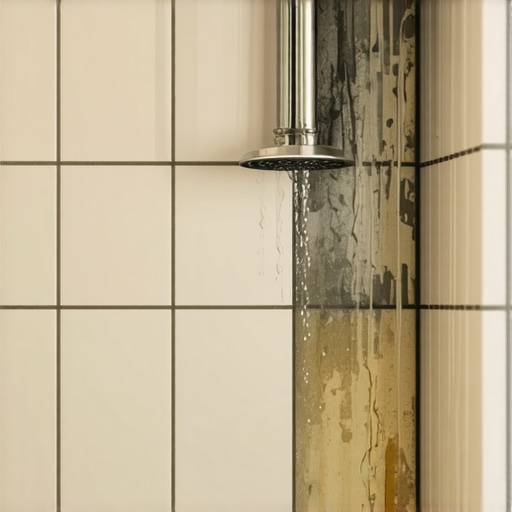
The slow death of a bathroom wall
Standard drywall is a gypsum-based product encased in paper that lacks the structural integrity to withstand constant moisture exposure. In a shower environment, water vapor penetrates grout and tile, leading to paper degradation, mold growth, and eventually a total structural collapse of the tile bond. I spent three days grinding concrete on a job last month just so the floor wouldn’t click like a castanet, and that experience reminded me of the absolute disaster I saw in a master bath last summer. The homeowner had used standard drywall behind a beautiful marble mosaic. Within eighteen months, the weight of the stone had pulled the paper right off the gypsum core because the moisture from the daily steam had turned the wall into a soggy sponge. Most guys skip the leveling compound and the proper backer boards because they think the underlayment or the tile will hide the dip. It won’t, and it certainly won’t stop the rot. When we talk about showers with a style that actually lasts, we are talking about engineering, not just aesthetics.
The physics of a saturated core
Gypsum is naturally a desiccant, meaning it actively seeks to absorb moisture from the surrounding environment. When encapsulated in a shower wall, the gypsum core of standard drywall loses its crystalline structure as water molecules break the bonds between the calcium sulfate dihydrate. This is the molecular reality that most weekend warriors ignore. They see a flat surface and think it is a perfect canvas for thin-set. However, the chemistry of the bond is where the failure begins. Modified thin-set requires a stable, non-shifting substrate to cure correctly. When the paper facing of the drywall gets damp, it detaches from the gypsum. Now, your entire tile assembly is hanging by a thread, or rather, a wet sheet of paper. This is why you see tile lines sagging or grout cracking near the base. It is the result of the wall literally melting behind the finish. If you are looking at showers that wow in a magazine, you aren’t seeing the cement board or the liquid membrane behind them, but I guarantee you those installers didn’t touch a sheet of white drywall.
“A floor is only as good as the subfloor beneath it; deflection is the enemy of every joint.” – Master Flooring Axiom
The myth of waterproof grout and tile
Grout is a cementitious product that is inherently porous, allowing liquid water and vapor to migrate through the joints and reach the substrate. Even porcelain tile, which has a very low absorption rate, cannot prevent water from finding its way into the wall cavity through microscopic fissures. People often think that once they apply a sealer, their shower is a submarine. It is not. Sealers are vapor-permeable. They slow down the absorption, but they do not stop it. Over time, the moisture accumulates. If that moisture hits standard drywall, it has nowhere to go. It sits against the paper, which is an organic food source for mold. You end up with a biological factory behind your tile. This is why grout restoration secrets often involve more than just cleaning. Sometimes, the grout is failing because the wall behind it is moving. You can scrub all you want, but you cannot fix a structural failure with a toothbrush and bleach.
| Substrate Type | Permeability Rating | Structural Integrity in Wet Zones | Recommended Use |
|---|---|---|---|
| Standard Drywall | High | Zero | Dry Living Areas Only |
| Greenboard (MR Drywall) | Moderate | Low | Kitchen Walls (Not Showers) |
| Cement Backer Board | Low | High | All Wet Areas |
| Extruded Polystyrene (XPS) | Zero (Waterproof) | Extreme | Steam Showers and Luxury Baths |
The capillary effect and secondary drainage
Water moves through gravity and capillary action, pulling itself into tight spaces behind the tile and hanging there due to surface tension. Without a proper waterproofing membrane over a stable substrate, this water creates a permanent state of dampness that destroys organic materials like drywall paper. I have seen hacks try to use greenboard, thinking the waxy coating will save them. It is a lie. Greenboard is only moisture-resistant, not waterproof. It is meant for high humidity, like a laundry room, not direct water spray. When you are installing tile cleaning tips won’t help when the tile starts falling off the wall. You need a substrate that doesn’t care if it gets wet. Cement boards like HardieBacker or WonderBoard are the baseline, but even those need a liquid-applied membrane like RedGard or a sheet membrane like Kerdi to be truly waterproof. The goal is to keep the water as close to the surface as possible so it can drain back into the pan and out the weep holes in the drain.
Why your subfloor is lying to you
The subfloor and the wall substrate must act as a single, rigid unit to prevent the cracking of tile and the intrusion of water into the framing. If the wall is soft, the floor-to-wall transition will always leak. This is the area where most bathrooms fail. The joint where the wall meets the floor is subject to the most movement. If you have used drywall, the bottom edge of that drywall will sit in any water that manages to get behind the cove base or the first row of tile. It will wick that water up the wall. This is why I always check the levelness of the floor before I even think about the walls. If the floor is out of whack, the walls will be too. I’ve spent days grinding concrete just to get a flat start. You cannot build a house of cards on a swamp, and you cannot build a tile shower on drywall.
- Never use standard drywall or greenboard in a shower or tub surround.
- Ensure your substrate meets the ANSI A118.10 standards for load-bearing and waterproofing.
- Apply a continuous waterproof membrane over cement board to create a tanking system.
- Check the plumb of your studs before hanging backer board to ensure a flat tile surface.
- Use stainless steel or high-quality galvanized screws to prevent rust streaks from bleeding through grout.
The chemical bond of modified thin-set
Modified thin-set mortars contain polymers that increase the bond strength and flexibility of the adhesive, but these polymers require a solid, dryable surface to reach their full Janka-equivalent hardness and shear strength. When the substrate is drywall, the thin-set actually pulls moisture out of the gypsum to hydrate itself, but if the gypsum becomes saturated later, that bond is chemically compromised. You need a substrate that provides a mechanical lock. Cement board is full of pores and nooks that the thin-set can bite into. Drywall is smooth and paper-faced. It is a surface designed for paint, not for 50 pounds of stone per square foot. When we look at eco-friendly tile solutions, using durable materials that don’t need to be replaced every five years is the most sustainable choice you can make. Ripping out a moldy bathroom is a waste of resources and a hazard to your health.
The ghost in the expansion gap
Movement joints are essential in any tile installation to accommodate the natural expansion and contraction of the building materials. Standard drywall has a different expansion coefficient than tile and thin-set, leading to shearing forces that pop tiles off the wall. If the wall is rigid, like a proper cement board installation, the movement is minimized and handled by the silicone at the corners. But if the wall is flexible drywall, it bows. Even a 1/16 inch of deflection can snap the bond of a large-format tile. I always tell my clients that the 1/8 inch that ruins everything is the gap they didn’t leave or the substrate they didn’t reinforce. This attention to detail extends even to the transition areas where chic baseboard designs meet the tile. If the wall is rotting, the baseboards will start to pull away, leaving gaps that invite more moisture and even pests into the wall cavity. You have to think about the whole system, from the studs to the finish. Anything less is just a temporary patch on a sinking ship. To fix a bad grout job, you might look at how to refresh grout, but if the wall behind it is drywall, you are just putting lipstick on a pig. Build it right, build it once, and keep the drywall in the bedroom where it belongs.