
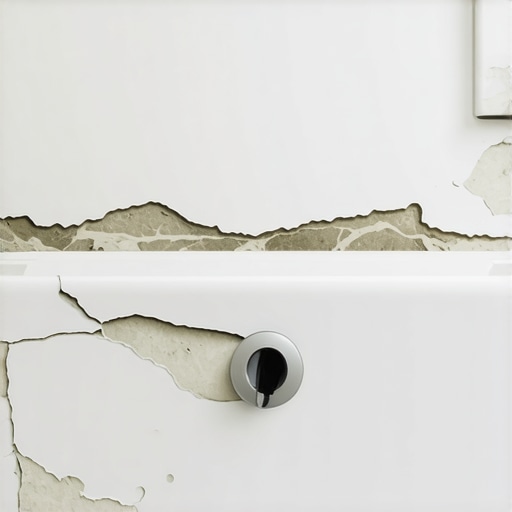
Why Your Bathroom Caulk is Peeling Behind the Sink Already
Most guys skip the leveling compound. They think the underlayment will hide the dip. It won’t. I spent three days grinding concrete on a job last month just so the floor wouldn’t click like a castanet. The same laziness happens behind the bathroom sink. I once walked into a luxury master suite where the homeowner had spent six figures on marble, yet the caulk behind the faucet was peeling off like a sunburnt back. The installer didn’t clean the soap scum before pumping a bead of cheap acrylic. He thought the shiny white line would cover his tracks. It lasted three weeks. Now the subfloor is drinking water every time they wash their hands. It is a structural failure waiting to happen. You cannot hide bad physics with a squeeze tube.
The chemistry of the failed bond
Bathroom caulk fails because of poor surface preparation, moisture contamination during the curing phase, and the use of low-quality acrylic sealants. High-quality 100 percent silicone requires a bone-dry, chemically clean substrate to achieve a molecular bond. If soap residue, old silicone oil, or moisture is present, the adhesion fails immediately. When we talk about the chemistry of a bond, we are looking at the way a polymer interacts with a surface. Most people think caulk is glue. It is not. It is a flexible bridge. If the surfaces on either side of that bridge are moving at different rates, or if the bridge is only held on by surface tension rather than a chemical link, it will snap. In bathrooms, the constant cycle of heat and humidity causes materials to expand. A cheap latex caulk lacks the elongation properties to handle this. It dries out, turns brittle, and pulls away. You need the stuff that stays flexible for twenty years, not twenty minutes.
“A floor is only as good as the subfloor beneath it; deflection is the enemy of every joint.” – Master Flooring Axiom
The gravity trap of the undermount sink
Undermount sinks create a specific mechanical stress on sealants because the weight of the water and the basin pulls away from the countertop. This constant downward force requires a sealant with high tensile strength and a mechanical support system to prevent the caulk joint from bearing the entire load. I see this in every second house I visit. Someone installs a heavy cast iron sink and expects a thin bead of silicone to hold it against the granite. It will not work. Gravity is patient. Over time, that sink drops by a fraction of a millimeter. That is all it takes. The seal breaks, and water starts its slow journey into your vanity cabinet. You must use sink clips or a harness. The caulk is there to keep water out, not to hold the sink up. If you see a gap appearing behind the faucet, your sink is likely sinking. This movement is the primary killer of bathroom aesthetics and structural integrity. You might also notice issues where the floor meets the vanity. If you are seeing gaps there, you might need to look into chic baseboard designs that transform rooms in 2025 to cover those structural shifts properly.
Why your subfloor is lying to you
Subfloor instability and joist deflection are often the hidden causes of peeling caulk in the bathroom. If the floor beneath the vanity flexes when you walk past, that movement transfers directly to the plumbing fixtures and the wall joints. This oscillation breaks the bond of even the most expensive sealants. I have spent decades telling people that their tile is only as good as what is under it. If your subfloor is 5/8 inch plywood with 24 inch on-center joists, your bathroom is a trampoline. Every time you step near the sink, the vanity tilts. The caulk joint at the backsplash is the sacrificial lamb in this scenario. It tears because it cannot bridge the gap between a moving floor and a static wall. Before you recaulk, check the deflection. You might need to stiffen the joists from the crawlspace or add a layer of cement board. This is especially true when dealing with heavy tile installations. If your grout is also cracking, you should read about grout restoration secrets for long-lasting results to understand how movement affects your entire bathroom ecosystem.
The 1/8 inch that ruins everything
The width of the caulk bead must be at least 1/8 inch to allow for the mechanical expansion and contraction of the building materials. Beads that are too thin lack the internal mass to stretch without tearing, leading to premature failure behind the sink and in the shower. People love a tiny, invisible caulk line. It looks clean for a week. But a thin film of silicone has almost no elasticity. Imagine a rubber band. A thick rubber band can stretch an inch without breaking. A microscopic sliver of rubber will snap the moment you touch it. The same logic applies to your sink. You need enough material in the joint to act as a gasket. I always tell my apprentices to aim for a consistent 1/8 to 1/4 inch bead. It provides the bulk needed to survive the house settling. If you are working on a full renovation, keep this in mind for your showers that wow modern designs for 2025 because the same physics apply to those large format tiles.
| Sealant Type | Flexibility Rating | Moisture Resistance | Best Use Case |
|---|---|---|---|
| 100% Silicone | Excellent | Highest | Sinks, Showers, Glass |
| Siliconized Acrylic | Moderate | Medium | Baseboards, Trim |
| Polyurethane | High | High | Exterior, High Movement |
| Latex Caulk | Low | Low | Drywall gaps only |
Moisture vapor and the hidden mold highway
Moisture vapor can penetrate behind the tile and vanity if the caulk seal is compromised, leading to subfloor rot and black mold growth. Once water finds a path behind the sealant, it becomes trapped between the non-porous tile and the wooden wall studs. This is the part that keeps me up at night. You see a little peel in the corner and ignore it. Meanwhile, every time the kids splash water, a few tablespoons disappear behind the wall. It hits the baseboard and soaks into the drywall. If you have been ignoring this, you might need tile cleaning tips for a sparkling bathroom in 2025 to at least clear the surface mold before you start the real repairs. But cleaning is just a band-aid. You have to stop the water at the source. The source is that failed bead of caulk. If you want to fix it without a full demo, look at how to refresh grout without replacing it as part of a comprehensive moisture-proofing plan.
- Strip every trace of the old sealant using a razor and chemical remover.
- Clean the joint with 99 percent isopropyl alcohol to remove skin oils.
- Ensure the area is dry for at least 24 hours before application.
- Use a backer rod for gaps deeper than 1/2 inch to prevent three-sided adhesion.
- Tool the bead with a dry finger or a specialized tool to force it into the pores.
Regional climate factors and expansion cycles
Regional humidity levels directly impact how bathroom materials expand and contract, which dictates the type of sealant required for a lasting bond. In humid climates like Houston, the constant moisture prevents certain caulks from ever fully curing, while in dry areas like Phoenix, the lack of humidity can cause wood vanities to shrink and pull away. If you live in a swamp, you cannot use water-based products. They will stay gummy and attract mildew within months. You need a neutral-cure silicone that does not rely on evaporation to set. In the desert, you have the opposite problem. The wood in your vanity is constantly gasping for air and shrinking. This creates massive gaps that will snap a standard caulk bead. You must account for the local building codes and environment. When I do jobs in high-humidity zones, I always use a moisture meter on the subfloor before I even think about opening a tube of caulk. If the subfloor is at 15 percent moisture, that caulk is doomed before it leaves the nozzle. If you are struggling with these issues in a smaller space, check out showers with a style trendy ideas for small bathrooms for more robust material choices. If you need specific help with your local conditions, you can always contact us for expert advice. One last thing, check your baseboards. If they are gapping, you might find inspiration in these baseboards makeover ideas to elevate your space to solve the aesthetic and structural gap simultaneously. Don’t forget to review our privacy policy for more information on how we handle your data.