
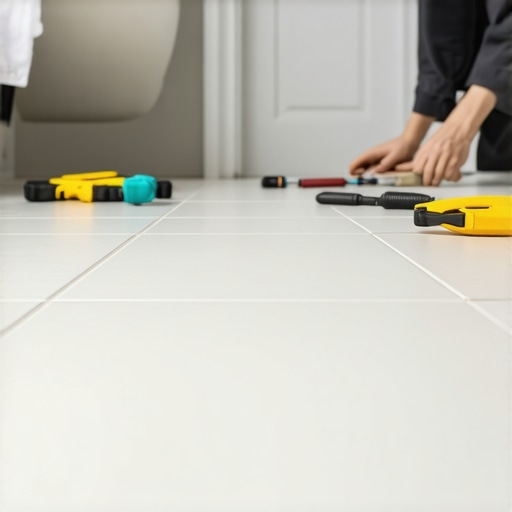
Most guys skip the leveling compound. They think the underlayment will hide the dip. It won’t. I spent three days grinding concrete on a job last month just so the floor wouldn’t click like a castanet. That is the reality of a professional install. If your floor feels like a boat deck in a storm, you are looking at a structural failure. I have seen too many homeowners spend five figures on imported Italian marble only to have the grout crack within three months because they did not want to spend five hundred dollars on proper floor prep. A floor is a performance surface. It is the foundation of your daily movement. When it fails, the beauty of your tile or your expensive fixtures does not matter. You are walking on a ticking clock. In my twenty five years of crawling through damp crawlspaces and measuring moisture in slabs, I have learned that the subfloor is the only part of the room that actually matters. The rest is just jewelry.
Why your subfloor is lying to you
Uneven bathroom floors originate from joist deflection, structural settling, or moisture expansion within the wooden subfloor layers. These issues manifest as visible slopes, bouncy sections, or tiles that sound hollow when tapped. A subfloor that looks flat to the naked eye often hides deviations exceeding the industry standard of one eighth of an inch over ten feet. I once walked into a house where a fifteen thousand dollar wide plank walnut floor was cupping so bad it looked like a potato chip because the installer did not check the crawlspace humidity. The same thing happens in bathrooms. Moisture from the shower or the crawlspace below migrates into the plywood. The wood fibers swell. The glue lines in the plywood shear. Suddenly, your level floor is a mountain range. You cannot fix this with extra thin-set. Mortar is not a leveling tool. It is an adhesive. If you try to build up a dip with mortar, it will shrink as it cures, leaving a void that snaps your tile the first time you step on it.
“A floor is only as good as the subfloor beneath it; deflection is the enemy of every joint.” – Master Flooring Axiom
The physics of the situation are simple. Most residential joists are spaced sixteen inches on center. If those joists are undersized or spanning too far, they will bend. This is called deflection. For tile, we look for a deflection rating of L over three hundred sixty. For natural stone, it needs to be L over seven hundred twenty. If your floor has too much bounce, your grout will turn to dust. You can learn about grout restoration secrets for long lasting results but if the floor is moving, no amount of restoration will save it. You have to stiffen the structure. This often means sistering the joists or adding a second layer of plywood. We are talking about thirty two sixty fourths of an inch of plywood as a minimum for a reason. Anything less is just a trampoline for your toilet.
The invisible sinkhole under your feet
Subfloor dips are frequently caused by the compression of insulation or the rot of the rim joist in older homes. When moisture gets into the subfloor through old grout lines, it rots the wood from the top down. You might think your tile is solid, but the wood beneath it has the consistency of wet cardboard. This is why I always tell people to check their tile cleaning tips for a sparkling bathroom in 2025 to ensure they are not using harsh chemicals that strip the sealer and let water penetrate the substrate. Once that water is in, the OSB or plywood will delaminate. OSB is especially bad. It is basically a sponge made of wood chips and resin. When it gets wet, the edges swell and never go back down. You end up with ridges at every seam. If you are installing new floors, use an exterior grade plywood with a high ply count. It handles the humidity of a bathroom much better than builder grade materials.
| Material Type | Thickness Standard | Deflection Resistance | Moisture Tolerance |
|---|---|---|---|
| CDX Plywood | 23/32 inch | High | Moderate |
| OSB Subfloor | 3/4 inch | Medium | Low |
| Cement Backer | 1/4 or 1/2 inch | Low (Structural) | Excellent |
| Self Leveling Underlayment | Variable | Very High | High |
The geometry of a level shower
Correcting an uneven floor requires a systematic approach involving mechanical grinding, structural reinforcement, and the application of self leveling compounds. You cannot just pour leveler and hope for the best. You have to prime the floor first. If you do not prime, the dry wood or concrete will suck the water out of the leveler too fast. The chemical bond will fail. It will crack and lift. It is about the chemistry of the hydration process. High quality levelers use calcium aluminate cement which provides rapid strength and minimal shrinkage. When I am working on showers with a style trendy ideas for small bathrooms I make sure the perimeter is sealed with foam tape. If you do not seal the edges, that expensive liquid leveler will find a hole and end up on your basement floor. It is a mess you do not want to clean up. It smells like wet concrete and regret.
- Inspect the joists for rot or insect damage from the crawlspace or basement.
- Check the subfloor thickness to ensure it meets the L/360 deflection standard for tile.
- Screw down any loose plywood sheets to eliminate squeaks and movement.
- Apply a high quality acrylic primer to the subfloor to ensure a proper bond.
- Use a gauge rake to spread self leveling underlayment at the required depth.
- Install a crack isolation membrane over the cured leveler to protect the tile.
The ghost in the expansion gap
Floor failure often happens at the edges where the subfloor meets the wall because of a lack of expansion gaps. Every material expands and contracts with temperature and humidity. If you jam your tile or your subfloor tight against the wall studs, it has nowhere to go. It will buckle in the middle. I have seen floors lift two inches off the joists because of this. You need a quarter inch gap at the perimeter. This gap is hidden by your baseboards. If you are looking to upgrade your room, check out chic baseboard designs that transform rooms in 2025 to see how they can cover those essential expansion zones. Without that gap, your floor is a ticking time bomb. The grout will pinch and pop. The tile will tent. It is a basic rule of physics that many DIY installers ignore because they want a tight fit. In the flooring world, a tight fit is a failed fit.
“Deflection is not just about the weight on the floor; it is about the frequency of the vibration and the resilience of the bond.” – TCNA Handbook Reference
The one eighth inch that ruins everything
A deviation of one eighth of an inch over a ten foot span is the maximum allowable limit for most modern flooring installations. If you go beyond that, your large format tiles will have lippage. Lippage is when one edge of a tile is higher than the neighbor. It is a trip hazard and it looks terrible. In bathrooms, where light often hits the floor at an angle from a window or a vanity light, lippage creates long, ugly shadows. To fix this, you have to be precise. I use a ten foot straight edge and a set of feeler gauges. I mark the high spots with a red pencil and the low spots with a blue pencil. Then I grind the red and fill the blue. It is tedious work. It is dusty. It makes your back ache. But it is the difference between a floor that lasts fifty years and one that fails in five. People always ask me why my quotes are higher. It is because I am doing the work they cannot see. I am fixing the bones of the house.
How to fix the foundation before the finish
Before you even think about the tile, you must address the moisture levels in the bathroom environment. If you have a leaky toilet or a shower pan that is weeping, no amount of leveling will help. You have to stop the water. High humidity in a bathroom can also affect the curing of thin-set and levelers. If the air is too damp, the water does not evaporate correctly. The polymers do not cross-link. You end up with a soft bond. I always run a dehumidifier on my jobs for twenty four hours before I pour any leveler. I want the wood to be at its stable moisture content. If you pour leveler on wood that is swollen with humidity, and then the wood dries out and shrinks, the leveler will pull away. It will crack. It is a structural engineering challenge every single time. If you need help with the final aesthetic touches after the structural work is done, you can how to refresh grout without replacing it but remember that the grout is only the skin. The subfloor is the skeleton.
The subfloor is the foundation of the home experience. Treat it with the respect it deserves. Grind the high spots. Fill the low spots. Stiffen the joists. Use the right chemistry. Do not settle for builder grade shortcuts. If you do the work right the first time, you will never have to think about your floor again. It will just be there, solid and silent under your feet. That is the mark of a master installer. If you have questions about your specific project or need a professional assessment, you should contact us to avoid making a costly mistake. Flooring is not a cosmetic choice. It is an engineering task. Do it right or do it twice.