
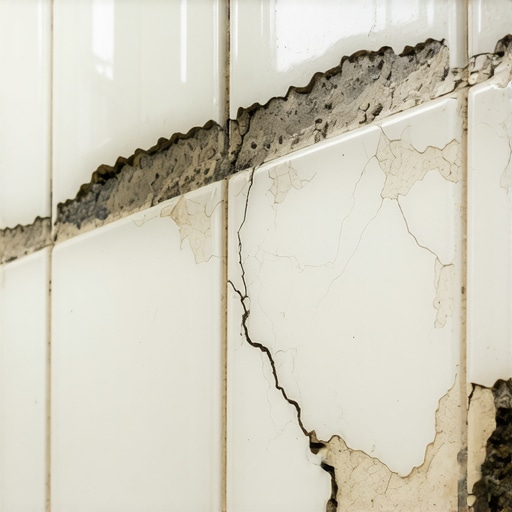
Why your bathroom wall is bowing behind the tile
You see it in the corner of your eye while you are brushing your teeth. That slight curve. That bulge in the subway tile that was not there last year. You press your hand against it and there is a terrifying bit of give. It feels soft. This is the sound of a thousand dollar repair bill whispering through your grout lines. I have spent twenty five years with a moisture meter in my pocket and sawdust under my fingernails, and I can tell you right now that your tile is not the problem. The tile is just the skin. The skeleton behind it is rotting, and it is doing so because someone thought they could outsmart the laws of physics and the Tile Council of North America standards. I once walked into a luxury remodel where the owner had spent twenty thousand dollars on Italian marble, only to have the entire west wall of the shower start leaning like the Tower of Pisa. The installer had used standard drywall instead of a cementitious backer board, thinking the waterproof membrane would do all the heavy lifting. It did not. The humidity from the shower turned that drywall into oatmeal in less than eighteen months. That is the reality of bathroom construction. If you ignore the substrate, the substrate will eventually ignore its duty to hold up your wall. When we talk about showers and tile, we are talking about a battle against hydrostatic pressure and moisture vapor. If you are seeing a bow, the battle is already lost. You are now in the recovery phase.
The structural anatomy of a failure
Bowing bathroom walls occur when moisture penetrates the tile substrate, causing the wooden studs to swell or the gypsum core to disintegrate. This structural failure is typically caused by improper waterproofing, high humidity, or lack of expansion gaps. When the sub-structure expands, it pushes the tile outward, creating a visible bulge. This is not just an aesthetic issue. It is a sign that the structural integrity of your home is being compromised. When water vapor hits a cold surface behind the tile, it condenses. That liquid water has nowhere to go. It sits against the 2×4 studs. Wood is a hygroscopic material. It wants to reach an equilibrium moisture content with its environment. In a bathroom, that environment is often saturated. As the wood fibers absorb water, they expand. Since the studs are anchored at the top and bottom, they can only move outward. This creates the bow. If you have baseboards at the bottom of that wall, you might notice them pulling away from the floor or the wall as the vertical plane shifts. You can see some of our baseboards makeover ideas to elevate your space to understand how these transitions should look when they are healthy and straight.
The chemistry of wet drywall
Most people do not realize that standard drywall is just a compressed sandwich of gypsum and paper. Water loves paper. Mold loves paper even more. When moisture gets behind your tile, it begins a process called delamination. The adhesive, usually a thin-set mortar or, god forbid, a premixed mastic, starts to lose its bond with the paper facing. The paper itself then peels away from the gypsum core. At the same time, the gypsum begins to absorb water and lose its crystalline structure. It turns from a rigid board into a soft paste. This is why the wall feels spongy. If your installer used greenboard, which is water-resistant but not waterproof, you only bought yourself a few extra months. Greenboard is not meant for the direct wet areas of showers. It is meant for the high-humidity areas near the sink or toilet. Using it behind a shower head is a recipe for disaster. The technical reality is that the moisture vapor transmission rate of your wall assembly was too high. Without a proper vapor retarder, the wall was doomed from the day the first stud was nailed into place. This is why we insist on rigid standards in every installation.
“A floor is only as good as the subfloor beneath it; deflection is the enemy of every joint.” – Master Flooring Axiom
Why your grout is a sieve
Grout is not waterproof. Let me repeat that because it is the most common lie in the home improvement world. Standard cementitious grout is a porous material. It is full of microscopic holes that allow water to pass through via capillary action. If you do not seal your grout or use a high-performance epoxy grout, every shower you take is essentially pouring a small amount of water directly into your wall cavity. Over time, this water accumulates. It bypasses the tile and hits the substrate. If you are struggling with old, porous grout, you might want to look into grout restoration secrets for long-lasting results to stop the leak before it ruins your studs. Even a tiny crack in a corner can let in enough water to cause a major bow over three or four years. This is a slow motion train wreck. You do not notice it until the 1/8 inch gap becomes a 1/2 inch bulge. By then, the mold has likely already taken up residence in your insulation. You have to be proactive about tile maintenance. You can find more on how to refresh grout without replacing it if you are lucky enough to catch the problem before the wall starts moving.
The 1/8 inch that ruins everything
Deflection is the silent killer of bathroom walls. In the world of the TCNA, we talk about L/360. This is the math that tells us how much a wall or floor can flex under load. If your wall studs are spaced too far apart, or if they are undersized, the wall will flex when you lean against it. Tile is rigid. Grout is rigid. Wood is flexible. When the wood moves and the tile does not, the bond breaks. This is often where the bowing begins. The tile pops off the substrate, creating a pocket. Gravity then pulls moisture into that pocket, and the cycle of rot accelerates. I have seen guys try to fix this by just slapping more thin-set on the back of a loose tile. That is like putting a band-aid on a broken leg. You are not fixing the deflection. You are just adding weight to a failing structure. You need a rock-solid foundation. This is why I always check the plumb and level of the studs before a single piece of backer board goes up. If the studs are bowed, I sister them with straight lumber. If they are wet, I wait for them to dry. There are no shortcuts in moisture management.
“The maximum allowable deflection for a floor or wall system intended to receive ceramic tile or stone is L over 360 under all live and dead loads.” – Master Flooring Axiom
Backer board comparison for bathroom longevity
To understand why your wall is bowing, you have to look at what was used to build it. Not all boards are created equal. Use this table to see where your contractor might have cut corners.
| Substrate Material | Moisture Resistance | Rigidity Rating | Proper Application |
|---|---|---|---|
| Standard Drywall | Low | Low | Living rooms and bedrooms only |
| Greenboard | Medium | Low | Bathroom ceilings and dry walls |
| Cement Board | High | High | Standard shower installations |
| Kerdi Board | Maximum | High | Professional steam showers |
As you can see, if your wall is bowing and you find standard drywall behind the tile, the cause is clear. The material was never rated for the environment. You need a cementitious product that will not lose its structural integrity when wet. Even if the cement board gets wet, it stays hard. It does not rot. It does not grow mold easily. This is the baseline for any quality shower. If you are planning a remodel to fix your bowing walls, check out these showers that wow modern designs for 2025 to see how the pros do it.
The myth of waterproof tile
People love to brag about their waterproof flooring and tiles. Tile itself is usually waterproof, especially porcelain which has an absorption rate of less than 0.5 percent. But a wall of tile is a system, not a single product. The system includes the tile, the thin-set, the grout, the sealer, the backer board, and the vapor barrier. If any one of those components fails, the whole system fails. A common mistake is thinking that a heavy coat of sealer on the grout will save a bad installation. Sealer is a breathable barrier. It slows down water, but it does not stop it entirely. If there is standing water or a constant spray, the water will get through. Once it is behind the tile, the sealer actually works against you by trapping the moisture inside the wall. It cannot evaporate back out through the tile. It is forced into the studs. This is why we see so much bowing in bathrooms that look perfectly clean on the surface. The rot is happening from the inside out. You need a drainage plane or a topical waterproofing membrane like Schluter-Kerdi or RedGard to ensure that any water that gets past the tile is directed back down to the drain.
Checklist for identifying a bowing wall early
- Look for grout lines that are cracking in a horizontal or vertical pattern.
- Press on the tile in the center of the wall to check for any movement or squishiness.
- Check the corners of the shower for any separation in the caulk or grout.
- Inspect the baseboards on the opposite side of the bathroom wall for moisture stains.
- Use a flashlight to look for a shadow or a curve when shining the light parallel to the wall.
- Monitor for a persistent musty smell that does not go away after cleaning.
Fixing the skeleton behind the skin
If your wall is already bowing, there is only one real fix. You have to tear it down. I know that is not what you want to hear. You were hoping for a magic injection or a special caulk. It does not exist. You need to remove the tile and the backer board to see the extent of the damage to the studs. If the wood is black and soft, it needs to be replaced. You cannot tile over rot. Once the structure is sound, you must install a proper moisture management system. This means using a high-quality cement board and a topical waterproofing membrane. You should also ensure that your baseboards are installed with a small gap at the bottom to prevent wicking from the floor. If you have questions about the technical specs of a repair, you can always contact us for professional guidance. We have seen every version of a failed wall, and we know how to make sure the next one lasts for thirty years. Do not let a contractor tell you that a little bit of bowing is normal settling. It is not. It is a sign of a failing system. Fix it now before the mold becomes a health hazard for your family. A bathroom should be a place of cleanliness, not a breeding ground for structural decay.