
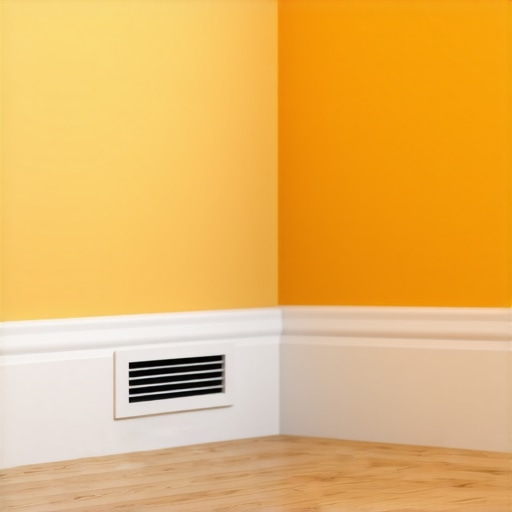
Most guys skip the leveling compound. They think the underlayment will hide the dip. It won’t. I spent three days grinding concrete on a job last month just so the floor wouldn’t click like a castanet. That same job had the homeowner complaining about PVC baseboards popping off the wall near the registers. I stood there, smelling the oak dust and WD-40 on my shirt, explaining that plastic and heat are a bad marriage if you do not respect the physics of the material. A floor is more than a color. It is a structural assembly where every 1/8 inch matters. When you install baseboards, you are not just decorating. You are managing the transition between two planes of movement. If you ignore the thermodynamics of your HVAC system, your expensive trim will look like a wavy noodle within one season.
The thermal expansion trap
PVC baseboards warp near heat vents because polyvinyl chloride has a high coefficient of linear thermal expansion which causes the material to grow and shrink rapidly. When concentrated hot air from a furnace hits a localized section of the trim, that specific segment expands while the cooler sections stay rigid. This imbalance creates internal stress that forces the board to bow outward from the wall or cup against the drywall. You have to understand the molecular reality of what you are putting in your house. PVC is a thermoplastic. It is literally designed to be malleable under heat. While it is great for moisture resistance in showers or near tile, it is a liability if you do not account for the BTU output of your floor registers. If you want to see better options, check out these baseboards makeover ideas to elevate your space which include materials better suited for high-heat zones.
The molecular dance of polyvinyl chloride
Polyvinyl chloride molecules increase their kinetic energy when exposed to heat which causes the polymer chains to slide further apart and expand. This is not a theory. It is a chemical certainty. At the microscopic level, the carbon-chlorine bonds in the PVC trim are vibrating. As the temperature at the vent rises to 120 degrees Fahrenheit, the trim length can increase by a fraction of an inch. If you have nailed that trim tight at both ends, that extra length has nowhere to go but out. This is why you see the baseboard pulling away from the wall. It is physically too long for the space it occupies during the heating cycle. Most installers fail to realize that the density of the PVC matters. Cheap, cellular PVC has more air pockets and moves more than solid-core versions. When you are looking for chic baseboard designs that transform rooms in 2025, you need to verify the material density and the expansion rating before you commit to a long run near a heat source.
“A floor is only as good as the subfloor beneath it; deflection is the enemy of every joint.” – Master Flooring Axiom
Why your subfloor is lying to you
Subfloor unevenness creates hidden gaps behind PVC baseboards that allow hot air to circulate behind the trim and accelerate warping. If your floor has a 3/16 inch dip within a 10 foot radius, your baseboard is already under tension just trying to follow that contour. When the heat vent kicks on, that tension finds the weakest point and snaps the bond. I have seen guys try to hide a bad subfloor with thick trim. It never works. The air from the vent gets trapped in the void between the uneven subfloor and the baseboard, creating a convection oven effect. This bakes the adhesive and softens the plastic. You cannot fix a trim problem until you fix the floor. If you are dealing with grout and tile, the subfloor rigidity is even more vital. Deflection will crack your grout and warp your trim simultaneously. I always tell people to spend their money on the prep, not just the finish.
The 1/8 inch that ruins everything
Leaving a mandatory expansion gap at the ends of PVC runs and near heat vents prevents the trim from buckling against door casings. Most DIYers and