
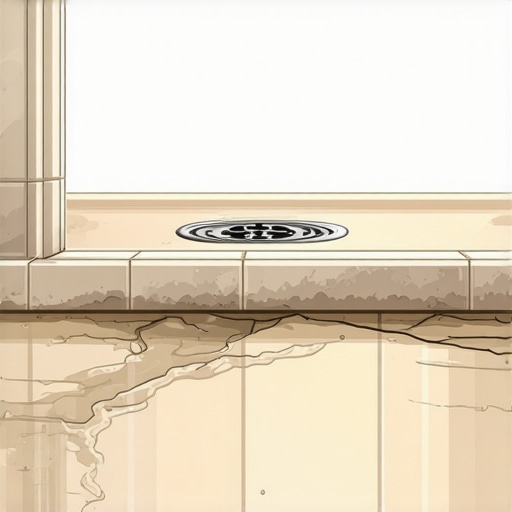
I spent three days grinding concrete on a job last month just so the floor wouldn’t click like a castanet because the previous installer thought a thick underlayment could hide a half-inch dip. It did not. That same logic of cutting corners is exactly why your shower curb is currently weeping water onto your luxury vinyl or hardwood. Most guys skip the leveling compound and they definitely skip the pre-slope. When you walk into a bathroom and see a dark stain creeping away from the shower threshold, you are looking at a structural failure of the waterproofing envelope. It is not just a loose tile. It is a fundamental breakdown of the moisture management system designed to keep your subfloor dry. I have seen fifteen thousand dollar wide-plank walnut floors turned into potato chips because a curb leak went unnoticed for six months. I have seen mold colonies that would make a biologist blush. If you want to understand why your bathroom floor is wet, you have to look past the ceramic and into the chemistry of the installation.
The invisible mechanics of water migration
Shower curb leaks occur because capillary action draws moisture through porous grout joints and into the internal framing of the curb. When the waterproofing membrane is punctured or improperly sloped, water saturates the mortar bed and migrates outward toward the bathroom floor instead of toward the shower drain. This process is often driven by hydrostatic pressure within the saturated mud bed of the shower pan. Gravity is your greatest ally or your most expensive enemy. If the top of that curb is not pitched at least an eighth of an inch toward the drain, water will sit there until it finds a microscopic pore to travel through. It is physics. You cannot argue with water. It will always find the path of least resistance, and often that path leads right through the corner of your threshold where the liner was tucked incorrectly. If you are looking for modern inspiration to replace a failed system, check out showers that wow modern designs for 2025 to see how professional integration should look. Most people think grout is a sealer. It is not. Grout is a sieve. It is a cementitious product that breathes and absorbs. Without a secondary drainage path, that moisture is trapped against your wooden 2×4 curb studs. Once those studs swell, they push the tile out, crack the grout, and the floodgates open.
“A floor is only as good as the subfloor beneath it; deflection is the enemy of every joint.” – Master Flooring Axiom
The lethal mistake of nailing through the liner
Puncturing the shower liner with nails or screws during the installation of cement board or metal lath creates immediate leak points. Professional tile installers must ensure that no fasteners penetrate the waterproofing membrane below the flood level of the curb, which is typically three inches above the finished floor. If a contractor nailed a wooden 2×4 on top of your liner to create the curb shape, they effectively turned your shower into a bucket with holes in the bottom. I have torn out dozens of curbs where the installer used a hammer and common nails. It is a crime against engineering. You need to use a mortar-based curb or a pre-fabricated foam curb that requires zero penetrations. These foam systems are hydrophobic and cannot rot. When we talk about eco-friendly tile solutions for sustainable homes in 2025, we are talking about products that last fifty years instead of five. A leaking curb is a waste of resources and a hazard to your home’s air quality. The chemistry of modern adhesives allows us to bond these curbs without a single screw. If your installer pulled out a nail gun, you should have fired him on the spot.
Capillary action and the porous nature of grout
Grout joints are naturally hydrophilic, meaning they attract and transport moisture through the capillary network of the cement matrix. In a leaking shower curb, water travels through the grout lines and hits the subfloor if the perimeter seal is broken. This is why grout restoration and sealing are critical for preventing surface-level migration of water. If you want to keep things looking sharp, you should know how to refresh grout without replacing it before the damage becomes structural. But let us be clear, sealing grout is a maintenance task, not a waterproofing solution. The real work happens under the tile. When water enters the grout, it needs a way out. A proper system uses a topical membrane like RedGard or a sheet membrane like Kerdi. This keeps the water in the tile layer where it can evaporate. If the water gets behind the tile and into a traditional mud bed, it must hit a pre-slope and travel to the weep holes in the drain. If those weep holes are clogged with thin-set, that water has nowhere to go but out the front door of your shower. You will see it first at the baseboards. The paint will start to bubble. The wood will start to soften. If you catch it early, you might save the floor. If you wait, you are looking at a full demo. Check out these tile cleaning tips for a sparkling bathroom in 2025 to keep your surfaces free of mineral buildup that can hide these early warning signs.
| Curb Construction Type | Moisture Resistance | Risk of Rot | Installation Complexity |
|---|---|---|---|
| Wood Frame with Liner | Low | High | High |
| Solid Concrete/Mortar | Medium | Low | Medium |
| Pre-fabricated Foam | High | Zero | Low |
| Structural Glass Block | Very High | Zero | High |
The 1/8 inch that ruins everything
Proper curb pitch requires a minimum downward slope of one eighth of an inch toward the interior of the shower enclosure. If the threshold is level or pitched outward, surface tension will hold soapy water on the top of the curb, allowing it to seep into the joint between the curb and the bathroom floor. This is the primary reason for baseboard rot in modern bathrooms. I always tell my clients that a level is for the walls, but a slight tilt is for the floor. You cannot trust your eyes. You need to put a spirit level on that curb and see the bubble move. If the bubble is centered, you are in trouble. If the bubble is toward the bathroom, you are doomed. Even the most beautiful showers with a style trendy ideas for small bathrooms will fail if the pitch is wrong. It is about managing the kinetic energy of the water coming off the shower door. When that water hits the curb, it must be directed back into the pan. If you have a frameless glass door, this is even more critical. The sweep on the bottom of the door can only do so much. If the curb is flat, the water will find the gap between the glass and the tile. Once it gets there, it sits. It dwells. It destroys.
“Waterproofing is not a product; it is a system of integrated layers working to manage gravity and surface tension.” – TCNA Handbook Standards
Baseboards and the silent rot
Bathroom baseboards act as a wicking agent when they come into contact with standing water escaping from a leaking shower. If your baseboards are made of MDF (Medium Density Fiberboard), they will swell like a sponge and lose their structural integrity within weeks of exposure. You should always look for chic baseboard designs that transform rooms in 2025 that utilize PVC or waterproof materials in wet environments. I have seen beautiful wood trim ruined because the installer did not leave a gap between the tile and the wood. You need a silicone joint there, not grout. Grout will crack as the house shifts, and that crack will let water right into the end grain of the baseboard. Once the rot starts, it moves up the wall. It gets into the drywall. It gets into the insulation. You might think you are just dealing with a cosmetic issue, but you are actually dealing with a compromised wall assembly. If you are planning a renovation, consider baseboards makeover ideas to elevate your space using moisture-resistant materials. A professional job includes back-priming any wood trim in a bathroom. It is that extra step that separates a master from a handyman. I do not care how good the paint looks on the front if the back is raw wood waiting to drink up a leak. If you want to keep your bathroom looking new, you need to master grout restoration secrets for long-lasting results to ensure the first line of defense remains intact.
The checklist for a waterproof curb
- Confirm the curb top is pitched 1/8 inch to 1/4 inch toward the drain.
- Ensure no fasteners were driven into the top or inside face of the curb.
- Verify that the shower liner or membrane extends over the curb and down the outside face.
- Check that the corners are reinforced with pre-formed waterproof