
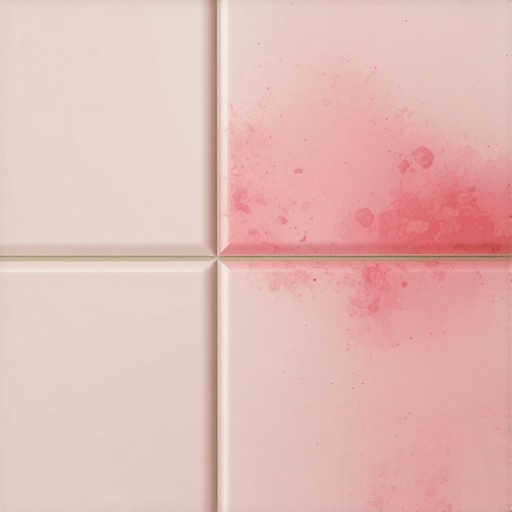
You step into the shower after a long day at the job site, expecting a clean environment, but the corners of your tile look like someone spilled a bottle of cheap strawberry soda. That pink film is not just an aesthetic annoyance. It is a biological invader. As someone who has spent thirty years looking at the underside of bathroom floors, I can tell you that the pink stuff is a warning sign that your maintenance routine or your ventilation system is failing. It is a symptom of a much larger structural and chemical battle happening in your bathroom.
The pink film that haunts your morning
Pink shower grout is caused by Serratia marcescens, an airborne bacterium that thrives in moist, dark environments. It is not a mold but a bacteria that feeds on fatty substances found in soaps and shampoos. To eliminate it, you must use disinfectants like bleach or vinegar and improve bathroom ventilation to lower humidity levels. This pink menace is resilient because it builds a biofilm, a microscopic fortress that protects the colony from standard surface wiping, requiring deep chemical penetration to fully eradicate the source.
I spent three days grinding concrete on a job last month just so the floor wouldn’t click like a castanet, and during that time, the homeowner asked me to look at their master shower. They thought the tile was bleeding. It was actually a massive colony of Serratia marcescens that had migrated from the grout lines up into the baseboards. Most guys skip the leveling compound and they definitely skip the grout sealer. They think the underlayment will hide the dip or the sealer is an unnecessary upsell. It isn’t. When grout is left unsealed, it acts like a sponge, pulling in moisture and organic material. That client had a twenty thousand dollar bathroom ruined because they used a five dollar bottle of generic soap and never wiped down the walls. The bacteria had even started to rot the chic baseboard designs they had recently installed. If you want to see what proper trim looks like, you can find chic baseboard designs that transform rooms in 2025 on our site, but no trim will survive a bacterial swamp.
The biological truth about your shower floor
Serratia marcescens is the specific scientific name for the pink or orange residue that appears in showers, sinks, and toilet bowls. This gram-negative bacteria is ubiquitous in the environment and enters your home through the air or water. It thrives on phosphates and fatty acids, which are the primary ingredients in most modern body washes. Once it finds a porous surface like cementitious grout, it attaches itself and begins to multiply, creating a slimy biofilm that is increasingly difficult to remove the longer it is allowed to sit. This is why standard scrubbing often fails to keep the pink away for more than a few days.
At a molecular level, the pink color comes from a pigment called prodigiosin. This pigment is produced only at room temperature. If you have a high performance steam shower, you might notice the pink stuff disappears when the temperature spikes, only to return as the room cools. The bacteria is an opportunist. It waits for that perfect window of humidity between eighty and ninety percent. In regions like Houston or Miami, where the ambient humidity is already high, these colonies can grow at an exponential rate. Even in drier climates like Phoenix, a poorly ventilated bathroom becomes a micro-climate where the bacteria can flourish. You need to understand that grout is essentially a network of tiny tunnels. To a bacterium, a single grout joint is a massive cave system with plenty of room to hide from your scrub brush.
“Cementitious grout is inherently porous and requires specific maintenance to prevent moisture ingress.” – TCNA Installation Standards
Why your subfloor is part of the problem
Subfloor moisture contributes to grout failure by creating a constant source of capillary action that pulls water upward through the tile assembly. If the waterproof membrane beneath the tile was installed incorrectly, the mortar bed can remain saturated for weeks, providing a permanent water source for bacterial colonies. This moisture trap ensures that even if you clean the surface, the bacteria is fed from below, leading to recurrent pink stains and potential structural rot in the surrounding wooden baseboards. If you ignore this, you might find yourself needing grout restoration secrets for long lasting results sooner than you think.
The physics of the shower pan are unforgiving. In a traditional mud bed installation, the pre-slope is the most important part of the architecture. If the pre-slope is flat, water sits on the liner. It never reaches the weep holes in the drain. This stagnant water becomes an anaerobic playground for bacteria. When you walk on the tile, you are essentially pumping that dirty, bacteria-laden water back up through the grout joints. This is why you see the pinkest areas around the drain and in the lower corners. It is not just surface dirt; it is a structural failure of the drainage system. This is also why I always tell people to look at showers that wow modern designs for 2025, because modern systems use topical waterproofing that keeps the moisture out of the mortar bed entirely.
The 1/8 inch gap that ruins everything
The expansion gap at the perimeter of a shower floor is often the primary entry point for moisture and bacteria to reach the wall studs and baseboards. According to the Tile Council of North America, change of plane joints must be filled with flexible sealant like 100 percent silicone, not hard grout. When installers use grout in these corners, it inevitably cracks, creating a micro-fissure that sucks in soapy water. This leads to the pink bacteria growing behind the tile, where no brush can reach it, eventually causing the baseboards to swell and rot. This is a common failure in showers with a style trendy ideas for small bathrooms where space is tight and moisture is concentrated.
When that gap is compromised, the capillary action is relentless. I have seen baseboards that looked fine on the outside but were completely hollowed out by rot on the back side because of a tiny crack in the corner grout. This is why I am a stickler for silicone. It doesn’t support bacterial growth like cement does. If you are doing a makeover, check out baseboards makeover ideas to elevate your space to see how to properly integrate trim with tile. You must ensure that the baseboard is not sitting directly on the floor where it can wick up water. A small 1/8 inch gap between the bottom of the baseboard and the floor, filled with a bead of silicone, can save you thousands of dollars in repairs later on.
Grout comparison and durability factors
| Grout Type | Porosity Level | Bacterial Resistance | Best Use Case |
|---|---|---|---|
| Standard Sanded | Very High | Low | Large joints over 1/8 inch |
| Unsanded Cement | High | Low | Wall tile and tight joints |
| High-Performance Cement | Medium | Moderate | Heavy traffic residential |
| Epoxy Grout | Zero | Extreme | Commercial kitchens and showers |
How to kill the Serratia marcescens colony
Killing pink grout bacteria requires an oxidative process that breaks down the biofilm and neutralizes the cellular structure of the Serratia marcescens. Using a mixture of one part bleach to two parts water is the most effective way to kill the bacteria on contact. For those who prefer non-toxic options, distilled white vinegar is an excellent alternative, though it should never be mixed with bleach. After killing the bacteria, the grout must be thoroughly scrubbed with a stiff brush to remove the organic remains, followed by a long drying period before applying a high-quality sealer. You can find more tile cleaning tips for a sparkling bathroom in 2025 to help maintain the surface.
The chemistry of cleaning is often misunderstood. Many people just spray a cleaner and wipe it off immediately. You need dwell time. The disinfectant needs at least ten minutes of contact time to penetrate the biofilm. If you wipe it off in thirty seconds, you are only killing the top layer of the colony. The survivors will replicate and be back in forty eight hours. Also, avoid using oil-based soaps to clean your tile. You are essentially feeding the very bacteria you are trying to kill. Use a pH-neutral cleaner specifically designed for tile and stone. If the staining is deep, you might need to learn how to refresh grout without replacing it to get back to that original clean look.
The expert checklist for a bacteria-free shower
- Install a high-CFM exhaust fan and run it for 30 minutes after every shower.
- Use a squeegee on the walls and floor after the last person bathes for the day.
- Switch from bar soap to liquid soap to reduce the amount of paraffin and fatty acids.
- Apply a penetrating grout sealer every six to twelve months depending on usage.
- Inspect the silicone caulk in the corners for any signs of peeling or cracking.
- Avoid using excessive amounts of fabric softener on towels that hang in the bathroom.
Sealing your grout for a decade of peace
Sealing grout is the only way to transform a porous cement surface into a hydrophobic barrier that repels water and bacteria. A penetrating solvent-based sealer enters the microscopic pores of the grout and hardens, preventing organic material from nesting inside the joints. Without this protection, the grout will inevitably succumb to biofilm accumulation regardless of how often you clean it. For a long-term solution, consider epoxy grout or eco-friendly tile solutions which are much denser and less prone to bacterial colonization. Check out eco-friendly tile solutions for sustainable homes in 2025 for more options.
While most people want the thickest underlayment or the flashiest tile, the real longevity of a floor is in the details. People often ask me why their waterproof vinyl is buckling. Usually, it’s because they locked it under a heavy kitchen island, killing the floor’s ability to breathe. Grout is the same way. It needs to be handled with respect for the physics of the room. If you seal the grout while it is still damp, you are just trapping the moisture and the bacteria inside. You must let the shower dry for at least forty eight hours before applying a sealer. I have seen homeowners rush this step and then wonder why their grout looks cloudy. It is the moisture trying to escape and hitting that sealer barrier. Patience is the hallmark of a master installer.
“A floor is only as good as the subfloor beneath it; deflection is the enemy of every joint.” – Master Flooring Axiom
If you find that your shower is beyond a simple cleaning, it might be time to bring in the pros. Dealing with recurring bacterial issues often points to a failed liner or a saturated subfloor that needs professional intervention. You can always reach out via our contact us page for a consultation on your specific flooring challenges. Understanding the chemistry of your bathroom is the first step toward a healthier home. Remember that a shower is a machine for moving water. When that machine breaks down, the biology takes over. Keep it dry, keep it sealed, and keep the pink stuff at bay for good. For more information on how we handle your data, please see our privacy policy.