
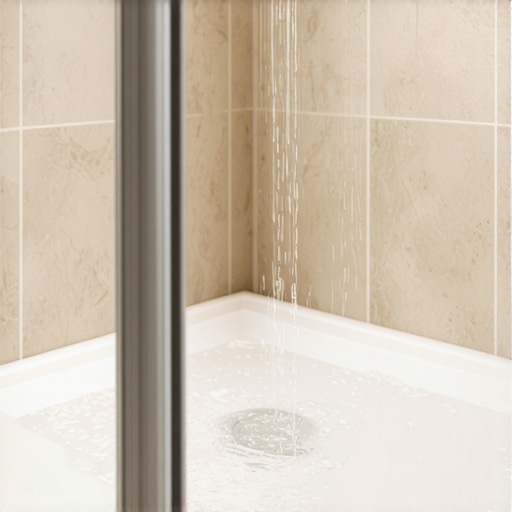
I once walked into a luxury master bath where the owner had just spent twenty thousand dollars on a renovation. Six months later, the kitchen ceiling below was a sagging mess of brown water spots and mold. The contractor had installed a brand new PVC liner, yet the floor was failing. When I ripped up the marble, I found a lake of stagnant, stinking water sitting on top of that new liner. The problem was not the material. It was the physics of the installation. Most installers treat a shower pan like a bucket when it should actually function like a funnel. If you do not understand the molecular behavior of water and the structural requirements of a mortar bed, your liner is just a temporary delay of an inevitable disaster.
The silent failure of the missing pre slope
A shower pan leaks despite a new liner because the installer failed to create a pre slope beneath the waterproofing membrane. Without this sloped foundation, water that permeates the grout and mortar bed sits flat on the liner. This creates a stagnant pool that eventually finds a mechanical failure point or wicks up the wall via capillary action. This is the most common error in modern bathroom construction. Installers often place the liner directly on the flat plywood or concrete subfloor, thinking the slope only matters on the top layer of tile. They are wrong. Water will penetrate the tile and grout. It is a mathematical certainty. When that water hits the flat liner, it has nowhere to go. It sits there, saturating the mortar bed, rotting the wall studs, and creating a breeding ground for bacteria. This is why you see grout restoration secrets mentioned so often, because bad drainage destroys grout from the bottom up.
“A floor is only as good as the subfloor beneath it; deflection is the enemy of every joint.” – Master Flooring Axiom
The chemistry of the three piece drain and weep holes
The mechanical bond between the drain flange and the liner must be watertight while the weep holes remain completely unobstructed. These tiny holes are located in the drain assembly and are designed to allow water that has reached the liner to exit into the plumbing. If an installer covers these holes with mortar or thin set, the system is broken. I have seen countless pans where the installer was too aggressive with the mud bed, effectively plugging the only exit for sub surface water. Once those holes are blocked, the mortar bed becomes a permanent sponge. The hydrostatic pressure builds until the water is forced over the top of the liner at the curb or into the wall cavity. This often leads to baseboard rot. If you are looking for baseboards makeover ideas, you must first ensure the moisture management behind the wall is flawless.
The capillary action in mortar beds and grout
Grout and thin set are porous materials that act as a wick for moisture through a process known as capillary action. Many homeowners believe that tile is a waterproof shield. In reality, tile is a decorative finish. The grout joints are microscopic highways for water. When the mortar bed stays wet due to poor drainage, the water travels upward through the grout. This is why you see dark, damp spots on your shower floor even when it has not been used for twenty four hours. The water is being pulled from the saturated base back to the surface. This constant moisture cycle weakens the chemical bond of the thin set, eventually causing tiles to pop or crack. Using tile cleaning tips will not help if the structure is rotting from the inside. You need to address the moisture migration at the source.
| Waterproofing Method | Permeability Rating | Structural Rigidity | Failure Risk Factor |
|---|---|---|---|
| PVC Liner | 0.10 | Low | High (Human Error) |
| Liquid Membrane | 0.05 | Medium | Moderate (Thin Application) |
| Integrated Foam System | 0.01 | High | Low (Factory Controlled) |
The structural flaw of the wooden curb
Building a shower curb out of stacked 2×4 lumber is a recipe for catastrophic failure because wood expands and contracts at a different rate than masonry. When you wrap a PVC liner over a wooden curb and then nail it in place, you have just created holes in your bucket. Even if you only nail the outside face, the wood will eventually swell from humidity. This movement cracks the grout joints at the floor to curb transition. Once those joints crack, water enters the wood, the wood expands more, and the liner is stretched to its breaking point. A professional installer uses solid masonry blocks or high density foam curbs that are chemically bonded to the floor. This creates a monolithic structure that does not move. For those looking for showers that wow, the beauty starts with a curb that will not rot in five years.
“Tile and grout are not waterproof; they are merely the decorative skin of a complex drainage assembly.” – Master Flooring Axiom
Why the Janka hardness of your subfloor matters
The deflection of your subfloor determines if your shower pan will crack under the weight of the water and the user. If your joists are spaced too far apart or your plywood is too thin, the floor will flex. This flex is often measured in millimeters, but it is enough to break the bond of the mortar bed. When the mortar bed cracks, the liner is subjected to sharp edges and mechanical stress it was never designed to handle. You need a L/360 rating for ceramic tile and L/720 for natural stone. If your subfloor is bouncing, your brand new liner is being pinched and pulled every time you step into the shower. This is the engineering reality that most contractors ignore because they are focused on the aesthetic and not the physics of the load.
The technical checklist for a leak proof shower
- Verify the pre slope is at least 1/4 inch per foot toward the drain.
- Ensure weep holes are protected with crushed stone or a dedicated plastic spacer.
- Use a flood test to verify the liner holds water for at least 24 hours before tiling.
- Apply a topical waterproofing membrane over the mortar bed for a secondary defense.
- Avoid using nails or staples below the six inch mark on the wall studs.
- Seal all transitions with high quality silicone instead of hard grout.
The relationship between showers and adjacent baseboards
When a shower pan fails, the first sign of trouble is often found in the baseboards of the bedroom or hallway sharing the wall. Water travels horizontally along the bottom plate of the wall studs. By the time you see the paint peeling on your baseboards, the interior of the wall is already colonized by mold. This is why choosing chic baseboard designs should be the final step of a project, only after you have confirmed the shower is a closed system. Moisture management is not just about the shower floor. It is about protecting the entire structural envelope of the home. If you suspect a leak, you should contact us immediately to assess the subfloor integrity. Ignoring a small damp spot today leads to a full joist replacement tomorrow. The physics of water do not care about your budget or your timeline. Water follows the path of least resistance, and if that path leads to your subfloor, it will take it every single time.