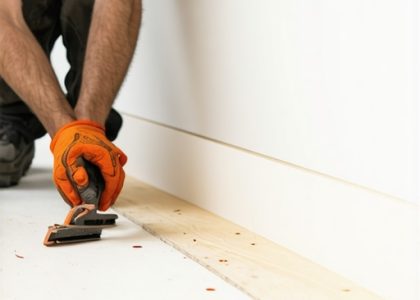
I have spent twenty five years on my knees with a moisture meter and a level. I know the smell of WD-40 and the gritty taste of oak dust better than I know the scent of my own home. I have seen the same tragedy play out in thousands of bathrooms. Homeowners always ask why their waterproof vinyl is buckling. Usually, it is because they locked it under a heavy kitchen island, killing the floor’s ability to breathe and expand. Or they installed MDF baseboards in a wet zone and expected them to survive. They do not. They swell like a bloated sponge until the paint cracks and the mold begins its invisible feast. In 2026, the industry is moving toward hybrid materials that treat the wall-to-floor transition as a structural engineering problem rather than a cosmetic one. A floor is a performance surface. It is a machine that must handle moisture, pressure, and expansion without failing. If you use the wrong trim, you are just waiting for the rot to find your studs.
The moisture wick that kills your drywall
To stop baseboard water damage in 2026, installers utilize hybrid trim materials like cellular PVC, porcelain tile base, solid surface quartz, and anodized aluminum profiles combined with 100% silicone sealant to prevent capillary action and mold growth in high-moisture environments such as showers and bathrooms.
When we talk about the physics of a bathroom, we are talking about vapor pressure and capillary action. Drywall is a giant wick. If your baseboard allows a fraction of a millimeter of water to sit at the bottom, that moisture travels upward through the gypsum core. I have torn out enough bathrooms to know that by the time you see the bubble in the paint, the framing is already soft. This is why the industry is pivoting toward hybrid trims. These are not just plastic moldings. They are engineered composites designed to create a hydrostatic barrier. You can find some of the aesthetic foundations for these transitions in chic baseboard designs that transform rooms in 2025, but for 2026, the focus has shifted entirely to technical resilience.
“A floor is only as good as the subfloor beneath it; deflection is the enemy of every joint.” – Master Flooring Axiom
The chemical bond of modern polymers
Cellular PVC trim and high-density polystyrene profiles offer zero percent water absorption, microbial resistance, and thermal stability to prevent expansion gaps where grout or caulk typically fails in high-humidity zones or wet rooms. These materials are non-porous at a molecular level, ensuring that baseboard water damage is physically impossible through the material itself.
The chemistry here is fascinating. Unlike traditional wood or even the cheap MDF you find at big box retailers, cellular PVC is created through a free-foam process that results in a dense, closed-cell structure. It does not have fibers. There is no cellulose for mold to eat. When you cut into it, the core is as solid as the skin. In 2026, we are seeing these polymers reinforced with calcium carbonate to give them the heft and feel of real wood without the biological vulnerabilities. When I install these in showers with a style trendy ideas for small bathrooms, I am not just looking for a look. I am looking for a material that will not expand when the steam hits it. Wood expands. PVC stays put. If the material stays put, the sealant stays intact. If the sealant stays intact, the water stays out.
The industrial truth about porcelain durability
Porcelain tile baseboards provide the highest Janka hardness and lowest porosity, making them the ultimate defense against baseboard water damage in showers and laundry rooms where liquid exposure is constant. These ceramic transitions are chemically inert and require high-performance grout to maintain a watertight seal between the vertical wall and horizontal floor.
I have a deep respect for porcelain. It is the only material that truly laughs at a flood. In the 2026 design landscape, we are seeing hybrid porcelain trims that are manufactured to look like white oak or walnut but carry a water absorption rate of less than 0.5 percent. This is the vitrification process at work. Under extreme heat, the silica and clay fuse into a glass-like state that is impenetrable. When you pair this with tile cleaning tips for a sparkling bathroom in 2025, you realize that maintenance becomes a simple wipe-down rather than a structural worry. I always tell my clients that if they want a floor that lasts a century, they should stop looking at wood for the wet zones. Porcelain is the king of the subfloor. It does not warp. It does not rot. It just performs.
“The ceramic tile industry recognizes that successful installations require a properly prepared substrate and the correct selection of setting materials for the environment.” – TCNA Handbook Standards
Why the 1/8 inch gap is not a suggestion
Expansion gaps of exactly one-eighth inch are required for LVP and hardwood to prevent floor buckling and joint failure, even when using waterproof hybrid trims. These perimeter gaps must be filled with flexible silicone rather than rigid grout to allow the building envelope to move without cracking the moisture barrier.
People think waterproof means indestructible. It does not. I spent three days grinding concrete on a job last month just so the floor would not click like a castanet. If the subfloor is not level within 3/16 of an inch over a 10-foot radius, your floor is going to fail regardless of the trim you use. The hybrid trims of 2026 are designed to hide this gap while providing a flexible seal. If you lock your floor tight against the wall, it has nowhere to go when the temperature shifts. It will peak at the seams. It will snap the locking mechanisms. I have seen $20,000 installations ruined because the guy didn’t leave a gap. Use a hybrid trim with a integrated gasket if you want the best results. This allows the floor to slide under the trim while the gasket maintains the water seal. It is a piece of engineering, not just a stick of plastic.
| Material Type | Moisture Absorption | Janka Hardness | Expansion Coefficient |
|---|---|---|---|
| Solid Oak | 8 to 12 percent | 1290 lbf | High |
| MDF (Standard) | High Swell | N/A | Unstable |
| Cellular PVC | 0.01 percent | N/A | Low |
| Porcelain Hybrid | <0.5 percent | 7+ (Mohs) | Negligible |
| Anodized Aluminum | 0 percent | N/A | Moderate |
The 10-point checklist for a waterproof trim install
- Check subfloor moisture levels using a calcium chloride test before proceeding.
- Ensure the wall base is free of old adhesive or crumbling drywall paper.
- Leave a 1/8 inch expansion gap between the flooring and the wall plate.
- Apply a bead of 100% silicone to the bottom edge of the hybrid trim.
- Use stainless steel finish nails or polymer-specific adhesives to prevent rust.
- Miter all corners at 45 degrees and use PVC cement for chemical welding of joints.
- Back-caulk the top edge of the trim where it meets the wall to prevent vapor entry.
- Verify that the grout in the floor-to-wall transition is actually flexible caulk.
- Inspect for any micro-gaps in the sealant after 24 hours of curing.
- Test the seal with a damp cloth to ensure no moisture penetrates the backing.
Solid surface and resin profiles for wet areas
Solid surface quartz baseboards offer a non-porous surface that integrates with bathroom vanities to eliminate baseboard water damage through seamless vertical integration. These resin-bound materials are stain-resistant and impact-durable, making them ideal for high-traffic wet zones where traditional wood would fail within months.
Quartz is not just for countertops anymore. In 2026, we are seeing 4-inch and 6-inch solid surface baseboards that are bonded directly to the wall with modified thin-set or high-tack resin adhesives. This creates a monolithic barrier. If you are doing baseboards makeover ideas to elevate your space, you should consider the long-term ROI of solid surfaces. They do not need painting. They do not need sanding. They just need an occasional wipe. I have seen these installed in high-end hotels where the cleaning crews use heavy-duty chemicals. A wood baseboard would be stripped of its finish in a week. The quartz hybrid trim looks exactly the same after five years of abuse. That is what I call a performance surface. It is about the chemistry of the resin. It is about the density of the stone. It is about doing the job once and never coming back.
The shadow line and architectural aluminum
Anodized aluminum baseboards and reglet trims create a modern shadow line that provides industrial-grade water protection while allowing for structural movement in modern architecture. These metal profiles are corrosion-resistant and prevent moisture wicking into the gypsum board by creating a physical break between the floor and wall.
This is for the minimalist curator. I usually hate bulky T-molding and ugly transitions. The aluminum shadow line is the architect’s dream. It creates a small recess at the bottom of the wall, making the wall look like it is floating. But from my perspective as an installer, it is a masterclass in moisture management. There is no surface for water to sit on. If a pipe leaks, the water runs onto the floor and stays there where it can be mopped up. It does not get sucked into the wall. We are seeing more of these in eco-friendly tile solutions for sustainable homes in 2025 because aluminum is infinitely recyclable. It is a clean, sharp look that solves a dirty, wet problem. Just make sure your drywall guy knows how to finish a straight edge. There is no hiding a crooked wall with a shadow line.
The final word on maintenance and grout
While most people want the thickest underlayment, too much cushion actually causes the locking mechanisms on LVP to snap under pressure. The same logic applies to your trim. Do not over-caulk. Do not use cheap latex. If you are dealing with old installations, check out grout restoration secrets for long-lasting results or how to refresh grout without replacing it to see if your current setup can be saved. But if you are building for 2026, go hybrid. The peace of mind is worth the extra cost. I have spent too many hours replacing rotten wood to ever recommend it for a bathroom again. Buy the porcelain, buy the PVC, or buy the metal. Your studs will thank you when the next leak happens. If you have questions about specific installations, you can always contact us for a technical breakdown. Protect your subfloor. It is the only thing standing between you and a very expensive reconstruction project.