
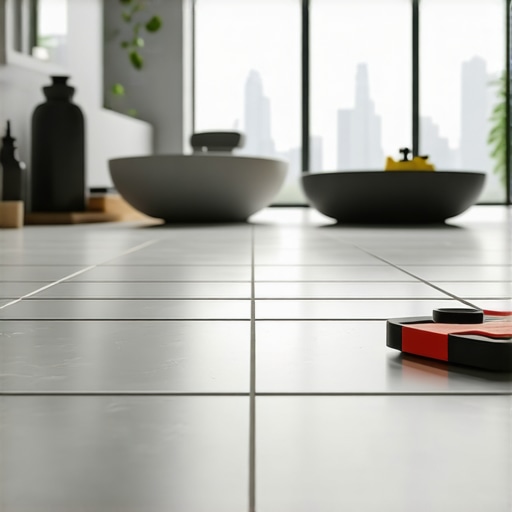
I spent three days grinding concrete on a job last month just so the floor wouldn’t click like a castanet. Most guys skip the leveling compound because they think the underlayment will hide the dip. It won’t. I have seen fifteen thousand dollar projects fail because a contractor thought he could compensate for a half inch slope with extra thin-set. It is a recipe for disaster. When you are dealing with large format tile, you are fighting the laws of physics and the inherent manufacturing limitations of the material itself. If you want a floor that feels like a single sheet of glass, you have to stop thinking like a decorator and start thinking like a structural engineer.
The ghost in the expansion gap
To stop tile lippage on large format bathroom floors, you must ensure the subfloor is flat within one eighth of an inch over ten feet. Use a mechanical leveling system and directional troweling to collapse mortar ridges. Avoid offset patterns greater than thirty three percent to minimize the impact of inherent tile bowing. Lippage is not just an eyesore, it is a structural failure that leads to chipped edges and grout degradation. In the moisture-heavy environment of a bathroom, uneven tiles create micro-pools where water sits, eventually eating away at the seal. Most people ignore the perimeter, but the expansion gap is where the floor breathes. If you lock the tile tight against the wall, the tension has nowhere to go but up. This creates a vertical shift that ruins the line of your chic baseboard designs.
Why your subfloor is lying to you
A subfloor may look flat to the naked eye but harbor significant deflection issues that cause large format tiles to lip once weight is applied. Concrete slabs often have high spots near the center and dips near the footings that exceed industry tolerances. Wood joist systems require L over seven hundred twenty stiffness. Deflection is the silent killer of the modern bathroom. When you step on a tile, the floor should not move. If the subfloor flexes even a millimeter, the rigid bond of the thin-set will crack or the tile will pop. I always pull a string line across the room before I even open a box of tile. If I see light under that string, the floor is not ready. Most homeowners want the latest showers that wow, but they forget that the beauty of those designs relies on the invisible work of self-leveling underlayment. You cannot fix a bad floor with expensive tile.
“A floor is only as good as the subfloor beneath it; deflection is the enemy of every joint.” – Master Flooring Axiom
The three millimeter margin of error
Large format tiles are defined as any tile with at least one edge longer than fifteen inches. These tiles often have a natural bow from the kiln firing process. Stopping lippage requires understanding that the center of the tile is slightly higher than the edges, necessitating specific installation patterns. When a tile is fired at two thousand degrees, it warps. It is unavoidable. If you try to do a fifty percent offset, also known as a brick pattern, you are putting the lowest point of one tile next to the highest point of the next. That is where you get those sharp edges that stub your toes in the dark. You have to use a one third offset to mask this bowing. This is especially true when integrating eco-friendly tile solutions that might have different thermal expansion rates than standard ceramic. You are managing the microscopic curvature of stone.
| Substrate Type | Max Deviation (10ft) | Recommended Underlayment | Cure Time |
|---|---|---|---|
| Concrete Slab | 1/8 inch | Self-Leveling Compound | 24 Hours |
| Plywood Subfloor | 1/8 inch | Uncoupling Membrane | Instant |
| Cement Board | 1/16 inch | Fiber-Reinforced Mortar | 12 Hours |
The chemistry of the mortar bed
Standard thin-set is not designed for large format tile because it shrinks as the water evaporates, pulling the tile down and creating lippage. You must use a Large and Heavy Tile mortar, formerly known as medium-bed mortar, which maintains its volume during the curing process. This is about the molecular structure of the adhesive. LFT mortars have specialized polymers that hold the tile in place without allowing it to slump into the low spots. If you use cheap thin-set, you will go to bed with a level floor and wake up with a mess. The ridges you comb with your trowel need to be straight and collapsed in the same direction. Swirling the trowel creates air pockets. Air pockets are weak points. When the mortar cures, those pockets collapse unevenly. If you are working on showers with a style that uses large slabs, this bond is the only thing keeping your walls from shedding stone.
The mechanical advantage of leveling clips
Leveling systems are not a crutch for bad installers but a precision tool to force tiles into a single plane while the mortar sets. These systems use wedges or caps to pull the low tile up and push the high tile down until they lock. I have seen old-timers mock these systems, but they are usually the ones leaving lippage behind. A clip system ensures that the tension is distributed across the entire surface. You have to be careful with the pressure, though. If you over-tighten, you can actually snap the corner of a porcelain tile. It is a delicate balance of torque and patience. Once the clips are in, you leave them alone. Walking on a freshly clipped floor is a sin. You will break the bond, and then no amount of leveling will save you. After the floor is set, you kick the clips off and prepare for the next phase. This is the stage where you consider how baseboards makeover ideas will cover your perimeter gaps.
- Check subfloor flatness with a 10 foot straightedge
- Apply an uncoupling membrane to prevent lateral stress cracks
- Select a Large and Heavy Tile (LHT) mortar with high polymer content
- Use a 1/2 inch by 1/2 inch square notched trowel
- Back-butter the tile to ensure 95 percent coverage
- Engage a mechanical leveling clip system on every edge
- Maintain a consistent 1/3 offset pattern
The 1/8 inch that ruins everything
Grout joints on large format floors should never be smaller than one eighth of an inch to allow for minor adjustments in tile sizing. Micro-joints look great in photos but lead to lippage because there is no space to transition between slight height differences. If the tiles are too close, you cannot slope the grout to hide a hair-width difference in height. If you want that high-end look, use a color-matched grout that blends the lines away. If your grout starts to fail later, you need to look into grout restoration secrets to keep the system waterproof. A bathroom is a wet environment. Every gap and every lip is a place for water to penetrate. I always tell my clients that a floor is a system. It is the subfloor, the membrane, the mortar, the tile, and the grout working in harmony. If one piece of the chemistry is off, the whole thing fails. For those looking to maintain their investment, following tile cleaning tips is the final step in preserving that flat finish. If you have questions about specific materials, you can always contact us for a consultation. Proper maintenance ensures that your grout refresh happens every decade, not every six months.