
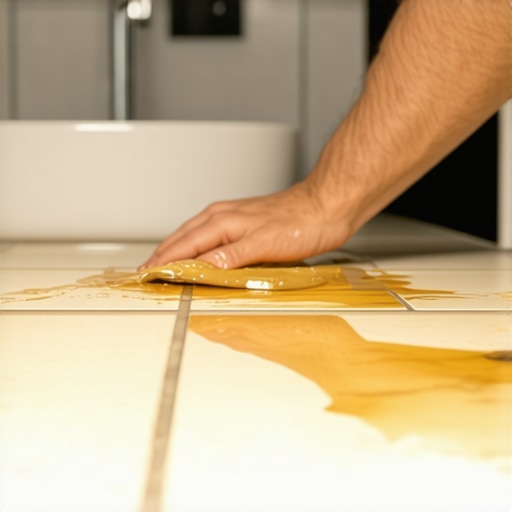
The Mistake Homeowners Make When Cleaning Penny Tile Grout
The most frequent error in maintaining penny tile grout is the application of acidic cleaning agents that chemically dissolve the cementitious matrix of the joint. Because penny tiles possess an exponentially higher grout-to-tile ratio compared to large-format ceramics, any chemical erosion quickly leads to structural instability and moisture penetration. This degradation often remains invisible until the subfloor fails. I have spent thirty years fixing floors that looked beautiful on the surface but were rotting from the inside out because a homeowner thought vinegar was a safe, natural cleaner. Last year, I walked into a bathroom in a high-end coastal home where the penny tile was literally floating. The homeowner had been using a lemon-based spray for two years. The acid had eaten through the top three millimeters of the grout, allowing water to bypass the waterproofing and saturate the thin-set. The entire floor had to be ripped out, a ten thousand dollar mistake that could have been avoided with a pH-neutral bottle of soap. Flooring is not about aesthetics; it is about the physics of water management. When you install penny tile in showers, you are creating a complex network of thousands of tiny dams. If you weaken those dams, the system fails.
The physics of penny tile surface area
Penny tiles create a honeycomb of grout joints that occupy nearly twenty percent of the total floor surface area. This density means the grout is the primary structural component that absorbs foot traffic and manages water runoff. Homeowners often overlook the fact that smaller tiles require more grout, which increases the potential for capillary action to draw moisture into the substrate. Unlike a 12×24 tile which has minimal joint exposure, penny tile is a grit-heavy environment. This makes the selection of cleaning materials a matter of chemical engineering rather than simple housekeeping. Every joint is a potential point of entry for moisture. If you are looking for tile options that minimize this risk, you have to understand the bond between the ceramic edge and the cement. The 1/8 inch gap is the only thing standing between your subfloor and a mold infestation. To understand how to manage this properly, you might want to look at tile cleaning tips for a sparkling bathroom in 2025 to avoid the common pitfalls of abrasive scrubbing.
“A floor is only as good as the subfloor beneath it; deflection is the enemy of every joint.” – Master Flooring Axiom
The chemistry of cementitious erosion
Standard grout is a mixture of Portland cement and sand which relies on a high pH level to maintain its structural integrity. When you introduce acidic cleaners like vinegar or citrus-based solutions, a chemical reaction occurs that breaks down the calcium carbonate bonds within the grout. This process, known as leaching, leaves the grout porous and brittle, which eventually leads to cracking and fallout. I often see homeowners who wonder why their grout is turning into a fine powder. They think they are cleaning it, but they are actually deconstructing it. In regions with high humidity like the Gulf Coast, this porous grout becomes a breeding ground for mildew that cannot be reached by surface cleaning. The moisture gets trapped in the micro-fissures created by the acid. If you are dealing with aged surfaces, you should investigate grout restoration secrets for long lasting results to see how to stabilize these chemical bonds before the damage becomes irreversible. You have to treat the grout as a living cement, not a plastic filler.
| Grout Type | Joint Width Requirements | Moisture Absorption Rate | Chemical Sensitivity |
|---|---|---|---|
| Sanded Grout | 1/8 inch to 1/2 inch | High | High |
| Unsanded Grout | Less than 1/8 inch | Very High | Extreme |
| Epoxy Grout | Variable | Near Zero | Low |
Why your baseboard transition is a hidden hazard
The interface between the penny tile floor and the baseboards is the most common site for catastrophic water intrusion in a bathroom. Most installers fail to leave a proper expansion gap or they fill that gap with hard grout instead of a high-quality 100 percent silicone sealant. As the house shifts and the wood baseboards expand with seasonal humidity, the rigid grout at the perimeter cracks. These hairline fractures act as a funnel for water used during cleaning. In dry climates like Arizona, the wood shrinks so much it pulls the grout away from the wall. In humid areas like Florida, the baseboards swell and crush the grout. You need to ensure that your baseboards are installed with a sacrificial joint of caulk. For those looking to upgrade these transitions, exploring baseboards makeover ideas to elevate your space can provide insights into moisture-resistant materials that handle these stresses better than standard pine. If you ignore this perimeter, you are essentially pouring water behind your walls every time you mop.
The danger of high pressure scrubbing
Mechanical force is another area where homeowners ruin penny tile by using stiff-bristled brushes or power scrubbers that exceed the shear strength of the grout. Penny tile circles have a limited contact area with the thin-set, meaning they rely on the surrounding grout for lateral stability. If you blast the grout out with high-pressure water or a wire brush, you are loosening the tiles themselves. This is particularly problematic in showers where the constant cycle of wetting and drying already stresses the bond. I have seen entire sections of penny tile pop off the floor because someone used a steam cleaner at too high a temperature. The thermal expansion of the moisture trapped under the tile creates enough pressure to blow the tile off the mortar bed. Instead of force, you should focus on chemical suspension. Use a cleaner that lifts the dirt to the surface so it can be wiped away. For modern aesthetic inspiration that balances beauty with these technical realities, see showers that wow modern designs for 2025. You want a design that is maintainable, not just pretty for a photograph.
- Always use a pH-neutral cleaner specifically formulated for stone or tile.
- Avoid all steam cleaners on penny tile installations to prevent thermal shock.
- Apply a high-quality penetrating sealer every six to twelve months.
- Use a soft nylon brush for agitation instead of metal or stiff plastic.
- Dry the floor completely after cleaning to prevent mineral buildup and efflorescence.
The role of capillary action in shower basins
Capillary action is the movement of water through tiny spaces without the assistance of gravity, and in penny tile, this is the primary cause of subfloor rot. When grout is improperly cleaned and its seal is broken, it acts like a wick. It pulls water from the surface down into the mud bed or the backer board. In many older homes, I find that the weep holes in the drain assembly are clogged with a mixture of hair and soap scum, which causes water to back up under the tile. If the grout is compromised, this water has nowhere to go but into the framing of the house. This is why I always tell people that the most important tool for cleaning a floor is a dry towel. You should never leave standing water on a penny tile floor after you are done mopping. The water will find the smallest crack in the grout and migrate downward. If you are struggling with grout that is already stained or failing, you should learn how to refresh grout without replacing it before the structural layers are affected. It is a race against time and gravity.
“Water is a persistent solvent; it will find the path of least resistance through any compromised seal.” – Master Flooring Axiom
The technical path forward for homeowners
Maintaining a penny tile floor requires a shift in perspective from cleaning to preservation. You are the steward of a complex masonry system. Stop looking for the strongest chemical on the shelf and start looking for the most compatible one. Check the labels for words like sodium hydroxide or phosphoric acid and put those bottles back. Those chemicals are meant for industrial applications, not your bathroom floor. In a humid environment, your goal is to keep the grout as hydrophobic as possible. This means regular sealing and gentle maintenance. If you are planning a renovation and want to avoid these headaches, perhaps look into showers with a style trendy ideas for small bathrooms that use larger tiles to reduce the grout footprint. But if you love the look of the penny, you must respect the science of the cement. A well-maintained penny tile floor can last fifty years, while a neglected one won’t last five. It all comes down to the chemistry of the bucket and the discipline of the homeowner. Never underestimate the power of a simple, neutral cleaner and a dry cloth. It is the difference between a lifetime of service and a catastrophic failure of the home’s envelope. “, “image”: {“imagePrompt”: “A macro high-resolution photograph showing a close-up of white penny tiles with grey grout, where the grout is pitted and eroded from acidic cleaners, moisture droplets sitting on the surface.”, “imageTitle”: “Eroded Penny Tile Grout Close Up”, “imageAlt”: “Macro view of damaged grout joints in a penny tile shower floor showing chemical erosion.”}, “categoryId”: 5, “postTime”: “2025-05-20T10:00:00Z”}