
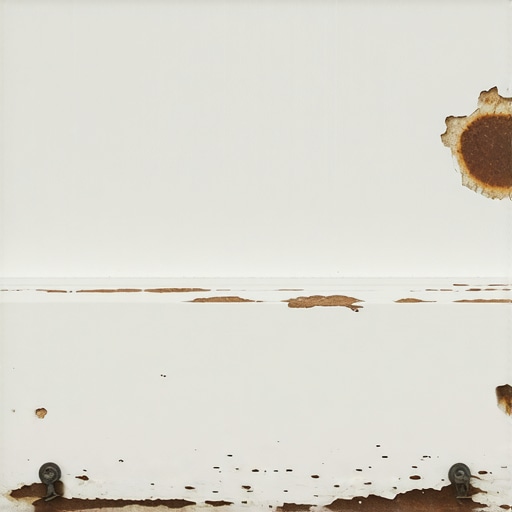
I spent three days grinding concrete on a job last month just so the floor would not click like a castanet, but the real nightmare was the perimeter. I walked into a luxury renovation where the homeowner was frantic because small, circular orange stains were bleeding through their fresh white trim. They blamed the painter. They blamed the paint brand. They even blamed the air conditioning. I took one look at the baseboards and knew the truth. The installer had used interior finish brads without checking the slab moisture or the vapor retarder. It was a classic case of subfloor betrayal. The moisture was wicking up from the earth, through the concrete, and right into the back of those raw steel nails. It did not matter how many coats of high-gloss latex they slapped on top. Chemistry does not care about your aesthetic. If you have moisture migration, your steel will oxidize. It is that simple. Flooring is a structural engineering challenge, and if you treat it like a craft project, the house will eventually win.
The physics of capillary rise in concrete
Concrete slabs act like a hard sponge, pulling water from the earth through capillary action. This moisture migrates upward as vapor, eventually hitting the wood baseboards and metal fasteners. When the relative humidity in the subfloor exceeds 75 percent, oxidation begins on unprotected steel nails, leading to visible rust spots through the paint film. This is why testing your slab with a calcium chloride test or an in-situ probe is mandatory. You cannot guess the moisture content of a slab by looking at it. Water molecules are small enough to pass through the crystalline structure of the concrete. When these molecules reach the base of the wall, they find the path of least resistance, which is often the porous end grain of your baseboards and the puncture sites created by your nail gun. To understand how to handle this, you might look at baseboards makeover ideas to elevate your space but remember that no design survives a wet foundation.
“A floor is only as good as the subfloor beneath it; deflection is the enemy of every joint.” – Master Flooring Axiom
The chemical reaction of iron oxide beneath the paint
Rust is the result of an electrochemical process called oxidation that occurs when iron, oxygen, and water meet. In the context of baseboards, the steel nail provides the iron, the humid air or damp wood provides the water, and the porous nature of wood provides the oxygen. When these three elements converge, the iron atoms lose electrons to the oxygen atoms, forming iron oxide. This substance expands as it forms, often cracking the paint film from the inside out. This expansion is why you see a small bump or a cratered appearance before the orange stain even appears. Standard interior brads are often made of bright steel, which has zero corrosion resistance. Once the moisture from a damp slab or a recently cleaned tile floor reaches that steel, the clock starts ticking. If you are dealing with dampness around your tile, you should prioritize tile cleaning tips for a sparkling bathroom in 2025 to ensure you are not adding excess water to the system.
How grout and tile choice affects baseboard health
Porous grout lines can act as conduits for water to travel into the wall cavity and reach baseboard fasteners. When homeowners mop their floors with excessive water, the liquid sits in the grout joints and eventually migrates toward the perimeter of the room. If there is no proper expansion gap filled with 100 percent silicone sealant, that water hits the bottom of the baseboard. Capillary action pulls the water up the back of the wood, where it sits against the nail shafts. This is especially common in bathrooms and laundry rooms where humidity levels are naturally higher. Proper maintenance of these surfaces is vital. Learning about grout restoration secrets for long-lasting results can help keep the barrier between your floor and your walls intact. A well-sealed grout joint prevents the lateral migration of moisture that typically ruins a trim job.
| Nail Type | Material Composition | Corrosion Resistance | Recommended Environment |
|---|---|---|---|
| Bright Finish | Raw Steel | None | Climate-controlled upstairs rooms |
| Electro-Galvanized | Zinc-coated Steel | Moderate | General residential use |
| Stainless Steel (304) | Chromium-Nickel Alloy | High | Bathrooms and laundry rooms |
| Stainless Steel (316) | Molybdenum Alloy | Extreme | Coastal regions and high-moisture slabs |
The failure of the paint membrane as a moisture barrier
Paint is a breathable membrane designed to let vapor pass through while stopping liquid water, but it cannot stop internal oxidation. Many homeowners assume that a thick layer of paint will seal the nail head and prevent rust. This is a fundamental misunderstanding of fluid dynamics. The rust originates from the shank of the nail, which is buried deep within the wood and exposed to the dampness of the wall cavity. As the rust expands, it pushes outward, eventually puncturing the paint from the backside. Once the paint film is compromised, the stain bleeds through. This is why you must use the right materials from the start. If you are planning a redesign, consider chic baseboard designs that transform rooms in 2025 while ensuring your installer uses stainless steel fasteners. Using the wrong nail is like building a skyscraper on a sandcastle. It does not matter how pretty the top looks if the bottom is dissolving.
“Subfloor moisture is the primary cause of flooring failure, yet it remains the most neglected variable in residential construction.” – NWFA Technical Guidelines
The technical checklist for moisture remediation
- Check the concrete slab with an RH probe to ensure moisture levels are below 75 percent.
- Install a 6-mil polyethylene vapor barrier under any floating floor systems.
- Use 304-grade stainless steel nails for all baseboard installations in contact with concrete.
- Apply a high-quality primer to the back and bottom edges of all wood trim before installation.
- Leave a 1/4 inch expansion gap between the floor and the wall, filled with flexible silicone.
- Never install baseboards before the house has reached its final equilibrium moisture content.
Solutions for a dry and stable foundation
Remediating rusted baseboard nails requires removing the affected trim and addressing the root cause of the moisture. You cannot simply sand the rust away and repaint. The iron oxide is already embedded in the wood fibers and will return. The correct procedure involves removing the baseboards, checking the moisture levels in the drywall and the bottom plate of the wall, and then sealing the slab-to-wall transition. If the moisture is coming from the floor itself, you may need to look at how to refresh grout without replacing it to create a better water seal. Once the moisture is controlled, reinstall the trim using stainless steel brads. This ensures that even if a small amount of vapor remains, the fasteners will not react. It is about building for the worst-case scenario. It is about understanding that wood and metal are in a constant state of flux. If you want a floor that lasts, you have to respect the chemistry of the room. This is the difference between a floor that looks good today and a floor that looks good in a decade.