
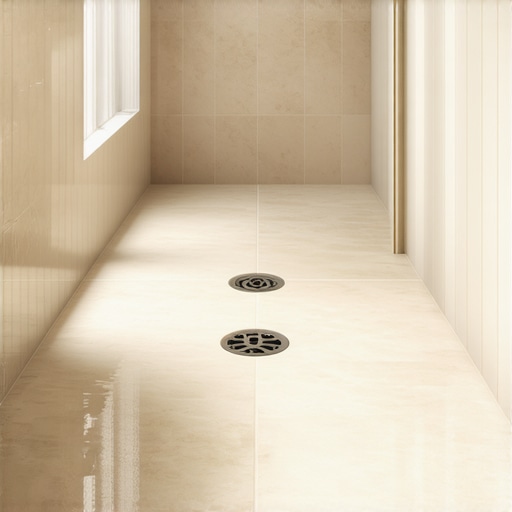
The hidden physics of standing water
A shower floor fails when the gravitational force required to move water toward the drain is overcome by surface tension or improper substrate geometry. Most installers ignore the fundamental math of the quarter inch per foot rule. If your shower has a puddle, the builder likely skipped the pre-slope or used a leveling compound that could not withstand the hydrostatic pressure of daily use. It is a structural engineering failure that begins long before the first tile is ever set. Most guys skip the leveling compound. They think the underlayment will hide the dip. It won’t. I spent three days grinding concrete on a job last month just so the floor wouldn’t click like a castanet. That same negligence happens in showers. If the subfloor is not dead level before the mud bed goes in, the entire system is built on a lie.
The pre slope determines your fate
Shower floor slope requires a minimum pitch of one quarter inch per foot toward the drain to ensure proper evacuation of water through the grout and tile surface. This geometry must exist at the subfloor level before the waterproof membrane is installed. If the membrane sits flat on the floor, water will sit in the pan forever. This leads to stagnant water, mold growth, and the eventual decay of the wooden framing or the degradation of the concrete slab. Water is heavy. It is relentless. It seeks the path of least resistance. When that path is a flat liner, the water stays put. It creates a swamp under your feet. Many installers try to fix the slope with thin-set during the tile installation. This is a recipe for disaster. Thin-set is an adhesive, not a structural filler. When used too thick, it shrinks. When it shrinks, it pulls the tile. The result is a series of ‘birdbaths’ where water pools despite the surface looking correct. You should look at showers that wow modern designs for 2025 to see how professional sloping looks in a finished product. If you do not get the pre-slope right, the beautiful tile is just a mask for a rotting core. I have seen thousand dollar mosaics ripped out because the installer forgot that gravity is not optional. It is the law. The TCNA guidelines are clear on this. There is no room for ‘close enough’ in a wet environment. You measure the height at the wall and the height at the drain. The math does not lie. If the delta is not at least a quarter inch for every twelve inches of travel, you have a problem. The capillary action of water means it can even travel uphill slightly if the surface tension is strong enough. You need the mechanical advantage of a steep enough grade to break that tension and force the water down the pipes.
“A floor is only as good as the subfloor beneath it; deflection is the enemy of every joint.” – Master Flooring Axiom
[image_placeholder]
The chemical reality of modified thin set
Polymer modified thin-set mortars use liquid latex or powdered polymers to increase bond strength and flexibility within the shower floor assembly. These chemicals allow the tile to withstand the expansion and contraction caused by temperature fluctuations during a hot shower. However, if the slope is wrong, these chemicals remain submerged in water. This leads to a process called re-emulsification. The polymers soften. The bond breaks. The grout starts to crack. This is why you see grout restoration secrets for long-lasting results frequently discussed by pros. When the slope is correct, the thin-set dries out between uses. When the slope is flat, the thin-set stays wet. It eventually turns back into a mushy paste. I have lifted tiles from five-year-old showers where the thin-set was still wet to the touch. That is not a leak. That is a slope failure. The water is trapped in the ‘valleys’ of the mortar. This constant moisture also affects the chic baseboard designs that transform rooms in 2025 that might be sitting just outside the shower door. Moisture wicks through the wall. It hits the baseboards. The wood swells. The paint peels. It all starts because a guy with a level was too lazy to check his work. We are talking about the molecular level of adhesion. Cement crystals grow and lock into the pores of the tile. If water is always present, those crystals cannot maintain their integrity. They dissolve. They crumble. The floor becomes a floating island of ceramic held together by hope and dirty grout. You need a mechanical bond that is supported by a dry environment. The only way to get a dry environment in a shower is through perfect drainage. There are no shortcuts. You cannot use more sealer to fix a bad slope. You cannot use better grout to fix a bad slope. You must have the angle.
The birdbath phenomenon in large format tile
Large format tiles create a specific challenge for shower slopes because they cannot conform to a complex bowl shaped drain area without lippage. When a contractor tries to put a 12 by 24 inch tile in a small shower, they have to ‘envelope cut’ the tile. If they do not, they create flat spots. These flat spots are known as birdbaths. Water sits in the middle of the tile. It never reaches the grout lines. It never reaches the drain. It just evaporates, leaving behind soap scum and hard water minerals. This makes tile cleaning tips for a sparkling bathroom in 2025 much harder to follow. You are fighting a losing battle against physics. The mineral deposits build up. They create a slip hazard. They ruin the aesthetic. You can avoid this by using smaller tiles or linear drains. A linear drain allows for a single plane slope. One direction. One angle. It eliminates the need for the complex four-way pitch. It is the modern solution for the modern home. But even with a linear drain, if the floor is not flat and sloped, you will get pooling at the edges. I always tell my clients that the drain choice is as much about the engineering as it is about the looks. If you want the big tiles, you need the linear drain. If you want the traditional center drain, you need pebbles or small mosaics. The smaller the tile, the better it can follow the curve of the slope. Think of it like pixels on a screen. More pixels mean a smoother curve. Larger tiles are like huge blocks. They cannot make a curve without sticking their corners up. That is called lippage. It will stub your toe. It will trap water. It will ruin your morning.
| Slope Characteristic | Requirement | Impact of Failure |
|---|---|---|
| Minimum Pitch | 1/4 inch per foot | Standing water and mold |
| Maximum Pitch | 1/2 inch per foot | Slip hazard and unstable footing |
| Pre-slope Layer | Below the liner | Saturated mortar bed and rot |
| Surface Slope | Above the liner | Direct water evacuation |
The ghost in the expansion gap
Expansion gaps are the silent protectors of a shower installation, allowing the different materials to move at varying rates without cracking the grout. Every shower meets a wall. Every wall is made of different stuff than the floor. When you turn on the hot water, the tile expands. When you turn it off, it contracts. If there is no gap filled with 100 percent silicone, the tile will push against the wall. This pressure has nowhere to go. It forces the tile to tent or the grout to crumble. This is why you should learn how to refresh grout without replacing it before the damage becomes structural. I see people use hard grout in the corners all the time. It is a rookie mistake. It will crack in three months. The house moves. The floor moves. The shower is a living thing. You need a soft joint at every change of plane. That means where the floor meets the wall and where the wall meets the wall. Silicone is your friend. It is flexible. It is waterproof. It handles the stress that cement cannot. If your shower floor is sloped correctly but your corners are cracked, you still have a water problem. Water will find that crack. It will go behind the tile. It will bypass the slope entirely. It will rot the studs. It will create a hidden disaster. You must respect the movement of the building. A shower is a rigid box inside a moving frame. If you do not give it room to breathe, it will break itself apart. This is the structural reality of the trade. It is not just about making things look pretty. It is about making them last. I have seen beautiful showers that were trash within a year because the installer did not understand the physics of thermal expansion. They built it too tight. The house breathed, and the shower choked.
“Waterproofing is not a suggestion; it is a thermal and hydraulic barrier that must be continuous and sloped.” – TCNA Handbook
Common failures in shower floor construction
- Skipping the pre-slope underneath the waterproof liner.
- Using a flat subfloor with a center drain.
- Incorrectly installing the weep holes in the drain assembly.
- Using too much thin-set to correct a lack of slope.
- Installing large format tiles without envelope cuts.
- Failure to use 100 percent silicone in change of plane joints.
- Ignoring the moisture content of the wood subfloor before installation.
The 1/8 inch that ruins everything
Small deviations in the levelness of the perimeter can cause water to migrate away from the drain and pool against the baseboards or the curb. If the back left corner is one eighth of an inch lower than the drain, that is where the water will go. It does not matter how much you spent on the tile. It does not matter how good the grout looks. You will have a puddle. You will have a smell. You will have a problem. This is why I use a laser level for every single pan. I want to see the light hit the same mark all the way around the room. I want to see the bubble in the center of the vial. Precision is the difference between a master and a handyman. A handyman guesses. A master knows. If you are worried about the state of your bathroom, you can always contact us for a professional evaluation. We see these failures every week. People think they can save a few bucks by hiring the guy with the lowest bid. That guy is going to skip the pre-slope. He is going to use cheap thin-set. He is going to leave you with a shower that smells like a wet dog. You have to do it right the first time. There is no easy fix for a bad slope. You have to rip it out. You have to start over. It is a painful lesson to learn. But it is a lesson that stays with you. When you see the water flowing perfectly into the drain, you know the job was done right. You know the subfloor is dry. You know the house is safe. That is the peace of mind that comes from following the rules of physics. Don’t fight gravity. It always wins. Use it to your advantage. Pitch the floor. Seal the joints. Walk away knowing it will last fifty years instead of five. That is the mark of a craftsman. That is the standard we should all strive for in every installation. The chemistry of the bond and the physics of the slope are the twin pillars of a successful floor. If one fails, the other cannot save it. You need both to work in harmony. You need the right products and the right technique. Anything less is just a temporary decoration that will eventually fail and cause more harm than good.