
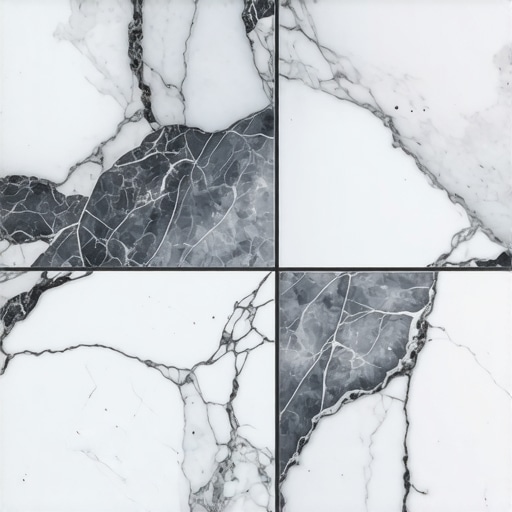
I once stood in a three million dollar penthouse where the master bath looked like a crime scene. The owner had paid forty dollars a square foot for premium Carrara marble, only to watch it turn a sickly, bruised grey within six months. The installer blamed the stone. The stone supplier blamed the homeowner. I walked in with a moisture meter and a grinder, and I knew exactly what happened. The subfloor was a wet sponge, and the stone was drinking it. Marble is not a solid, impenetrable surface. It is a dense, metamorphic rock filled with microscopic tunnels. When you put it in a wet environment like a shower without proper drainage or the right chemistry, you are asking for a geological disaster.
The geological reality of marble porosity
White marble tiles turn grey because the stone absorbs moisture and contaminants through its capillary network, often reacting with iron deposits inside the rock or pulling dirty water from the setting bed. This phenomenon occurs when the moisture content within the stone exceeds the evaporation rate, leading to a saturated appearance that persists as a dark grey shadow. Understanding the density of your stone is the first step in preventing this expensive failure. Marble typically has a porosity rating between 0.5 percent and 2.0 percent. This sounds small, but on a molecular level, it represents billions of open pores ready to suck up anything they touch. If the water behind the tile cannot escape, it sits in those pores and changes the refractive index of the stone. This makes the marble look darker, just like a white t-shirt looks grey when it gets wet. If your tiles are in the shower, check out showers that wow modern designs for 2025 to see how professional waterproofing makes a difference.
“The use of white thin-set is mandatory for light-colored translucent stones to prevent shading and discoloration.” – Master Flooring Axiom
The chemistry of iron oxidation within the stone
Iron oxidation occurs when the naturally occurring pyrite or iron sulfides within marble come into contact with water and oxygen, causing a chemical reaction that creates grey or yellow staining. This is not a surface stain. This is a cellular level change within the stone. When these iron minerals oxidize, they expand and bleed into the surrounding calcite. This is why a perfectly white slab can look like it is rusting or rotting from the inside out. This often happens in showers with a style trendy ideas for small bathrooms where the ventilation is poor and the stone never truly dries. You are essentially watching a slow-motion chemical fire happen inside your bathroom floor. Once the iron has oxidized, it is nearly impossible to reverse without professional-grade poultices that can pull the metal ions out through the stone face.
How thinset color ruins your aesthetic
Using grey thin-set under white marble is a fundamental installation error that causes the dark mortar to telegraph through the translucent stone as a muddy grey hue. I see this in low-bid jobs where the contractor uses whatever bags are on the truck. White marble is often translucent. If you put a dark grey adhesive behind it, the light enters the stone, hits the grey mortar, and reflects back as a shadow. This is why the TCNA (Tile Council of North America) specifically mandates white thin-set for marble. Furthermore, if the installer did not use a notched trowel followed by back-buttering to achieve 100 percent coverage, you will see the trowel lines through the tile. Those lines look like long, grey ghosts running across your floor. It is a sign of a hack job. Proper installation requires a smooth, consistent white bed of mortar that reflects light back to the eye.
| Marble Type | Porosity Level | Iron Content | Discoloration Risk |
|---|---|---|---|
| Carrara | Medium | High | High |
| Calacatta | Low | Medium | Moderate |
| Thassos | Very Low | Very Low | Low |
| Statuary | Medium | High | High |
The moisture trap under your baseboards
Moisture often collects at the perimeter of a room where the tile meets the wall, leading to greying edges that spread inward as the subfloor remains saturated. If the gap between the tile and the wall is not properly caulked or if the baseboards makeover ideas to elevate your space were installed with nails that punctured a moisture barrier, water will find a home there. This is particularly common in bathrooms where cleaning water or shower overspray hits the baseboard and seeps down. The water has nowhere to go, so the marble wicks it up. I have seen entire bathrooms ruined because someone used a wet mop and let the water sit against the wall. To prevent this, you need a high-quality sealant and a proper expansion joint at the perimeter. For more on keeping these areas clean, see tile cleaning tips for a sparkling bathroom in 2025.
- Always use a moisture meter on the subfloor before laying a single stone.
- Verify that the mortar is a high-quality, polymer-modified white thin-set.
- Ensure 100 percent mortar coverage to avoid air pockets that trap moisture.
- Apply a high-quality impregnating sealer, but only after the stone is bone dry.
- Install a proper vapor barrier if you are on a concrete slab on grade.
The failure of the topical sealer
Sealing a damp marble tile traps moisture inside the stone, preventing it from breathing and causing a permanent grey haze known as moisture entrapment. This is the most common mistake I see. An installer finishes the job, the stone looks great, and they immediately slap a sealer on it. But that stone is still full of the water from the wet-saw and the mortar. You have just locked that water in a cage. The water eventually turns to vapor but cannot escape the sealer, so it sits in the pores and darkens the stone. You must wait at least 72 hours, sometimes a week depending on humidity, before sealing marble. If you have already made this mistake, you might need grout restoration secrets for long-lasting results to help vent the system and clean out the minerals. If the grout is also failing, you can learn how to refresh grout without replacing it to improve the overall look while the stone dries out.
“A floor is only as good as the subfloor beneath it; deflection is the enemy of every joint.” – Master Flooring Axiom
The physics of the mud bed and drainage
A poorly sloped mud bed or a clogged weep hole in a shower drain will cause water to back up into the stone, leading to a saturated grey appearance from the bottom up. In a shower, there is a liner beneath the tile. If the installer didn’t put pea gravel around the weep holes of the drain, those holes get plugged with mortar. The water then sits on top of the liner and has to go somewhere. It goes into your marble. This is why you see marble showers that look dark at the bottom but light at the top. It is literally drowning. Professional installers use a “pre-slope” to ensure water moves toward the drain even under the tile. If your installer skipped the pre-slope, your marble is destined to be grey forever. You might want to look into chic baseboard designs that transform rooms in 2025 if you are planning a full tear-out and remodel to fix these structural issues. Building it right the first time is the only way to keep white marble white.