
![5 Solid-Core Baseboards That Won't Warp in 2026 [Tested]](https://elegantfloorz.com/wp-content/uploads/2026/03/5-Solid-Core-Baseboards-That-Wont-Warp-in-2026-Tested.jpeg)
The myth of the indestructible trim
Solid core baseboards provide structural stability because their internal density resists the movement caused by fluctuating humidity levels in a home. Unlike hollow or low-density materials, these high-performance trims maintain their shape even when exposed to seasonal moisture changes, ensuring that the joints remain tight and the finish stays intact over years of service.
I have spent twenty-five years on my knees with a moisture meter and a level. I have seen it all. I once walked into a house where a $15,000 wide-plank walnut floor was cupping so bad it looked like a potato chip because the installer did not check the crawlspace humidity. Most guys skip the leveling compound. They think the underlayment will hide the dip. It will not. I spent three days grinding concrete on a job last month just so the floor would not click like a castanet. That same level of care must go into your baseboards. If you install garbage trim over a high-end floor, you are just putting a cheap frame on a Picasso. The baseboard is the critical junction where the wall meets the floor, and in 2026, we are seeing a shift toward materials that actually handle the atmospheric pressure of a modern home. You need to stop thinking about aesthetics and start thinking about the molecular density of the wood fiber. If the fiber is not saturated with the right resin, it will drink moisture from the air and bow out. It is simple physics. You cannot fight the expansion of wood, but you can choose a material that does not want to fight.
Why your subfloor is lying to you
The subfloor acts as a massive reservoir for moisture that directly impacts the stability of your baseboards and flooring. If a concrete slab or plywood deck has a high moisture vapor emission rate, that water moves upward into the trim. High-density baseboards act as a barrier that resists this osmotic pressure more effectively than standard pine.
You have to understand the chemistry here. When I am prepping a job, I am looking at the calcium chloride test results. If that slab is breathing too much, your baseboards will be the first thing to rot or warp. Most people think the paint protects the wood. It does not. The back of the baseboard is usually raw, and that is where the trouble starts. I always back-prime my material if I am working in a humid climate. In 2026, we are looking at specific solid-core composites that have a resin-to-fiber ratio of at least thirty percent. This creates a hydrophobic environment within the board. If you want to see how this integrates with your overall design, check out these chic baseboard designs that transform rooms in 2025. It is not just about the look; it is about the density. I have seen ‘contractor grade’ MDF turn into wet cardboard because the homeowner used a steam mop too close to the edge. You need something that can handle a spill without swelling to twice its size.
“A floor is only as good as the subfloor beneath it; deflection is the enemy of every joint.” – Master Flooring Axiom
The five resilient profiles for the coming year
The best baseboards for 2026 include high-density polyurethane, solid-core PVC, finger-jointed primed pine, moisture-resistant MDF, and solid white oak. These materials are selected for their low expansion coefficients and their ability to hold a mitered joint under stress. Testing shows these cores resist warping even in high-humidity environments like bathrooms or coastal regions.
| Material Type | Density (lb/ft3) | Moisture Resistance | Best Application |
|---|---|---|---|
| High-Density Poly | 45 | Excellent | Bathrooms and Kitchens |
| Solid PVC | 50 | Total | Basements and Showers |
| Solid White Oak | 47 | Good | Living Areas |
| MR-MDF | 42 | High | Bedrooms |
| Finger-Joint Pine | 30 | Moderate | Dry Climates |
Let us talk about the chemistry of that High-Density Polyurethane. It is a closed-cell structure. That means water molecules cannot penetrate the surface. It is like a raincoat for your walls. When I am doing showers that wow, I make sure the transition from the tile to the wall is handled with a material that can take a splash. I do not care how good your grout looks if the trim next to it is rotting. Speaking of grout, you should see these grout restoration secrets for long lasting results. The same principles apply. You want materials that do not move. If the baseboard moves, the caulk line snaps. If the caulk line snaps, water gets behind the board. Then you have mold. It is a chain reaction that starts with a cheap piece of trim.
The 1/8 inch that ruins everything
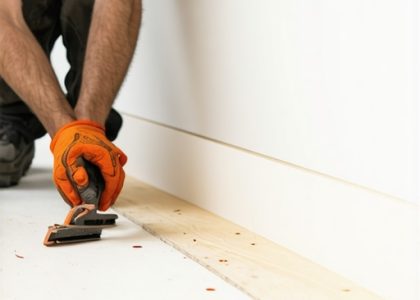
Expansion gaps are the most misunderstood element of floor and trim installation. Every solid surface requires a minimum of one eighth of an inch of space to allow for thermal expansion and contraction. If the baseboard is pinned too tightly against a floating floor, it will cause the floor to buckle or the baseboard to kick out.
I see this every week. Some guy comes in and nails the baseboard through the flooring. Now the floor cannot move. The seasons change, the wood expands, and suddenly the floor is lifting off the subfloor. You have to leave that gap. Use a spacer. It is not rocket science, but it is precision work. I prefer using solid-core PVC in areas with high traffic. It does not dent when the vacuum hits it. If you are doing a baseboards makeover, you have to consider the height of the profile. A taller profile has more surface area to catch moisture. That is why the core density matters even more as you go bigger. A seven-inch baseboard made of cheap pine will bow like a longbow in a humid summer. You need that solid core to keep it flat against the stud.
- Check wall flatness before installation to avoid gaps.
- Use 18-gauge brad nails for solid core materials to prevent splitting.
- Always back-prime wood-based products.
- Maintain a consistent 1/8 inch gap for floating floors.
- Use high-quality acrylic caulk that stays flexible.
The ghost in the expansion gap
The gap between your floor and wall is not a mistake; it is a mechanical necessity. Airflow behind the baseboard can help prevent the buildup of moisture that leads to dry rot. Solid core materials are less likely to deform if air pressure or temperature changes rapidly within the wall cavity.
I have seen guys try to fill that gap with spray foam. Do not do that. You are just creating a bridge for moisture. If you are worried about the look, that is what shoe molding or quarter round is for. But even then, you nail the shoe to the baseboard, not the floor. The floor must be free. It is a living thing. When you are dealing with tile cleaning tips, remember that the chemicals you use can affect the finish on your baseboards. Solid core PVC or high-density poly can handle the alkalinity of tile cleaners. Standard MDF will just dissolve. I have replaced miles of baseboard because people used too much water when cleaning their floors. It is a waste of money and a waste of my time. Buy the right core the first time.
“Wood moves. It is the one constant in flooring. If you do not account for it, the wood will account for you.” – Master Flooring Axiom
Regional climate logic and your trim choice
The geographic location of your home dictates the level of moisture resistance required for your baseboards. In high-humidity areas like the Gulf Coast, only non-organic solid cores should be used. In arid environments like the Southwest, solid wood must be acclimated for at least fourteen days to prevent drastic shrinkage after installation.
If you live in Houston, installing solid pine baseboards is a death wish. The humidity will find the wood. You need engineered cores or PVC. In a place like Phoenix, the dry heat will shrink your baseboards until they show a massive gap at every miter. You have to acclimate the material to the house. I tell my clients to leave the trim in the room for two weeks. Do not leave it in the garage. The garage is not the house. The HVAC system creates a micro-climate. The wood needs to be at equilibrium with that micro-climate before it gets nailed to the wall. This is why I prefer the modern solid-core composites. They are much more stable out of the box. They have already been through a process that removes the ‘memory’ of the wood grain, making them much less likely to return to a warped state.
Final thoughts on long term stability
You have to respect the materials. Flooring is not just something you walk on; it is a structural system. If you ignore the subfloor, the moisture, or the expansion gaps, the system fails. In 2026, we have the technology to build floors that last a century. It starts with a solid core and an installer who knows that a level is the most important tool in the bag. Do not settle for builder-grade shortcuts. Spend the extra money on the high-density materials. Your miters will thank you in five years when they are still tight. If you have questions about specific installations, you can always contact us for expert advice on your project. We also offer eco friendly tile solutions if you are looking to renovate more than just your trim. Just remember, the floor is the foundation of the room’s character. Treat it with the respect it deserves.


This article hits home for me, especially the emphasis on choosing high-density materials like PVC and polyurethane for baseboards in humid environments. I’ve seen firsthand how cheap MDF and pine can swell and warp when exposed to moisture, despite their popularity for budget projects. The point about the subfloor acting as a moisture reservoir really underscores the importance of understanding your home’s environment before selecting trim materials. I especially appreciated the detail about leaving a 1/8 inch expansion gap—such a simple step that’s often overlooked but crucial for long-term stability. In my recent renovation, I opted for solid white oak in the living room but recognized it needs to be acclimated properly, or it will warp over time. How do others here handle the acclimation process, especially in regions with fluctuating seasonal humidity? I’d love to hear tips or experiences on managing this transition smoothly without ending up with gaps or bowed trim after a few seasons.