I have spent twenty five years on my knees with a moisture meter and a level. I have seen the same mistake repeated in thousands of high end homes. Homeowners always ask why their waterproof vinyl or tile is buckling at the edges. Usually, it is because they locked it under a heavy kitchen island or used builder grade MDF baseboards that acted like a sponge. I once walked into a luxury bathroom where the homeowners had spent ten thousand dollars on custom glass showers and imported Italian tile. Within six months, the baseboards had swollen to twice their original thickness. The fiberboard had sucked up moisture from the daily steam and the damp slab. It looked like a soggy marshmallow. The grout was cracking because the expanding wood was putting three hundred pounds of lateral pressure on the tile edges. This is why I treat trim as a structural engineering challenge. If you do not respect the physics of moisture, your aesthetic choices do not matter. In 2026, we are moving away from decorative wood towards antimicrobial polymers and inert materials that do not react to humidity. You need to understand the molecular reality of your bathroom before you nail a single piece of trim to the wall. The following guide breaks down the only materials I trust to survive the high humidity environments of modern bathrooms.
The moisture trap behind your walls
Bathroom moisture exists as both liquid water and airborne vapor that penetrates standard trim through capillary action and hydroscopic absorption. When steam from showers fills a room, the vapor pressure forces water molecules into the porous structure of wood fibers. This causes linear expansion and thickness swelling that ruins your grout lines and baseboard finish. If you want to see showers that wow modern designs for 2025, you have to start with the perimeter protection. Water does not just sit on the floor. It travels. It finds the gap between the tile and the drywall. If your baseboard is made of medium density fiberboard, it is essentially a wick. It pulls water from the subfloor up into the wall. This leads to mold growth behind the trim where you cannot see it until the smell becomes unbearable. I have ripped out entire bathrooms because of one leak that the baseboards hid for years. The physics of 2026 bathroom design require materials that have a zero percent absorption rate. We are talking about polymers that are chemically engineered to repel H2O at the molecular level. This is not about being fancy. It is about preventing structural rot.
“A floor is only as good as the subfloor beneath it; deflection is the enemy of every joint.” – Master Flooring Axiom
Cellular PVC and the end of wood rot
Cellular PVC baseboards consist of unplasticized polyvinyl chloride which features a closed-cell structure that is completely waterproof and impervious to rot. Unlike standard plastic trim, cellular PVC has the density and workability of pine, allowing for precise miter cuts and clean finishes in high-moisture zones. This material does not swell because it lacks organic fibers. When you install it, you are basically putting a shield around the base of your wall. I prefer this for clients who want the look of traditional chic baseboard designs that transform rooms in 2025 without the maintenance nightmare. You can submerge cellular PVC in a bucket of water for a year and it will not change size by even a millimeter. The trick is the installation. You must use a high quality PVC cement on the miters to create a fused joint. If you just nail them, the joints will open up when the house settles. I always tell my guys to treat PVC like plumbing. You are creating a water tight seal. This material also handles the alkalinity of concrete slabs much better than wood. If you are installing over a slab in a place like Houston or Miami, wood is a death wish. The slab will breathe moisture for the life of the building. PVC stays stable. It is the mechanic’s choice for a reason. It works every time.
Stainless steel and the medical grade finish
Stainless steel baseboards offer a zero-clearance moisture barrier that provides absolute resistance to bacteria growth and chemical corrosion in wet rooms. These metal profiles are often used in modern minimalist architecture to create shadow lines and flush transitions between large format tile floors and drywall surfaces. This is the ultimate choice for showers with a style trendy ideas for small bathrooms where space is tight and water spray is constant. Stainless steel does not just resist water. It reflects it. The chemical composition, usually 304 or 316 grade, ensures that even the harshest bathroom cleaners will not pit the surface. I see a lot of architects moving toward this for the 2026 cycle because it eliminates the need for bulky T-moldings. You can run the tile right up to a recessed metal base for a look that is incredibly sharp. However, you have to be careful with the subfloor levelness. Metal is not forgiving. If your floor has a dip of even an eighth of an inch over ten feet, the metal will show a gap. I spent three days grinding concrete on a job last month just so the floor wouldn’t click like a castanet and the metal base would sit flush. It is about precision. You are not just a carpenter anymore. You are a machinist. You have to use a high modulus adhesive to bond the metal to the wall. This creates a permanent bond that vapor cannot penetrate.
Natural stone for permanent wicking protection
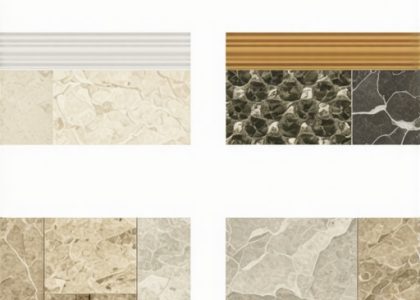
Natural stone baseboards utilizing marble or granite provide a dense mineral barrier that is naturally resistant to moisture and thermal expansion. When sealed correctly with a penetrating silane-based sealer, these stone trim pieces prevent capillary wicking and maintain structural integrity in steam showers and saturated environments. I always recommend stone for high end eco-friendly tile solutions for sustainable homes in 2025 because it lasts a century. Wood dies. Plastic degrades. Stone remains. But you have to know the chemistry. If you use a cheap water based sealer, the stone will eventually absorb oils and minerals from the bath water, leading to staining. You need a solvent based sealer that creates a molecular bond within the stone’s pores. Also, the weight of stone baseboards requires a different approach to the wall substrate. You cannot just glue these to thin drywall and expect them to stay. You need a cement backer board or a reinforced gypsum. The Janka Hardness Scale does not apply to stone, but the density ratings do. A dense granite is much better than a porous travertine in a bathroom. I have seen travertine baseboards crumble because the grout behind them failed and water got trapped in the stone’s natural voids. Do not let that happen to your job.
Integrated tile baseboards and the continuity of grout
Integrated tile baseboards use the same porcelain or ceramic material as the primary floor surface to create a unified waterproof envelope. By coving the tile up the wall, you eliminate the vulnerable joint where the floor meets the vertical surface, ensuring total moisture containment. This is the standard in European design for a reason. It is the most logical way to build a wet room. You are using a modified thin-set to bond the tile to the wall, which creates a much stronger connection than any nail. The grout stability is the key here. If the grout cracks, the water gets in. That is why I always use a high performance epoxy grout for the baseboard joints. It is flexible enough to handle the minor shifts in the house but hard enough to block every drop of water. If you have old grout that is failing, you should look into grout restoration secrets for long lasting results to fix the seal before you install new trim. A bathroom is essentially a giant bucket. Every seam is a potential leak. By using the same tile for the floor and the base, you reduce the number of material transitions. This is structural common sense. You are building for the long haul, not just for a magazine photo shoot.
“A floor is only as good as the subfloor beneath it; deflection is the enemy of every joint.” – Master Flooring Axiom
High density polystyrene for a wood look without the risk
High density polystyrene (HDPS) baseboards are engineered polymers that mimic the grain and texture of wood while remaining entirely water resistant. This high performance material is impact resistant and does not warp, bow, or twist when exposed to high humidity levels found in modern residential bathrooms. Most people want the look of wood but they do not want the rot. HDPS is the answer for 2026. It is denser than standard polystyrene, so it can handle the vacuum cleaner hitting it without denting. But here is the contrarian truth. While most people want the thickest underlayment or the heaviest trim, too much mass can actually make the installation harder if your walls are not perfectly straight. HDPS has a slight flex to it that allows it to follow the contour of a wall better than solid oak or thick PVC. This means fewer gaps for moisture to hide in. You should also look at baseboards makeover ideas to elevate your space to see how these modern materials can be styled. When you install these, use a specialized polymer adhesive. Do not rely on finish nails alone. The nails are just there to hold the piece in place while the glue cures. The glue is what actually does the work of sealing the wall.
Comparison of Moisture Resistance and Durability
| Material | Absorption Rate | Installation Method | Longevity (Years) |
|---|---|---|---|
| Medium Density Fiberboard | High (Swells) | Nails | 3 to 5 |
| Cellular PVC | Zero | Glue/Nails | 50+ |
| Stainless Steel | Zero | High-Mod Adhesive | 75+ |
| Natural Stone | Low (Sealed) | Thin-set | 100+ |
| High Density Polystyrene | Zero | Adhesive/Nails | 30+ |
Pre-Installation Checklist for Bathroom Baseboards
- Check subfloor moisture levels with a pinless meter.
- Verify wall plumbness and floor levelness within 1/8 inch.
- Acclimate materials to room temperature for 48 hours.
- Apply a waterproof membrane to the bottom 4 inches of drywall.
- Select a high performance caulk with 100 percent silicone content.
- Ensure all miter joints are back-cut for a tighter fit.
The capillary effect in bathroom subfloors
Capillary action occurs when water molecules travel through microscopic spaces in porous subfloor materials like plywood or concrete. This hydrostatic pressure can push moisture upward into your baseboards and drywall, causing delamination and mold even if the surface appears dry. You have to understand that the air in your bathroom is a living thing. It moves. It carries heat and water. When that air hits a cold surface, like the slab under your tile, it condenses. If your baseboard is sitting directly on the slab, it is drinking that condensate all day long. This is why I always leave a 1/16th inch gap between the baseboard and the floor tile. I then fill that gap with a high grade silicone. Never use grout to bridge the gap between the floor and the wall. The floor moves differently than the wall. If you use grout, it will crack. If you use silicone, it will stretch. It is a simple physics problem. Use the right bridge for the movement you expect. If you need help with cleaning the rest of your space, check out tile cleaning tips for a sparkling bathroom in 2025. Keeping your surfaces clean prevents the buildup of organic matter that mold feeds on when moisture is present. For more information on our services, feel free to contact us. We take these structural details seriously. Every job is an engineering project. If you are going to do it, do it once and do it right. Use materials that don’t care about water. That is the only way to sleep at night in this business.