
Most guys skip the leveling compound. They think the underlayment will hide the dip. It won’t. I spent three days grinding concrete on a job last month just so the floor wouldn’t click like a castanet. I have seen it all in twenty five years. I have seen homeowners spend twenty grand on Italian marble only to frame it with cheap plastic trim that warps the second the HVAC kicks on. Baseboards are not just a decorative transition. They are the structural bumper of your home. Most people default to PVC because it is cheap and easy to cut. But in 2026, we are seeing a shift toward materials that actually respect the architecture of the subfloor. If you want a floor that lasts decades, you stop thinking about the surface and start thinking about the perimeter chemistry. [image placeholder]
The structural lie of plastic trim
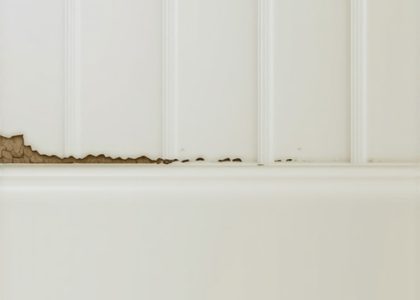
PVC baseboards fail because they possess a high coefficient of thermal expansion which causes them to warp, bow, and pull away from the wall when temperature fluctuations occur. Unlike solid surfaces, plastic lacks the rigidity to withstand mechanical impacts from vacuums and furniture, leading to permanent dents and aesthetic degradation within five years of installation. Plastic is a thermoplastic polymer. It is soft. It has a Shore D hardness that barely cracks seventy five. When you hit it with a heavy upright vacuum, you aren’t just scuffing it. You are deforming the molecular structure. I have walked into houses where the PVC looks like a series of waves because the installer did not leave enough room for linear expansion. It is a lazy man’s material. It is the participation trophy of the flooring world. Real installers look for materials with a low moisture absorption rate and high compressive strength. If you are checking out chic baseboard designs that transform rooms in 2025, you need to look beyond the white paint. You need to look at the density.
The ghost in the expansion gap
Expansion gaps are required structural voids left between the flooring material and the wall to allow for natural movement caused by humidity and temperature changes. Solid-surface baseboards provide the necessary coverage for these gaps while offering a rigid, non-compressible barrier that protects the perimeter from moisture infiltration and structural shifting. The NWFA is very clear about this. You need that quarter inch or half inch gap. But if your baseboard is a piece of flexible plastic, it does nothing to protect that gap. It just hides it. I have seen floors buckle because the baseboard was too thin to cover the gap properly, or too flexible to resist the pressure of the floor moving.
“A floor is only as good as the subfloor beneath it; deflection is the enemy of every joint.” – Master Flooring Axiom
Porcelain tile strips for high traffic zones
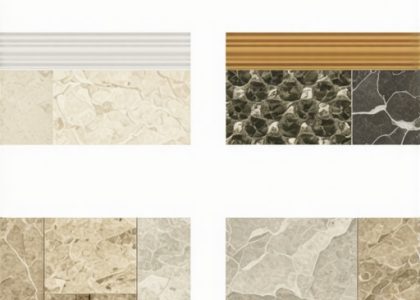
Porcelain baseboards are created by cutting high density vitrified tiles into strips, offering a water absorption rate of less than 0.5 percent and a Mohs hardness rating of seven. These solid surfaces are impervious to moisture, making them the superior choice for bathrooms and kitchens where PVC would eventually fail due to adhesive breakdown and mold growth. I tell people all the time that if they are doing a tile floor, they should run the tile right up the wall as a baseboard. It is called a sanitary base. It is what we do in commercial kitchens and high end showers that wow. Porcelain is fired at twelve hundred degrees Celsius. It is basically a rock. You can’t dent it. You can’t scratch it. When you use it as a baseboard, you use a modified thin-set with high polymer content. This creates a chemical bond that plastic can never match.
Natural marble for timeless structural integrity
Marble baseboards provide a metamorphic stone barrier that offers exceptional thermal stability and a natural resistance to rot and insect damage. While marble is softer than porcelain, its density allows for intricate edge profiling that maintains its shape for centuries, outperforming synthetic materials that become brittle over time. Marble is a calcium carbonate based stone. It is heavy. It is dense. When you set a marble baseboard, you are not using finishing nails. You are using an epoxy or a high quality thin-set. It becomes part of the wall. If you are dealing with moisture issues, you might want to look at grout restoration secrets before you install stone, because once that stone is in, it is in. It does not move. It does not breathe. It just stands there.
Quartzite as a permanent perimeter solution
Quartzite baseboards represent the pinnacle of solid-surface durability, featuring a Mohs hardness of eight and a crystalline structure that is nearly immune to chemical etching and physical impact. As a metamorphic rock primarily composed of quartz, it offers a higher compressive strength than PVC or wood, ensuring it will never warp. Most people confuse quartzite with quartz. Quartzite is the real deal. It started as sandstone and got crushed by the earth until it became a hard crystal. If you put quartzite baseboards in your home, your great-grandchildren will be looking at those same baseboards. They won’t yellow. They won’t crack. They are the ultimate shield for your drywall.
Granite and the resistance to hydrostatic pressure
Granite baseboards are igneous rocks formed from cooled magma, providing a dense silicate structure that resists water penetration and thermal expansion better than any plastic or composite. With a high concentration of feldspar and quartz, granite trim maintains its structural alignment even in environments with high humidity or frequent floor washing. I have installed granite trim in basements where the humidity stays at sixty percent. PVC would be falling off the wall in two years because the moisture would kill the glue. Granite doesn’t care. It is a heavy weight material for a heavy weight job. It is the only thing I trust in high-moisture zones.
Sintered stone the engineered titan
Sintered stone is a man-made solid surface produced through extreme heat and pressure to mimic natural stone without the porosity, resulting in a baseboard material with a near-zero expansion coefficient. It is harder than granite and more flexible than porcelain, allowing for long, seamless runs that do not require the frequent joints seen in shorter PVC strips. Sintered stone is the future. It is basically the smartest material on the planet. It doesn’t use resins like quartz, so it won’t fade in the sun. It is a pure mineral product. When I install this, I use a zero-joint technique. It looks like one continuous piece of stone circling the room. It is beautiful. It is tough. It makes PVC look like a child’s toy.
Comparing Solid Surfaces vs PVC in 2026
| Material | Mohs Hardness | Water Absorption | Life Expectancy |
|---|---|---|---|
| PVC | 2-3 | High (Surface) | 5-10 Years |
| Porcelain | 7-8 | <0.5% | 50+ Years |
| Marble | 3-4 | Moderate | 100+ Years |
| Quartzite | 8 | Low | 100+ Years |
| Sintered Stone | 8-9 | <0.1% | 100+ Years |
Pre-Installation Checklist for Solid-Surface Baseboards
- Verify subfloor levelness within 1/8 inch over 10 feet.
- Check concrete moisture levels using an anhydrous calcium chloride test.
- Ensure all drywall mud is sanded flush to prevent gaps behind the stone.
- Select a high-polymer modified thin-set for vertical applications.
- Measure expansion gaps twice to ensure the baseboard thickness covers them.
The 1/8 inch that ruins everything
A discrepancy of only 1/8 inch in subfloor levelness can cause solid-surface baseboards to show visible gaps at the floor line or prevent the material from seating properly against the wall. Because stone and porcelain do not flex, the installer must grind the high spots of the subfloor or scribe the baseboard to the floor to ensure a professional, structural fit. This is where most guys fail. They think they can just caulk the gap. You can’t. If the floor is wavy, a rigid stone baseboard will highlight every single dip. I spend more time with a floor grinder than I do with a trowel. You have to get that concrete flat. If you don’t, the baseboard will look like it was installed by a drunk. It is about the physics of the line. A straight line doesn’t lie.
“The National Wood Flooring Association (NWFA) states that subfloors must be flat to within 3/16 inch in 10 feet or 1/8 inch in 6 feet for a successful installation.” – NWFA Technical Standards
The final verdict on perimeter protection
Choosing a baseboard is not an aesthetic choice. It is an engineering decision. If you want a home that stays together, you stop using plastic. You look at the mineral content. You look at the hardness. You look at the bond. Whether you are doing a baseboards makeover or building from scratch, go with a solid surface. It will outlast you. It will outlast the house. It will definitely outlast that cheap PVC junk from the big box store.